



Published
Taylor Swift’s net worth is $2 billion, according to her Forbes profile, which shows the value as of 11/24/26. Forbes’ own itemized breakdown adds up to only about $1.5 billion, and in 2023 Bloomberg left out her pre-2019 catalog, which it said was worth about $1 billion on its own.
Swift wanted to own the recordings behind her first six albums, and for years she couldn’t. The masters went from Big Machine to Ithaca Holdings in 2019, then to Shamrock Capital in November 2020 for $405 million. On May 30, 2025, she announced she had bought them back. What she paid has never been officially disclosed, and the estimates of her fortune treat that catalog very differently.
Key takeaways
- Forbes lists Swift at $2 billion, yet its itemized breakdown (nearly $800 million in royalties and touring, about $600 million in catalog, about $110 million in real estate) totals about $1.5 billion, and the page doesn’t explain the gap.
- Bloomberg’s October 2023 estimate counted only what could be traced to public figures, so it was likely conservative.
- The Eras Tour grossed $2,077,618,725, but gross revenue isn’t her earnings: Forbes estimated about $305 million pretax from 56 shows in 2023.
- On May 30, 2025, Swift announced she had bought back the masters of her first six albums; the price was never officially disclosed.
Contents
- What is Taylor Swift’s net worth, and why doesn’t Forbes’ math add up?
- Why did Bloomberg say $1.1 billion when Forbes said more than $1.1 billion?
- How much of the Eras Tour’s $2 billion did Taylor Swift keep?
- Did the Eras Tour really move local economies?
- What are Taylor Swift’s masters, and why didn’t she own her first six albums?
- How much did Taylor Swift pay to buy back her masters in 2025?
- Who is richer than Taylor Swift, and what does the net worth mean now?
- Frequently asked questions
What is Taylor Swift’s net worth, and why doesn’t Forbes’ math add up?
Forbes shows $2 billion for Swift as of 11/24/26, with an editorial summary last updated June 3, 2026 and a Self-Made Score of 8. The itemized list in that summary reaches only about $1.5 billion, and the page doesn’t say what fills the gap.
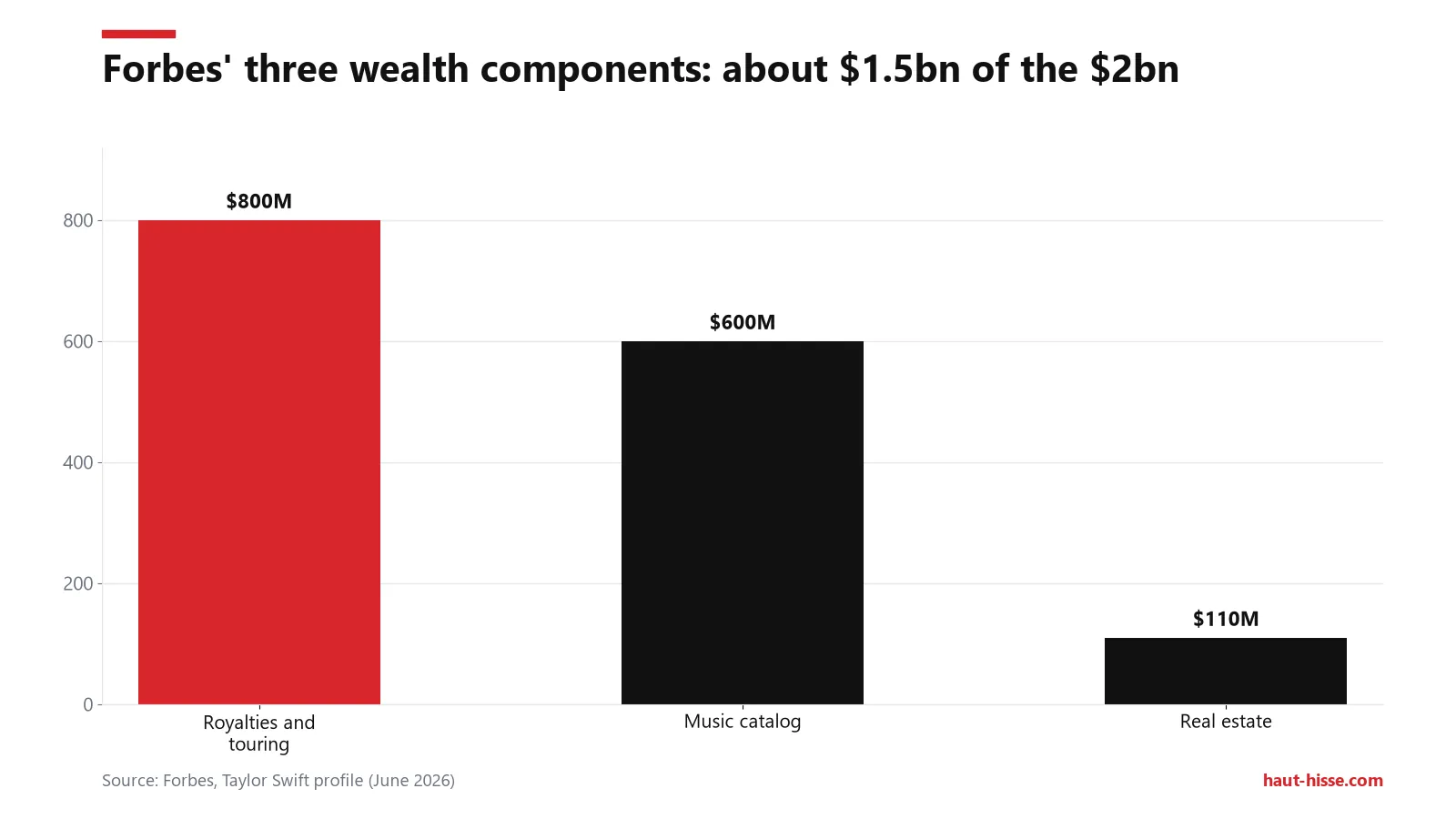
The list has three lines: nearly $800 million from royalties and touring, Eras Tour included; about $600 million for the music catalog; and about $110 million in real estate. Together that’s roughly $1.5 billion, some $500 million short of the headline. Forbes’ March 11, 2026 article repeats the same three figures and places the properties in Nashville, Los Angeles, New York and Watch Hill, but it doesn’t show the calculation either.
The profile links only to Forbes’ self-made methodology, not to a detailed method for Swift’s figure. The explanation on offer is growth rather than arithmetic. Variety’s report on Forbes’ June 2026 Iconoclast 50 list says her fortune doubled to $2 billion by March 2026, crediting the 2023-24 Eras Tour, the albums The Tortured Poets Department and The Life of a Showgirl, and her re-recordings.
Le Monde, the French daily, covers the album side of that story in a video titled “The Life of a Showgirl: how Taylor Swift makes so much money.”
The $2 billion is one method’s answer. In 2023 Bloomberg reached about $1.1 billion with a very different rule, and the difference shows what each estimate counts.
Why did Bloomberg say $1.1 billion when Forbes said more than $1.1 billion?
The two October 2023 figures landed in the same place by different routes: Bloomberg counted only traceable public figures, while Forbes reasoned by comparison.

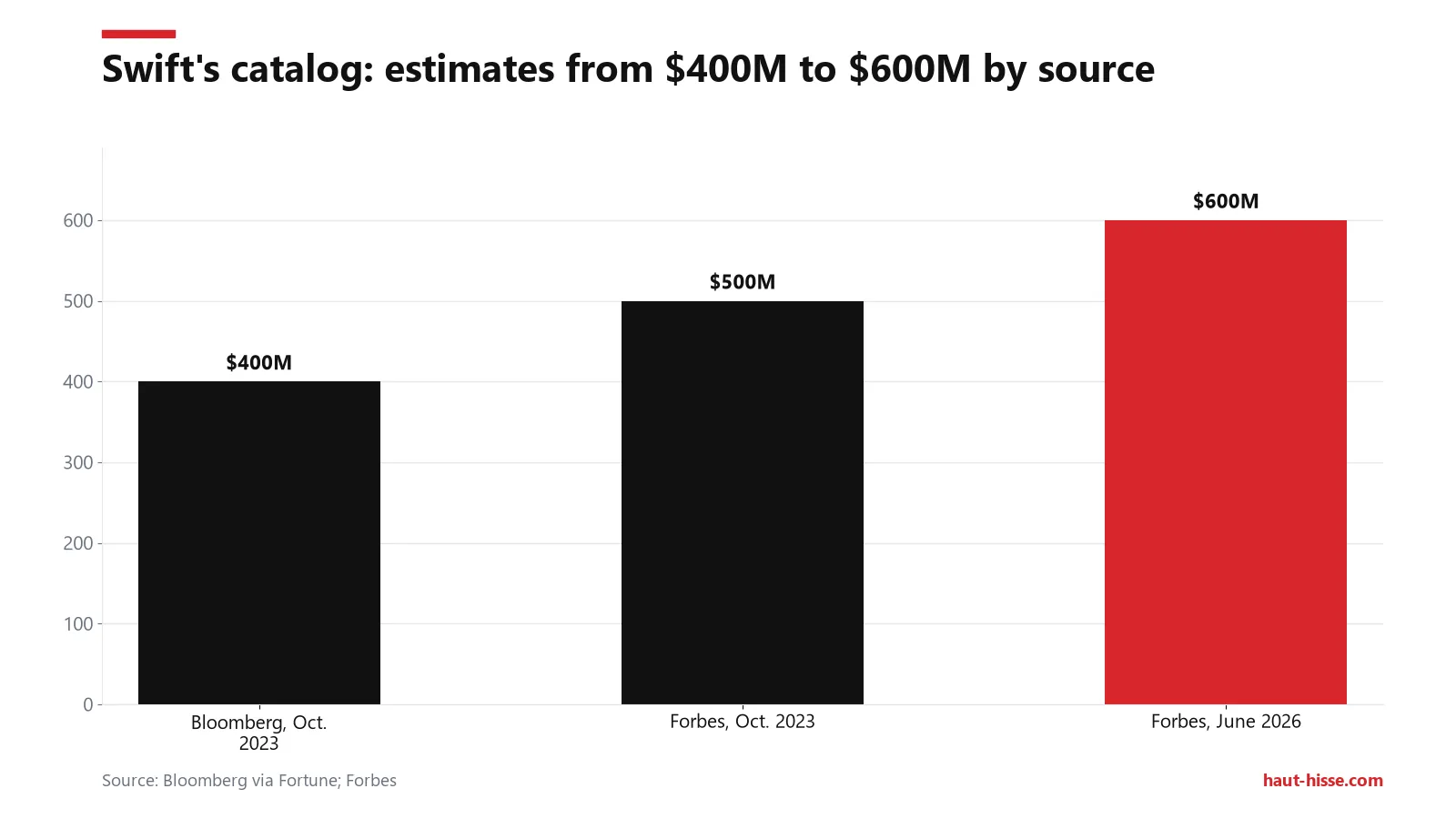
On October 26, 2023, Bloomberg put Swift at about $1.1 billion. The pieces were a post-2019 music catalog at $400 million, ticket sales and merchandise at $370 million, Spotify and YouTube at $120 million, and five homes at $110 million. Its rule was to count only assets and earnings that could be confirmed or traced from publicly disclosed figures, and it called the result likely conservative.
That rule left out one large item. Bloomberg said the pre-2019 catalog, then held by Shamrock, would be worth about $1 billion on its own if included. The $400 million catalog line covered only post-2019 music.
Forbes, that same month, landed on more than $1.1 billion, up $360 million from June. The total included about $190 million after taxes from the tour’s first leg and $35 million from the concert film’s first two weeks. Its split was cash of more than $500 million, a catalog of about $500 million, and real estate of about $125 million, covering six homes and a $10 million private jet. It gave no detailed method. For the catalog, sources told Forbes it was now worth roughly what Bruce Springsteen’s sold for in 2021: nearly $500 million.
The table below sets the two 2023 estimates beside Forbes’ June 2026 breakdown, using Fortune’s report of Bloomberg’s figures, Forbes’ 2023 estimate and the June 2026 Forbes profile.
| Estimate | Catalog | Other lines and total |
|---|---|---|
| Bloomberg, Oct 2023 | $400 million (post-2019 music only) | Tickets and merchandise $370 million; Spotify and YouTube $120 million; five homes $110 million. Total about $1.1 billion |
| Forbes, Oct 2023 | About $500 million | Cash over $500 million; real estate about $125 million. Total more than $1.1 billion |
| Forbes, June 2026 | About $600 million | Royalties and touring nearly $800 million; real estate about $110 million. Total $2 billion |
The 2026 row repeats the 2023 pattern: Forbes gives a catalog figure and a total with no method, and the page doesn’t say how its lines reach $2 billion. Bloomberg’s 2023 total left out a pre-2019 catalog it valued at about $1 billion, while Forbes priced its catalog line by comparison with Springsteen’s sale.
Both 2023 estimates leaned on the Eras Tour, so the next question is how much of its billions actually reached Swift.
How much of the Eras Tour’s $2 billion did Taylor Swift keep?
The Eras Tour grossed $2,077,618,725 per Guinness World Records, but gross revenue isn’t Swift’s pay. Forbes estimated in 2023 that she earned about $305 million pretax from 56 shows, roughly 39% of the roughly $780 million those shows grossed.

Guinness counts 149 shows in 51 stadiums across 19 countries, from March 17, 2023 to December 8, 2024. It records 10,168,008 tickets sold, an average of 68,242 per show.
Pollstar’s separate estimate is $2.2 billion, from about 10.055 million tickets at an average price near $218.90 over 21 months. Its method crosses Boxoffice reports with ticket prices in each market, venue capacities, premium seating and comparable tour data. Two sources, two totals. Variety’s 2026 piece uses the $2.2 billion as tour revenue without saying what share Swift kept.
The four figures below measure different things.
| Measure | Scope | Amount |
|---|---|---|
| Guinness gross | 149 shows | $2,077,618,725 |
| Pollstar estimate | Full tour | About $2.2 billion |
| Forbes gross, 2023 | 56 shows | Roughly $780 million |
| Swift’s pretax earnings, Forbes 2023 | 56 shows | About $305 million |
Forbes’ figure is the narrowest. It puts Swift’s take at $10 million to $13 million a night on tickets that averaged $253. It subtracts fees for representation (managers, lawyers, agents) and tour operating costs, and the results are pretax. The page doesn’t say whether promoter and ticketing shares are included. The after-tax figure inside Forbes’ net worth estimate is a separate calculation from this pretax one.
The arithmetic, with Forbes’ own inputs: Swift earned about $305 million of roughly $780 million.
- Estimated earnings, pretax: about $305 million
- Gross from the same 56 shows: roughly $780 million
- $305 million ÷ $780 million ≈ 0.39, or about 39%
Even Swift’s share was only part of the tour’s money. The rest flowed into the cities that hosted it, and central banks noticed.
Did the Eras Tour really move local economies?
Federal Reserve reports do mention Swift, but only in hotel data. The headline impact numbers are projections or the estimates of unnamed analysts.
The observed evidence is thin and specific. The Philadelphia Fed’s July 2023 Beige Book reported that May was the strongest month for hotel revenue in the city since the onset of the pandemic, largely due to Swift’s concerts. More than two years later, the Atlanta Fed’s November 2025 Beige Book explained a drop in hotel activity by year-earlier comparisons of robust bookings during the Eras Tour in parts of its District. Both are hotel notes, not tallies of total spending.
The big numbers are a different kind of evidence. In August 2023, the Harvard Gazette cited analysts who put the total economic impact of tour-related spending on host cities at $5 billion, when the tour was on track for $1.4 billion in revenue. The $5 billion impact figure comes from unnamed analysts.
The Common Sense Institute’s July 10, 2023 report is openly a forecast. It projected $140 million added to Colorado’s GDP from two Denver shows, built on 76,000 attendees a night, $1,327 average spend per attendee and a $250 average ticket, including $201.7 million in direct spending. It said post-event data would be needed to confirm it.
So hotel revenue is observed, while the $5 billion and the $140 million are projections or estimates.
Touring money is real but one-off. What made Swift’s fortune last was who owned the recordings, and for her first six albums it wasn’t her.
What are Taylor Swift’s masters, and why didn’t she own her first six albums?
A master is the original recording of a song, and its owner collects the income it earns. Swift’s first six albums changed hands without her, so she re-recorded them.
In 2019, Ithaca Holdings, the company led by Scooter Braun, acquired Big Machine Label Group, which owned the masters. In November 2020, Ithaca sold them to Shamrock Capital for $405 million, per Music Business Worldwide.
Swift’s workaround was to record the albums again. Variety reports she re-recorded most of her discography starting in 2020, so royalties on the new versions go directly to her. Four of the six albums had received that treatment as Taylor’s Version before the 2025 buyback: Fearless, Red, Speak Now and 1989. The debut album and Reputation had not.
The re-recordings also show up in the estimates. Forbes, as relayed by Variety, lists them among the drivers of her doubled fortune, and Forbes’ catalog line moved from about $500 million in October 2023 to about $600 million in 2026.
Four albums had a workaround; two did not. On May 30, 2025, Swift announced how she resolved the rest.
How much did Taylor Swift pay to buy back her masters in 2025?
Swift’s buyback has no official purchase price. Variety called it a nine-figure sum, Page Six floated $600 million to $1 billion without confirmation, and an estimated $360 million circulates in the press, repeated by Variety Australia.
On Friday, May 30, 2025, Swift confirmed in a handwritten letter to fans that she had bought the masters for Taylor Swift, Fearless, Speak Now, Red, 1989 and Reputation from Shamrock Capital, Music Business Worldwide reported. She called it her “greatest dream come true” and thanked Shamrock for being the first to offer her the chance to buy. What she had wanted, she wrote, was:
“the opportunity to work hard enough to be able to one day purchase my music outright” — Taylor Swift (2025)
The only published anchor is the $405 million Shamrock paid in 2020. The $360 million estimate sits below it, and the Page Six range sits above it. None of the three numbers is confirmed.
That changes how the 2023 Bloomberg gap reads. Its estimate left out a pre-2019 catalog valued at around $1 billion, held by Shamrock. Since 2025 Swift owns those masters, but what she paid remains unknown.
Owning the masters changes what each estimator can count, and the Bloomberg-style gap should narrow.
Who is richer than Taylor Swift, and what does the net worth mean now?
Nothing in the figures above ranks Swift against other entertainers. They establish that her $2 billion is an estimate, and that its catalog share now stands on firmer footing than in 2023.
Forbes pairs the $2 billion with a catalog of about $600 million, and its page gives no method. In 2023, Bloomberg’s traceable-figures rule excluded the pre-2019 catalog. Since May 2025 Swift owns all six early masters, so that approach has more to count, though the price stays unreported.
For any celebrity net worth, the useful check is whether the number counts only traceable assets, as Bloomberg did, or compares with similar deals, as Forbes did with Springsteen’s catalog.
As of 11/24/26, Forbes shows $2 billion with a catalog of about $600 million, and since May 30, 2025 Swift has owned the masters of her first six albums. The purchase price remains unreported. The next question is what happens when a sudden windfall isn’t protected by owning the asset: why lottery winners go broke despite a huge payout.
Frequently asked questions
Who is the richest singer in the world?
No ranking of singers is established here. Forbes lists Taylor Swift at $2 billion as of 11/24/26, and that figure is an estimate with no published method. Check any other artist’s number against its method before comparing totals.
Is Taylor Swift’s dad wealthy?
Nothing verified here covers her father’s finances. The documented fortune is Swift’s own: Forbes puts it at $2 billion as of 11/24/26, drawn from royalties and touring, a music catalog and real estate.
Is Justin Bieber still rich?
No current figure for Justin Bieber is verified here, so a claim either way would be a guess. When you find one, check whether it counts only traceable assets, as Bloomberg’s method does, or compares with similar deals, as Forbes’ does.
Read next
How these articles are prepared: our editorial policy

