


Pop hits are written by collaborative teams of lyricists, topliners, and producers—often assembled in organized song camps—rather than by the solo performing artist alone. Powerhouse hitmakers like Max Martin steer these sessions, while signed split sheets formally establish each co-writer’s percentage of the publishing royalties before tracks are released.
On the album cover, a single artist gets top billing. In the credits, there is often a long list of co-writers, backed by contracts deciding who collects which fraction of a cent per stream. This breakdown follows the entire chain: Cheiron Studios where it started, the Max Martin method, how writing camps operate, the surge in credited writers, and the agreements that divide the money.
Key takeaways
- Max Martin holds 31 Billboard Hot 100 number-one hits according to Wikipedia, or 30 according to Hit Songs Deconstructed, depending on the counting methodology.
- The average number of writers per hit song grew from 1.7 in the 1970s to 4.5 today, according to a 2023 iMusician report.
- A split sheet establishes each co-writer’s share in writing; without one, ownership disputes can freeze royalty payouts entirely.
- On a stream paying roughly $0.004, publishing receives 14% and the songwriter receives 68% of that share, according to MIDIA Research (2024).
Key milestones
| Date | Event | Source |
|---|---|---|
| 1993 | Cheiron signs the future Max Martin | Songwriters Hall of Fame |
| 1998 | Max Martin’s first Hot 100 number one; death of Denniz Pop | Wikipedia |
| 1999 | First non-American to win ASCAP Songwriter of the Year | Wikipedia |
| 2000 | Cheiron Studios closes | Wikipedia |
| 2015 | Stockholm Songwriting Camp launches | Songwriting Camps |
| 2017 | Songwriters Hall of Fame induction; NME interview with Max Martin | Songwriters Hall of Fame, NME |
| 2022 | Announcement of a three-year research project on song camps | University of Huddersfield |
| 2024 | Max Martin lands his 27th number one in March; study on song camps | Wikipedia, Leuphana |
1993: Cheiron signs the future Max Martin
The modern hitmaking era began at Cheiron, where Denniz Pop took an aspiring songwriter under his wing and named him Max Martin.

In 1993, Cheiron, a label run by Denniz Pop, signed the young writer. Pop renamed him Max Martin and became his mentor, according to the Songwriters Hall of Fame. In 1998, Denniz Pop passed away. Martin took over Cheiron Studios, which later shut its doors in 2000, according to Wikipedia.
The transition was abrupt. The label’s founder and mentor died in 1998, and the studio under his protégé survived for only two more years.
1998: “…Baby One More Time” kicks off the number-one streak
Max Martin is a songwriter and producer whose total Billboard Hot 100 number-one tracks vary by source: 31 on Wikipedia (June 2026 data), and 30 according to Hit Songs Deconstructed (2026).
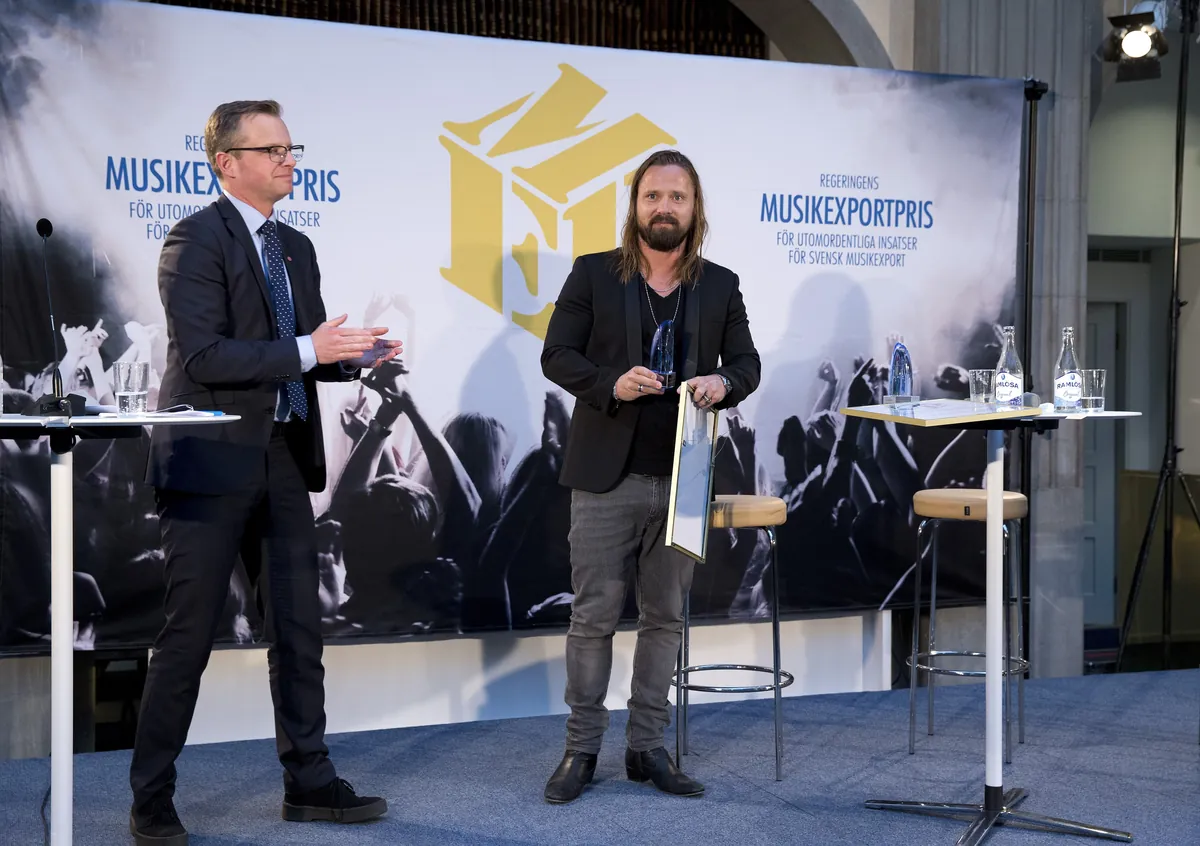
His breakout hit was “…Baby One More Time” in 1998 on the Hot 100, the main US singles chart published by Billboard. According to Wikipedia, Max Martin has written or co-written 31 chart-toppers, producing or co-producing 29 of them—a record for the chart. Hit Songs Deconstructed lists 30 number ones alongside 91 top-10 entries. The discrepancy comes from differences in counting criteria, which should always be cited with the date.
Wikipedia also ranks Max Martin second for the most number-one hits as a songwriter, behind Paul McCartney (32). He passed John Lennon (26) with his 27th number one in March 2024. He has won ASCAP Songwriter of the Year eleven times—an all-time high—and became the first non-American to claim the award in 1999. ASCAP is the American Society of Composers, Authors and Publishers, a US performance rights organization.
The Songwriters Hall of Fame inducted him in 2017. His credits include “I Want It That Way” (Backstreet Boys), “Since U Been Gone” (Kelly Clarkson), and “Blank Space” (Taylor Swift).
Yet Max Martin is only part of the answer to who writes pop hits. The rest of the industry has organized into collaborative teams, as shown below in the breakdown of multi-writer tracks.
2015: Stockholm launches its songwriting camp
A songwriting camp is a multi-day retreat lasting two to five days, often held in a secluded location, bringing together writers, producers, and audio engineers to create tracks collaboratively.
According to the University of Huddersfield, these camps run from two to five days. They often take place in remote settings to encourage distraction-free collaboration. The format remains relatively under-researched in academic literature.
One prominent example is the Stockholm Songwriting Camp, launched in 2015, which brings leading songwriters and producers together in a hotel for three days. It operates on a neutral model and claims no copyright ownership over the finished work. “We will always stay neutral,” said Niclas Molinder in 2016, according to a press release from Songwriting Camps. That same year, the initiative gathered 45 participants in Stockholm, alongside 21 in London and 21 in Paris.
2017: Max Martin details the melody-first method
The “melody first” approach builds the melody before anything else; songwriter Savan Kotecha describes it as the core of Max Martin’s school.
The idea is straightforward: establish the melody, then build the rest of the track around it. Savan Kotecha summarized this process, according to Wikipedia: “We work melody first. That’s Max Martin’s school.”
Max Martin outlined his own approach in an interview cited by NME in 2017. Each chorus, he noted, should vary in energy rather than melodic phrasing. His goal is for the listener to retain the song after one or two listens.
In that interview, he also compared his role to that of a coach who pushes artists outside their comfort zones.
These observations come directly from creators describing a workflow, rather than empirical proof that melody alone dictates a song’s performance. The statements provide no way to isolate the precise commercial impact of melody versus vocal delivery, production, or marketing.
2022: Research project identifies two camp models
British songwriting camps lean toward talent development, while German camps focus on producing commercial records for specific markets.
This distinction comes from a three-year research project announced in December 2022. According to the University of Huddersfield, it received £350,000 from the AHRC (the UK’s Arts and Humanities Research Council) and €350,000 from the DFG (the German Research Foundation). The University of Huddersfield, Birmingham City University, and Leuphana University of Lüneburg are collaborating on the study.
2023: Up to 4.5 writers per hit
Today’s hits rely on large creative teams: according to iMusician (2023), the average number of credited writers per hit rose from 1.7 in the 1970s to 4.5 today.
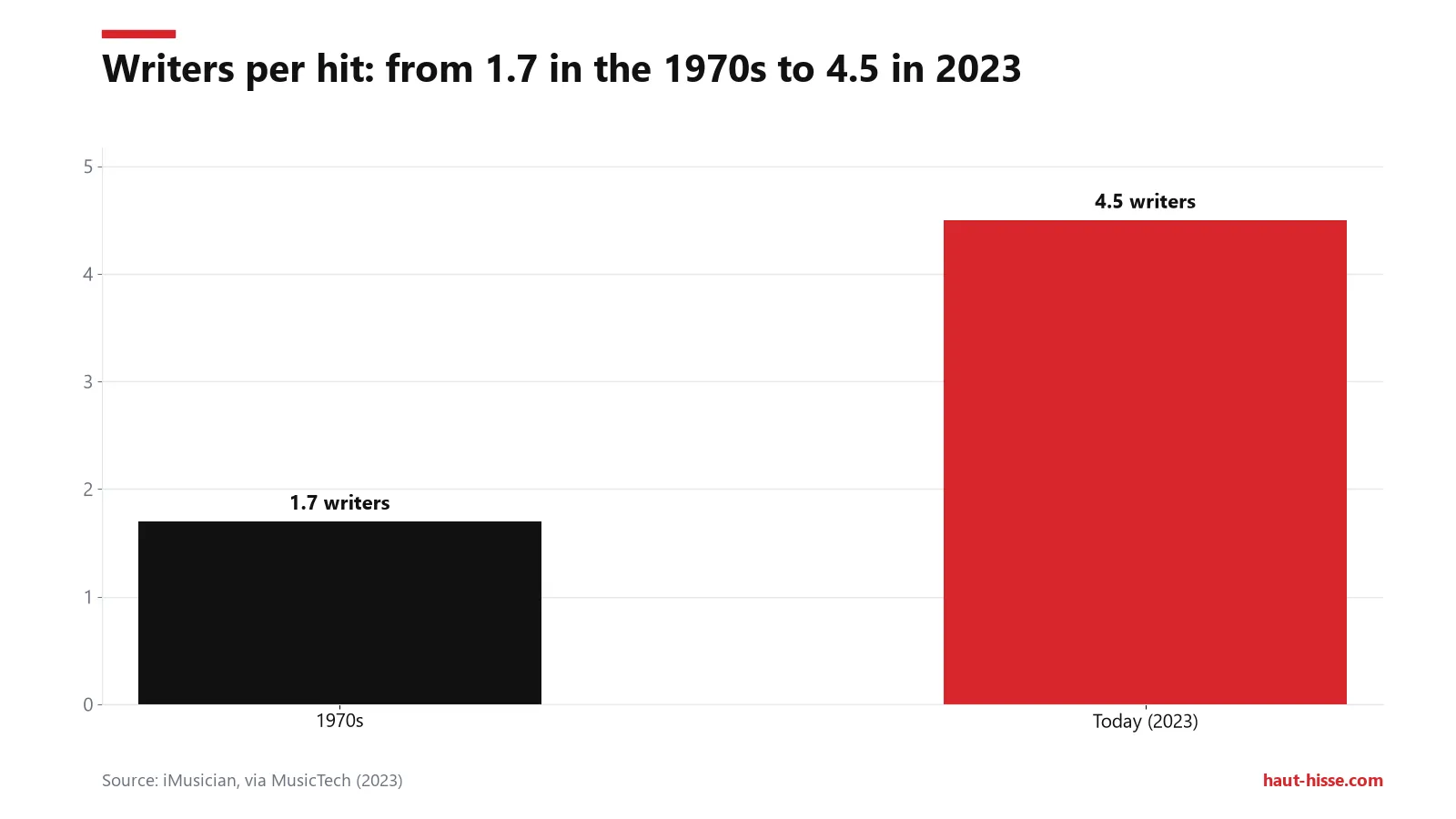
The figure comes from an iMusician report covered by MusicTech in 2023. Another dataset aligns with this trend: according to Music Reports, cited by RightsTech in 2017, a Billboard top-10 single in the 1960s averaged 1.87 writers and 1.68 publishers. By 2017, mainstream hits averaged at least four writers and six publishers.
The two datasets draw from different sample groups. They illustrate a shared upward trajectory rather than exact decimal comparisons.
Extreme cases highlighted by iMusician include Drake’s “In My Feelings” with 14 writers, and Beyoncé’s “Heated” with 18.
2024: Why stars do not write alone
A 2024 study by Herbst, Ahlers, and Barber concluded that songwriting camps “have a proven track record of producing commercially successful pop songs.” Songwriters value them for networking, career longevity, and ongoing royalty revenues.
Researchers at Huddersfield also highlighted the pressure to protect an artist’s personal authenticity: “And to keep the impression of authenticity, there cannot be any outside contributors,” noted the university. As a result, behind-the-scenes collaborators often keep a low public profile.
The question of how earnings are divided among creators is examined further in this analysis of commercial creative earnings in another media sector.
The split sheet: a signed agreement against disputes
A split sheet is a signed contract that establishes the exact ownership share of each co-writer on a track; without one, the law often defaults to equal distribution, and disagreements can freeze royalty distributions.
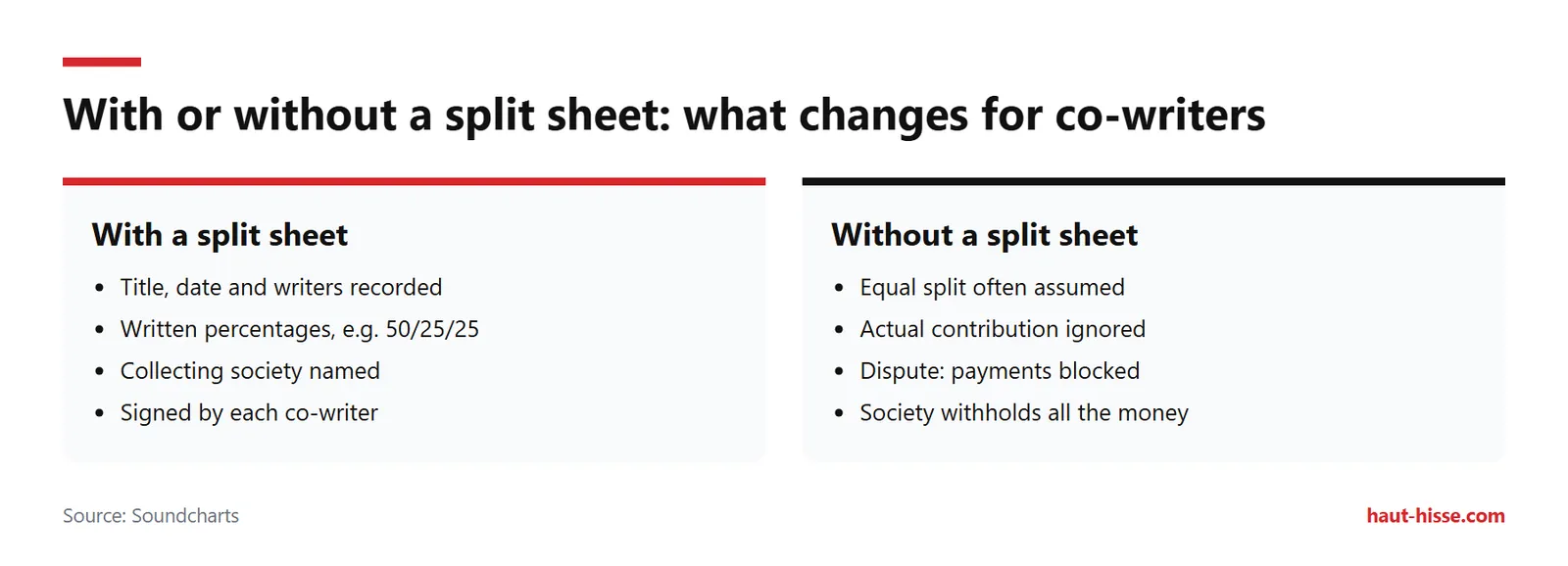
According to Soundcharts, the document records the song title, date, writers, percentages (writer’s share and publisher’s share), performance rights organizations (such as SACEM in France or ASCAP in the US), and signatures.
Soundcharts provides an example of a 50/25/25 split. In pop production, a topliner is the songwriter who crafts the vocal melody and lyrics over an existing instrumental track.
| Role | Share in example | Effect |
|---|---|---|
| Producer | 50% | Receives half of the composition royalties |
| Lyricist | 25% | Receives one quarter of the royalties |
| Topliner | 25% | Receives one quarter of the royalties |
| Without a split sheet | Presumed equal split | Everyone receives an equal share, regardless of input |
The “without a split sheet” scenario often defaults to equal shares, though this depends on local jurisdiction. The table reflects the Soundcharts model, where the 50/25/25 distribution is validated by the signed document.
Disputes: what happens when co-writers disagree
When co-writers cannot agree on their respective percentages, payouts can stop completely. Soundcharts notes that a performance rights organization (PRO) will freeze all royalty disbursements until the dispute is settled.
The system is uncompromising. Unless all parties agree on the split registration, no one receives royalties—even the contributors whose shares are uncontested. Signing a split sheet right after the session avoids this deadlock, even if personal relationships sour later.
2024: Streaming payouts split into fractions of a cent
On a stream generating roughly $0.004, MIDIA Research estimated in 2024 that the master recording receives 56%, the streaming service keeps 30%, and publishing collects 14%. The recording share goes to the performing artist and the record label.
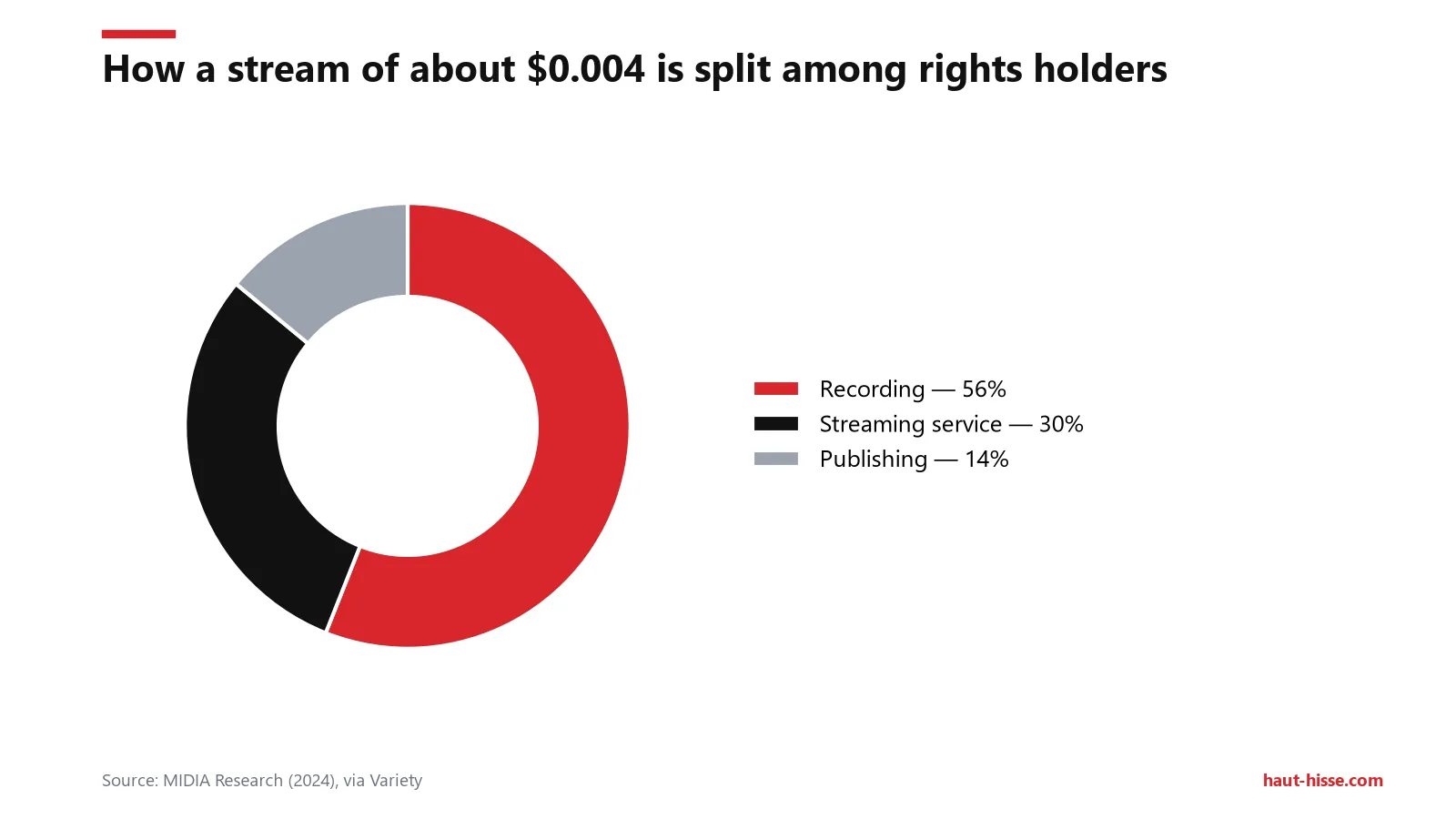
From the 14% publishing share, the songwriter receives 68%, the music publisher receives 17%, and the collective management organization receives 15%, according to the same MIDIA Research data.
An illustrative calculation
The following calculation serves as an illustration rather than an official payout statement. On a $0.004 stream, using the MIDIA Research breakdown, the publishing pool equals 0.004 × 14% ≈ $0.00056. The songwriting pool receives 68% of that figure, or roughly $0.00038, which is then divided based on the split sheet. A 25% songwriting split would amount to around $0.0001 per stream.
Market scale and the US regulatory framework
Across the broader market, the Variety report notes that Spotify paid over $4.5 billion to publishing rights holders over two years (published in 2025, reflecting 2024 figures). This total includes music publishers and collecting societies, not just individual songwriters.
In the United States, the Copyright Royalty Board raised the statutory publishing royalty rate by 23% for the 2023–2027 cycle, bringing it to 15.35% of streaming service revenue, according to Variety. The Board is the federal entity responsible for setting statutory mechanical licensing rates.
The total revenue earned by a global hitmaker cannot be calculated uniformly: it depends on total stream counts, contractual publishing agreements, and signed split sheets.
Inside the hit factory: concentrated power and vulnerable writers
Mainstream pop relies on a structured, team-based pipeline where established powerhouses like Max Martin retain significant influence, while emerging writers face financial instability.
The production cycle operates across three stages: song camps generate the raw tracks, split sheets define ownership stakes, and collection societies distribute fractions of a cent per stream.
Regarding financial instability, University of Huddersfield researchers point to rejected credits, buyout contracts, and the marketing need to maintain the artist’s image of solo authenticity. As the researchers observed: “And to keep the impression of authenticity, there cannot be any outside contributors.” Protecting this perception functions as a core brand asset, similar to Liquid Death’s marketing strategy in the consumer goods space.
Several analytical limits apply. Academic literature on songwriting camps is still emerging, historical credit data is drawn from varying sample sets, and British and German camps pursue distinct operational goals.
The fundamental rule of modern pop songwriting is clear: credits and percentages must be negotiated, and signed contracts offer the only real protection. Invisible contributors shaping consumer value also define other creative markets, as detailed in this breakdown of why luxury costs so much.
Frequently asked questions
Why are so many writers credited on a single hit?
Songwriting camps gather specialized producers, lyricists, and topliners into collaborative teams, a method proven to yield commercial tracks. Anyone contributing to the melody, lyrics, or production can be credited, though exact roles vary significantly from song to song.
What happens if co-writers disagree on their shares?
Performance rights organizations can withhold all royalty payouts until the dispute is resolved, according to Soundcharts. Without a split sheet, applicable legal frameworks often assume equal splits, making a signed agreement at the time of creation the strongest protection.
How much does a songwriter earn from a global hit?
Total earnings depend on aggregate streams, the percentages specified on the split sheet, and individual publishing contracts. On any single stream, songwriters split a small fraction of the publishing share, which is itself a minor portion of the total streaming payout.
Sources
- Max Martin — Wikipedia
- The Max Martin Evolution — Hit Songs Deconstructed
- Max Martin — Songwriters Hall of Fame (2017)
- Max Martin Interview: The Perfect Pop Song — NME (2017)
- Songwriting Camps AHRC-Funded Project — University of Huddersfield (2022)
- The Song Factories Have Closed: Songwriting Camps as Spaces of Collaboration — Leuphana University / Creative Industries Journal (2024)
- Swedish Songwriting Initiative Goes Global — Songwriting Camps via Cision (2016)
- Music Reports: The Average Hit Song Has 4 Writers and 6 Different Publishers — RightsTech (2017)
- iMusician Report: Songwriters — MusicTech (2023)
- What Is a Split Sheet? — Soundcharts
- Spotify Paid $4 Billion to Music Publishing Rights Holders — Variety (2025)
Prepared with the help of AI tools, then fact-checked and edited by the Haut-Hisse editorial team.


