


Published
Lidl history in France begins on April 5, 1989, when the German chain opened its first store in Sarreguemines, Moselle. It started as a bare-bones hard discounter, announced an upmarket shift in 2012 without becoming a traditional supermarket, and refocused on prices in 2025. The chain targets a 10% market share by 2030, according to Le Journal de l’Économie.
Key takeaways
- 1989: First French store opens in Sarreguemines, according to Lidl France.
- October 2012: Management announces plans to move upmarket “without becoming a traditional supermarket,” according to Wikipedia.
- September 2025: About 1,627 stores and a target of 10% market share by 2030, according to Le Journal de l’Économie.
Lidl history in France begins in Sarreguemines in 1989
Lidl opened its first French store on April 5, 1989, in Sarreguemines, Moselle, after its German beginnings in the 1970s and 1980s. France was therefore one step in an expansion already underway across the Rhine.
The first Lidl store anywhere opened in 1973 in Ludwigshafen-Mundenheim. German expansion began in 1984 with a store in Dortmund-Wickede, according to Lidl France. Five years later, the chain crossed the border.
The timing matters. According to Wikipedia, hard discount held about 14% market share in the early 1990s. Lidl was therefore entering a fast-growing format. The initial model was simple: a bare-bones store, a limited range, and low prices.
The location is another question. Sarreguemines sits near the German border, which suggests a link to the group’s origins. That is an analytical guess, though: no documented criteria exist for choosing the first sites.
1997: national brands arrive, then hard discount loses steam
In 1997, Lidl France began selling national brands, breaking with a model based only on its own-label products. During the 2000s, hard discount lost momentum, while the chain kept expanding.
1997: Pepsi and the first national brands
According to Wikipedia, the chain has carried national brands since 1997. Pepsi in 2-liter bottles reportedly was the first.
The logic is easy to follow without attributing a motive to management. A familiar brand reassures a customer who is visiting an unfamiliar store. It also serves as a reference point: if the customer sees that brand priced lower than elsewhere, they assume the rest of the aisle is cheap too. This is an analytical reading, not an explanation from the chain.
The 2000s: hard discount loses momentum
Hard discount peaked at about 14% market share in the early 1990s. According to Wikipedia, the trend reversed during the 2000s. No precise figure is established for that period.
Lidl kept growing. The chain opened its 1,000th French supermarket in 2002, according to Lidl France’s corporate website. The format was losing steam, yet the chain kept growing, and that gap partly explains the shift that followed.
2012: a shift toward upmarket positioning
In October 2012, Lidl France management said it wanted to move upmarket “without becoming a traditional supermarket,” according to Wikipedia. The chain then had about 1,500 stores and 25,000 employees.
The documented context is the decline of hard discount since the 2000s. Beyond that, any specific motive is speculation. One could argue that a format built only on very low prices hits a ceiling once it attracts only part of the customer base, but no statement backs that reasoning.
Renovating and enlarging the store network
The pivot involved larger, renovated neighborhood stores. The bare-bones store of the early days gave way to a more welcoming outlet, while keeping the low-price logic.
The effect shows in the brand’s image. Lidl gradually stopped being seen only as the store for tight budgets and began attracting a broader clientele. No quantified measure of this image shift is available.
Late 2024: from 4% to nearly 8% market share
Under Michel Biero, Lidl’s market share in France rose from 4% to 8%, making it the country’s sixth-largest retailer, according to Pleinchamp (January 2025).
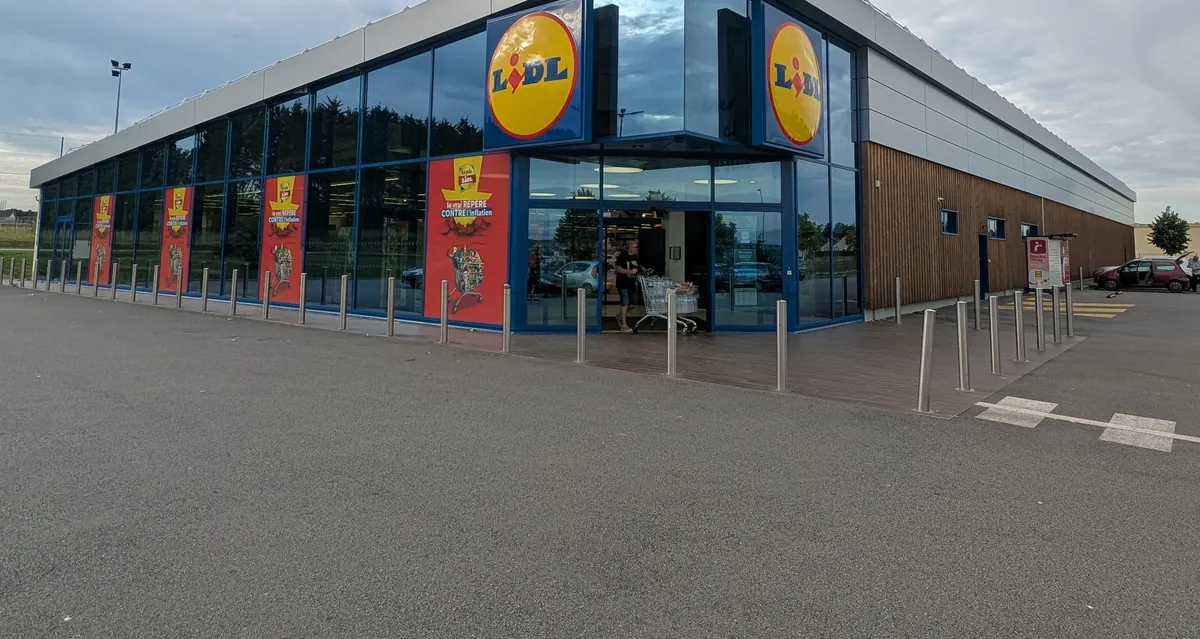
Another measure exists. According to the Kantar study from December 2024, as reported by Pleinchamp, Lidl accounted for 7.6% of fast-moving consumer goods (FMCG) and fresh self-service products, up 0.5 points. The French acronym PGC-FLS refers to this scope: everyday products sold in self-service.
In September 2025, Le Journal de l’Économie counted about 1,627 stores and about 7.8% market share. The goal is to exceed 2,000 supermarkets and 10% market share by 2030. The two measures may not cover exactly the same scope.
The table below summarizes the key dates.
| Date | Event | Figure | Source |
|---|---|---|---|
| 1973 | First store in Ludwigshafen-Mundenheim | Not disclosed | Lidl France |
| 1984 | Dortmund-Wickede | Not disclosed | Lidl France |
| 1989 | Sarreguemines | First French store | Lidl France, Wikipedia |
| 1997 | National brands | Not disclosed | Wikipedia |
| 2002 | 1,000th supermarket | 1,000 | Lidl France |
| October 2012 | Shift toward upmarket positioning | About 1,500 stores | Wikipedia |
| December 2024 | Kantar study | 7.6% | Pleinchamp |
| September 2025 | Network status | About 1,627 stores, 7.8% | Le Journal de l’Économie |
| 2030 | Company target | More than 2,000 stores, 10% | Le Journal de l’Économie |
Comparing store counts: from about 1,500 in October 2012, according to Wikipedia, to about 1,627 in September 2025, according to Le Journal de l’Économie, the network grew by about 127 stores. No revenue per store is published, so it’s impossible to tell how much of the market share gain came from more traffic per store rather than more locations.
This logic resembles other chains that rely on low prices and a limited range, as shown in our analysis of how Costco makes money.
2024: a 1 to 2% net margin and owned buildings
Lidl combines a thin net margin, mostly owned buildings, and integrated logistics to keep prices low. Each of these three levers cuts a cost that other chains bear.
In 2024, Michel Biero told Capital magazine that Lidl’s net margin sits between 1% and 2%, as reported by Pleinchamp. In other words, for every €100 in sales, €1 to €2 remains once all costs are paid. Margins by product are not public.
On real estate, Lidl owns 80% of its buildings, which eliminates rent, according to Lidl France’s corporate website. For a chain that lives on thin margins, not paying rent lowers costs over the long term.
Why build its own warehouses?
A logistics platform in the Yvelines department has been under construction since May 16, 2023, according to Wikipedia. It was supposed to serve southern Île-de-France and open in 2025.
The link to costs is analytical: a warehouse close to stores shortens trips and keeps supply under the chain’s control. Lidl has not quantified the savings expected from this platform.
French and fresh products
Lidl France has signed 5,000 three-way contracts with French farmers for eggs, meat, and fruits and vegetables, according to Pleinchamp in January 2025. No volumes or prices have been disclosed.
For a look at another pricing tactic, see the psychology of prices ending in 99. Nothing shows that Lidl makes this a pillar of its strategy; its main lever is structural.
2025: a new tagline, a departure and opaque accounts
Lidl France’s model has its gray areas. The true financial scale is impossible to verify: Lidl France does not publish its accounts, according to Wikipedia. There is therefore no official revenue figure and no verifiable net profit.
The tone shifted in September 2025, when the tagline “Le vrai prix des bonnes choses” (“The real price of good things”) gave way to “Lidl, ça vaut le coup” (“Lidl is worth it”), according to Le Journal de l’Économie. The change puts price front and center.
Leadership also changed. Michel Biero, demoted from president to vice president the previous summer, left Lidl France on March 1, 2025, after 25 years with the company, according to Pleinchamp. No reason has been documented.
The model’s limit shows here: a chain built on low prices depends on that image. When inflation squeezes budgets, even a small perceived price gap against competitors gets noticed. This is analysis, and no figure measures it.
2025: the price push and the Auchan store takeover
In 2025, Lidl relaunched its pricing strategy and took over 19 Auchan supermarkets, with the goal of exceeding 2,000 stores and 10% market share by 2030, up from about 7.8% in September 2025, according to Le Journal de l’Économie.
According to BFMTV, as cited by Le Journal de l’Économie, Lidl has invested €150 million since early 2025 to lower its prices. Over the first eight months of the year, store traffic rose 5% and volumes rose 4%. These figures come from a press article, not published accounts.
On the network side, France’s competition authority, the Autorité de la concurrence, cleared without conditions on September 22, 2025, the takeover of 19 Auchan supermarkets and 8 service stations. The deal was notified on August 20, 2025 (decision 25-DCC-214).
What Lidl’s French history shows, and its limits
Lidl’s path shows that a format designed around low prices can expand without losing its core principle, as long as its costs stay under control. The mechanism combines thin margins, owned real estate, integrated logistics, and a range that includes national brands.
Four dates mark the journey: 1989 for entry, 1997 for national brands, 2012 for the upmarket shift, and 2025 for the price push. To the question “Is Lidl still a hard discounter?”, the 2012 answer is clear: management wanted to move upmarket without becoming a traditional supermarket.
The limits come from the data. The accounts are not published, market shares come from different measures, and recent results still need confirmation. The 2030 target is the company’s goal, not a result.
Frequently asked questions
Where did Lidl open its first store in France?
In Sarreguemines, in the Moselle region, on April 5, 1989. Wikipedia and Lidl France’s corporate website both confirm this date. Lidl’s first store anywhere had opened in 1973 in Ludwigshafen-Mundenheim, Germany.
How many Lidl stores are there in France?
About 1,627 as of September 2025, according to Le Journal de l’Économie. The chain aims for more than 2,000 supermarkets by 2030. In October 2012, it had about 1,500, according to Wikipedia.
Is Lidl still a hard discounter?
In 2012, Lidl chose to move upmarket “without becoming a traditional supermarket,” according to Wikipedia. It has also sold national brands since 1997. Low prices remain its core principle, but the format is broader than it was at the start.
How did Lidl choose where to open its first stores?
No selection criteria are documented. The first store opened in Sarreguemines, near the German border, which suggests a link to the group’s origins. That reading remains a hypothesis.
How these articles are prepared: our editorial policy


Comments are closed.