


Published
In 1854, on rue Neuve-des-Capucines in Paris, a trunk-maker set up his workshop under his own name: Louis Vuitton. The house’s first bag did not appear until 1901.
The oldest Louis Vuitton bag is the Steamer Bag, introduced in 1901 and presented as the house’s first bag, 47 years after the brand was founded in 1854. Soft and designed to be packed inside trunks, it was an extra piece of luggage, made after decades devoted to rigid trunks.
Between the 1854 workshop and that first soft bag, nearly half a century of trunks passes. In the meantime, the house launches a flat trunk, changes canvas several times and opens a shop in London. This piece follows these milestones in order, explains why the dates differ between sources, shows how to date an old piece, then reviews the Speedy and the Damier Azur dispute.
Key takeaways
- The house is founded in Paris in 1854. Louis Vuitton sells the flat trunk from 1858.
- The Steamer Bag (1901) is presented as the house’s first bag: soft, in Monogram canvas, and designed for trunks.
- The Speedy is not the first bag. Its date ranges from the 1930s to 1965 depending on the source.
- The Damier dates from 1888. The Damier Azur was the subject of a ruling by the General Court of the European Union in 2022.
1837-1858: from apprentice to inventor of the flat trunk
Before he ever made a bag, Louis Vuitton learned the trade of layetier-emballeur-malletier (a French trunk-maker and packer), opened his workshop in 1854, and in 1858 launched the flat trunk, which changed luggage.
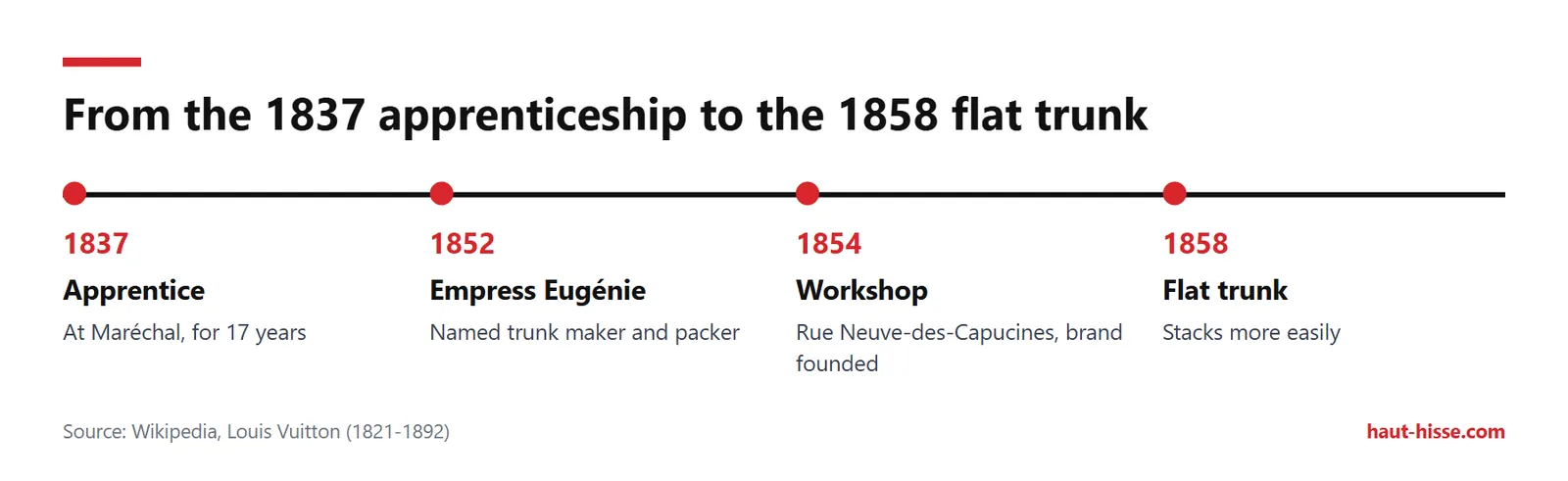
Louis Vuitton joins Maréchal, a layetier-emballeur-malletier, as an apprentice in 1837 and stays there for 17 years. In 1852, after the Empire was restored, he is named trunk-maker and packer (malletier-emballeur) to Empress Eugénie de Montijo.
In 1854, he opens his own workshop on rue Neuve-des-Capucines in Paris and founds the brand.
Before 1858, trunks had a domed lid, usually to help water run off. The dome stops them from being stacked. In 1858, Vuitton introduces the flat trunk, which stacks more easily than domed-lid trunks. According to English Wikipedia, these were flat-lidded trunks in Trianon canvas, light and airtight. Numéro says he sold them from 1858, aimed at the new mass transport of trains and ships.
Grailed describes this Trianon trunk as grey and as the first with a flat top and bottom. LVMH also cites the flat trunk, the light canvas and the gorge lock among the house’s innovations.
Christie’s video traces the rest of this history of travel trunks.
Why a flat trunk? Trains, ships and stacking
The flat trunk solves a logistics problem: a flat lid can be stacked, a domed one cannot.

The mechanism is simple. The dome sheds water, but it rules out stacking luggage. A flat top lets trunks be stacked, which suits trains and ships.
In 1859, the workshop moves to Asnières-sur-Seine, on the riverbank, to make use of river transport. You can read more about this site in our feature on the Asnières workshop.
From Trianon canvas to Monogram: the canvases before the bag
Each canvas followed another to set the house apart from imitations, from the grey Trianon of 1858 to the Monogram of 1896, with dates that differ between sources.

The table below goes back to the 1837 apprenticeship and compiles the milestones found in French Wikipedia, English Wikipedia, Numéro, Grailed and LVMH. The last column flags each gap between sources.
| Date | Milestone | Source | Caveat |
|---|---|---|---|
| 1837 | Louis Vuitton apprentice to Maréchal, layetier-emballeur-malletier, where he stays for 17 years | French Wikipedia | None |
| 1852 | Named trunk-maker and packer (malletier-emballeur) to Empress Eugénie de Montijo | French Wikipedia | None |
| 1854 | Workshop on rue Neuve-des-Capucines, Louis Vuitton brand | French Wikipedia, LVMH | None |
| 1858 | Flat trunk, which stacks more easily than domed-lid trunks; grey Trianon canvas | French Wikipedia, Numéro, Grailed | The grey colour comes from Grailed |
| 1859 | Workshop moved to Asnières-sur-Seine, on the river | French Wikipedia | None |
| 1876 | Red and beige striped canvas | Numéro | French Wikipedia cites 1872 for a beige line with red stripes |
| 1885 | First shop outside Paris, in London | Numéro | None |
| 1886 | Single-key lock for a set of trunks | Numéro | None |
| 1888 | Damier canvas | English Wikipedia | None |
| 1896 | Monogram canvas | English Wikipedia, Grailed | Numéro gives 1892; Grailed 1896-1897 |
| 1901 | Steamer Bag | English Wikipedia | None |
| 1930 | Keepall | English Wikipedia | None |
| 1932 | Noé | English Wikipedia | None |
| 1930s to 1965 | Speedy | English Wikipedia, Numéro, Grailed | Date disputed |
Read from top to bottom, the table shows that 17 years of apprenticeship and two years of imperial appointment come before the 1854 founding, and that the workshop moves five years later, a year after the flat trunk. The 1888 Damier was created against imitations and carries the words “marque L. Vuitton déposée” (registered L. Vuitton trademark).
According to English Wikipedia, the Monogram launched in 1896 with worldwide patents. Louis Vuitton died in 1892, and his son Georges took over the house, then introduced the interlocking L-V monogram.
Nearly half a century of rigid luggage before the first bag
From 1854 to 1901, the milestones concern trunks and their canvases, not handbags.
The flat trunk of 1858, the striped canvas of 1876, the London shop of 1885 and the single-key lock of 1886, designed for a set of trunks, make up a catalogue of rigid luggage. The first bag, the Steamer, does not clearly break with that logic: it is an extra piece of luggage designed to be stored inside trunks.
This period without a bag is a finding. Describing a “refusal” to make handbags would give the house an intention that nothing fixes: neither the decision, nor the date, nor the reason. The Speedy comes much later, with a date that is still debated.
1901: the Steamer Bag, the oldest Louis Vuitton bag
The Steamer Bag, introduced in 1901, is presented as Louis Vuitton’s first bag: a soft piece of luggage designed to live inside trunks.
English Wikipedia describes it as a small piece of luggage designed to be stored in Vuitton trunks. Robb Report Malaysia describes it as an extra bag that could fold into a compartment of the wardrobe trunk. The magazine also dates the arrival of motoring trunks in Vuittonite or Monogram canvas to the early 1900s.
PurseBop describes it as soft, in Monogram canvas, with a flap and vachette (calf) leather handles. In 2025, the site writes that every house has a first bag and that, for Louis Vuitton, it was the Steamer.
Grailed treats it as the forerunner of the Alma.
Jessiestyle’s video features new Steamer Bags inspired by the 1901 original.
1930-1932: Keepall, Noé and Speedy, the shift to the city bag
The Steamer is not the Speedy: Keepall and Noé arrive in 1930 and 1932, while the Speedy’s date remains debated.
According to English Wikipedia, the Keepall was introduced in 1930. The Noé followed in 1932, first designed to carry champagne bottles.
For the Speedy, the sources contradict each other. Wikipedia places it in the 1930s, a date judged inconsistent. Numéro mentions the early 1960s. Grailed gives 1965 and credits the request to Audrey Hepburn.
The common mistake is to confuse two objects. The Steamer (1901) is the house’s first soft travel bag. The Speedy is a modern handbag, much later.
Why dates differ between sources
House dates mostly circulate through secondary sources: online encyclopedias, cultural press, luxury magazines and resale platforms. Each relies on its own references, and the gaps in the table are the trace of that.
Three cases recur. The Monogram is dated 1896 by English Wikipedia, 1896-1897 by Grailed and 1892 by Numéro. The striped canvas is dated 1876 by Numéro, while French Wikipedia cites 1872 for a beige line with red stripes, a description that is not strictly the same. The Speedy, finally, ranges from the 1930s to 1965.
Faced with these gaps, the most cautious rule is to give the range and name the source, rather than settle the question without archival evidence. LVMH, the group’s official source, cites the house’s innovations, but on its own does not settle these dates.
How to date an old piece
Dating an old piece means cross-checking several clues, because the canvas alone gives only a rough marker.
- Identify the canvas: grey Trianon, striped, Damier or Monogram.
- Look for visible markings: the 1888 Damier carries the words “marque L. Vuitton déposée” (registered L. Vuitton trademark).
- Match the canvas to its launch date, keeping the range where sources differ, as with the Monogram.
- Have the piece examined by a specialist in vintage leather goods.
This method has a clear limit. In principle, a piece cannot predate the canvas it uses, but a canvas stays in use for a long time: the 1888 Damier still gave rise to a Damier Azur registered in 2008. The canvas timeline is not enough, and only an expert can authenticate an item.
Damier: a European dispute until 2022
The 1888 Damier canvas has its own legal history. In 2022, the Tribunal de l’Union européenne (TUE), the General Court of the European Union, rejected Louis Vuitton’s appeal over the Damier Azur.
The Damier Azur was registered internationally with the World Intellectual Property Organization (OMPI) on 4 November 2008, in class 18. The procedure lasted seven years, according to Legal 500:
- 25 June 2015: application for invalidity;
- 14 December 2016: decision of the cancellation division;
- 10 June 2020: partial annulment by the TUE (T-105/19).
In its ruling of 19 October 2022 (T-275/21), the General Court of the European Union held that the Damier Azur did not acquire distinctive character through use across the European Union. The evidence was judged insufficient for Bulgaria, Estonia, Latvia, Lithuania, Slovakia, Slovenia and Malta, where Louis Vuitton had no shop, according to Legal 500.
The dispute concerns the Damier Azur, not the 1888 Damier canvas in general.
What the history shows: a trunk-maker turns to bags under the pressure of travel
The history shows a simple chain: transport imposes the flat trunk, travel calls for an extra piece of luggage, then the city adopts the soft bag.
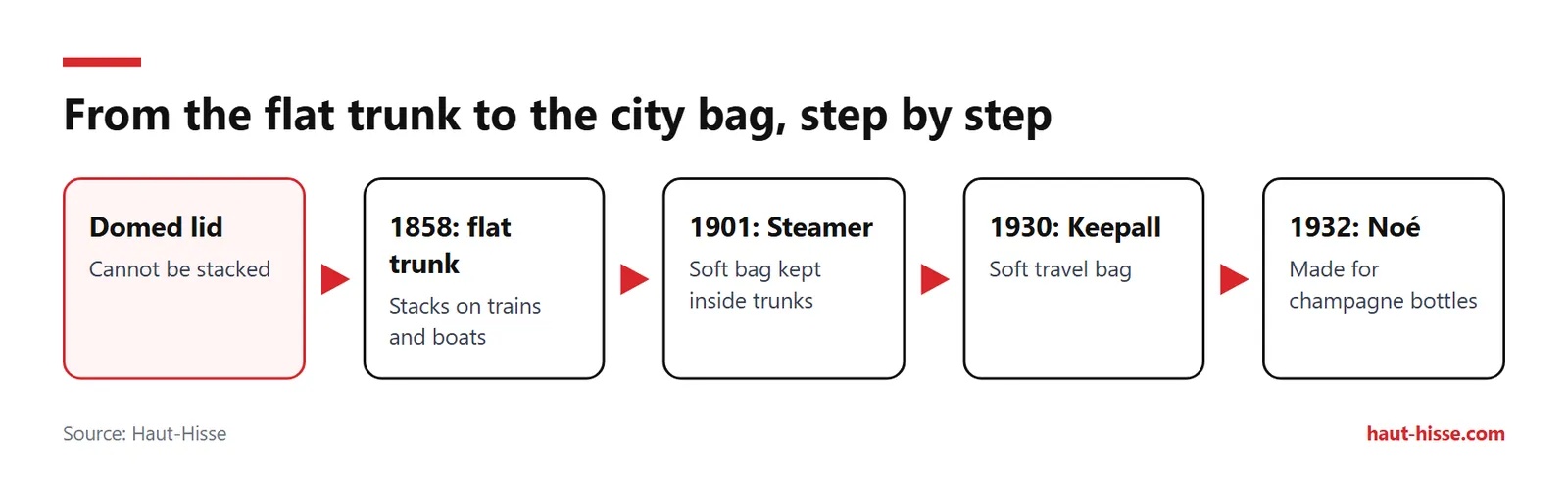
The chain reads as follows:
- A domed lid cannot be stacked.
- The flat trunk arrives in 1858.
- The Steamer is stored inside trunks in 1901.
- Keepall and Noé follow in 1930 and 1932.
The Trianon, striped, Damier and Monogram canvases succeed one another against imitations, and trademark law extends that logic to 2022.
The house’s internal motivation is not documented. One hypothesis, which belongs to analysis rather than the record: the rise of trains and ships made a bag that fits inside a trunk useful. This trunk-making know-how helps explain the value of the pieces, as our article on the price of luxury details.
Frequently asked questions
Which canvas came before the Monogram at Louis Vuitton?
The Damier, created in 1888, comes before the 1896 Monogram. Before it came the grey Trianon of 1858 and a red and beige striped canvas, dated 1876 by Numéro.
When was the Damier canvas created?
The Damier canvas dates from 1888, according to English Wikipedia. It carries the words “marque L. Vuitton déposée” (registered L. Vuitton trademark) and was a response to imitations. The Damier Azur, registered in 2008, is a separate variant.
What is the difference between the Steamer Bag and the Speedy?
The Steamer Bag (1901) is a soft piece of luggage, first designed to be stored inside trunks. The Speedy is a modern handbag whose date remains uncertain, somewhere between the 1930s and 1965. The first came decades before the second.
Can you date an old Louis Vuitton bag from its canvas?
The canvas gives only a starting point, since a piece cannot predate the canvas it carries. It does not fix the manufacturing date, and only a specialist’s examination can authenticate the item.
How these articles are prepared: our editorial policy

