



Published · Updated
Louis Vuitton opened the Asnières workshop outside Paris in 1859 for practical reasons: his central Parisian workshop lacked space, while Asnières offered the Seine to deliver poplar wood by barge and an early railway line connecting directly to Gare Saint-Lazare, according to LVMH’s official website.
Understanding why Louis Vuitton chose Asnières goes to the heart of trunkmaking operations: where to manufacture, how to receive bulky timber, and how to supply the Paris store. Here is the story behind the 1859 move, the strategic advantages of the location, and what the workshop produces today.
Key takeaways
- In 1859, Louis Vuitton purchased land in Asnières, close to both the Seine and the railway.
- Poplar wood arrived by river barge, while the train line to Gare Saint-Lazare kept the workshop connected to Paris.
- Starting with around twenty employees, the site became a model of industrial organization studied by ESCP business students by the 1870s.
- The historic workshop still manufactures rigid trunks today and only opens to visitors during special events.
This setup aligns with why luxury goods carry high price tags: the production facility is part of what customers pay for. Here, it was designed as an integrated logistics link rather than a simple workspace.
1859: Louis Vuitton leaves Rue Neuve-des-Capucines for Asnières
By 1859, Louis Vuitton had outgrown his Parisian workshop on Rue Neuve-des-Capucines. He bought a plot of land in Asnières, close to the river Seine and the railway.
According to Sortiraparis, the land was “close to the Seine and the railway” and intended for a new workshop. The central Paris site could no longer provide enough room, according to Robb Report Malaysia. Yet Paris remained easily accessible.
The workshop launched with around twenty employees. The relocation aimed to capitalize on river transport, according to ESCP Business School. Workshop construction began that same year, specifies AEWorld, which dates Louis Vuitton’s establishment in Asnières-sur-Seine to 1859.
1859: lack of space makes the Paris workshop too cramped
The primary motivation was practical. The Rue Neuve-des-Capucines location could no longer provide enough room, according to Robb Report Malaysia. For a trunkmaker, space constraints are tangible: raw timber, works in progress, and finished trunks take up substantial volume.
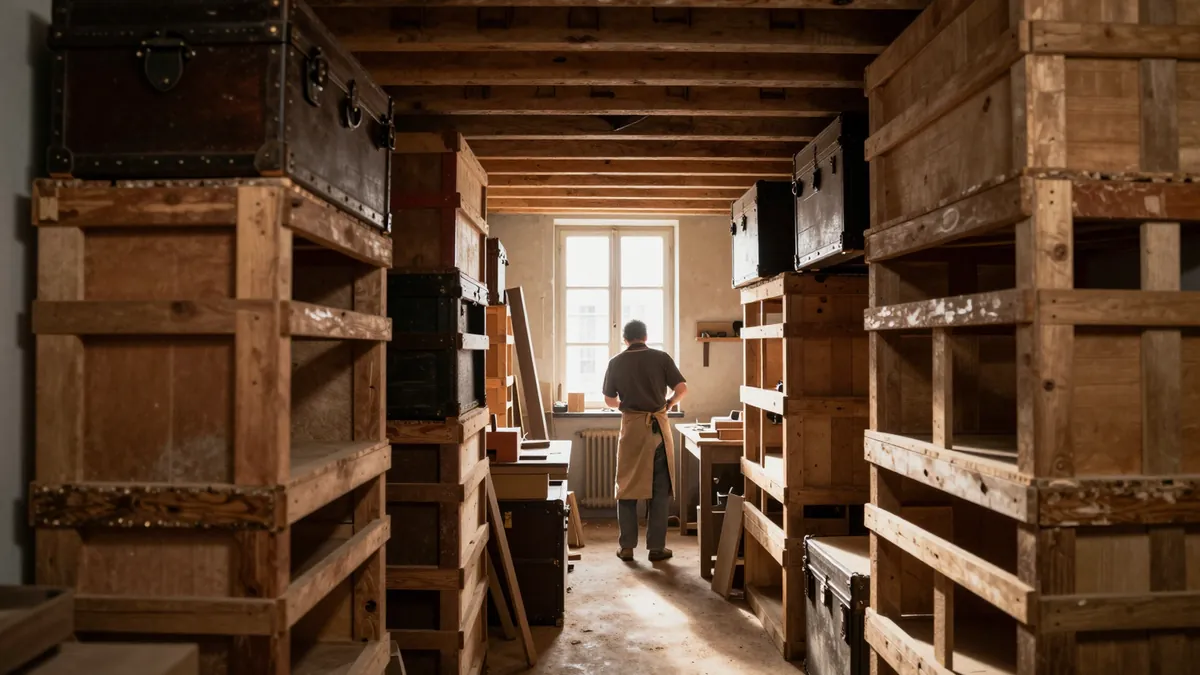
Purchasing land in Asnières solved this constraint. It allowed Vuitton to construct a workshop designed specifically for manufacturing, whereas remaining in central Paris meant working within the limits of existing buildings.
The storefront remained in Paris. The workshop moved outside the capital without losing contact with it, as Paris was only a short train ride away.
1859: Haussmann’s renovations, an unproven theory
Baron Haussmann’s urban renewal works are sometimes mentioned as a reason for Louis Vuitton’s departure from Paris. However, the documented motives for the relocation are space, the Seine, and the railway, not Haussmann’s construction sites.
As a matter of historical analysis, Paris was undergoing massive changes in the late 1850s, leaving workshops with few options to expand within city limits. Yet this remains an inference rather than an established fact. Without supporting documents, any link between Haussmann’s works and the 1859 move remains an unverified hypothesis.
Why Louis Vuitton opened the Asnières workshop between river and rail
Asnières combined two transport channels: the Seine for receiving raw materials and one of France’s earliest railway lines heading into Gare Saint-Lazare. The workshop sat directly between them.
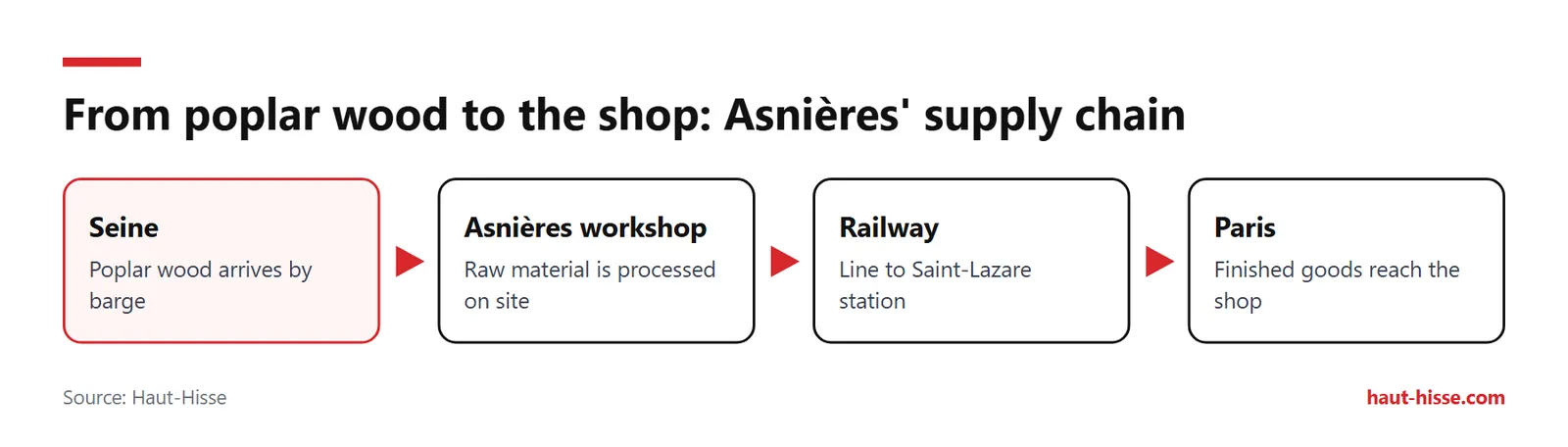
The system operated in three stages:
- Raw materials arrived by water.
- The workshop processed them on-site.
- Finished trunks traveled back to Paris.
No surviving figures document the exact time or shipping costs saved. The efficiency gain is a logical inference rather than a measured metric.
Poplar wood arrives via the Seine
According to LVMH’s official site, the banks of the Seine in Asnières made it easier to bring in raw materials, particularly poplar wood used for trunks. Robb Report Malaysia notes that this wood was delivered by barge, a flat-bottomed river vessel. For a trunkmaker, timber is the bulkiest raw material; receiving it directly beside the workshop avoided repeated handling and transfers.
The train line to Gare Saint-Lazare
LVMH points to the proximity of early railway lines running to Gare Saint-Lazare. Robb Report Malaysia also notes that one of the country’s first rail lines served the town. This rail connection linked the workshop to the capital, where the boutique and clientele were located, without forcing Louis Vuitton to manufacture inside Paris.
Why choose Asnières? Examining the site’s strategic advantages
Four primary assets stand out: space, the Seine, the railway, and proximity to Paris. However, certain popular dates require nuance.
The table below contrasts established facts, dates that require caution, and unverified claims.
| Advantage or claim | What the sources state | Certainty level |
|---|---|---|
| Space | Paris lacked enough room; land purchased in 1859 | Established |
| Seine | Poplar wood delivered by waterway (LVMH, Robb Report Malaysia) | Established |
| Rail | Proximity to early rail lines to Saint-Lazare | Established |
| Proximity to the capital | Paris remained close to the new workshop | Established |
| Haussmann renovations | Absent from documented motives | Unconfirmed |
| “1878” family home | House built around 1878 according to Robb Report Malaysia; AEWorld dates the move to the 1870s | Dated with caution |
The 1870s: from twenty workers to a model of industrial organization
During the 1870s, the Asnières workshop drew outside attention. ESCP business students visited the site at least five times across the 1870s, 1880s, and 1890s.
These visits were part of technology coursework, according to ESCP, which views this interest as proof of the site’s status as a model of industrial organization. André Delavaud, from the graduating class of 1897, was later hired by the workshop. This marked significant growth from its modest start of roughly twenty employees during the 1859 move.
Family structure played an equally central role. The Vuitton sons apprenticed in the workshops before managing retail stores, an idea introduced by Georges Vuitton, according to AEWorld. The workshop has since expanded well beyond its original footprint, notes Robb Report Malaysia.
Calling it the “first manufacturing model of modern luxury” is an analytical interpretation. ESCP records only demonstrate that the workshop served as an operational model for its students; they do not benchmark it against other luxury houses of the era.
Around 1878: family home and Art Nouveau decor, a timeline requiring caution
The family home beside the workshop was built in stages. Its Art Nouveau interior dates to the end of the 19th century, not to 1878.
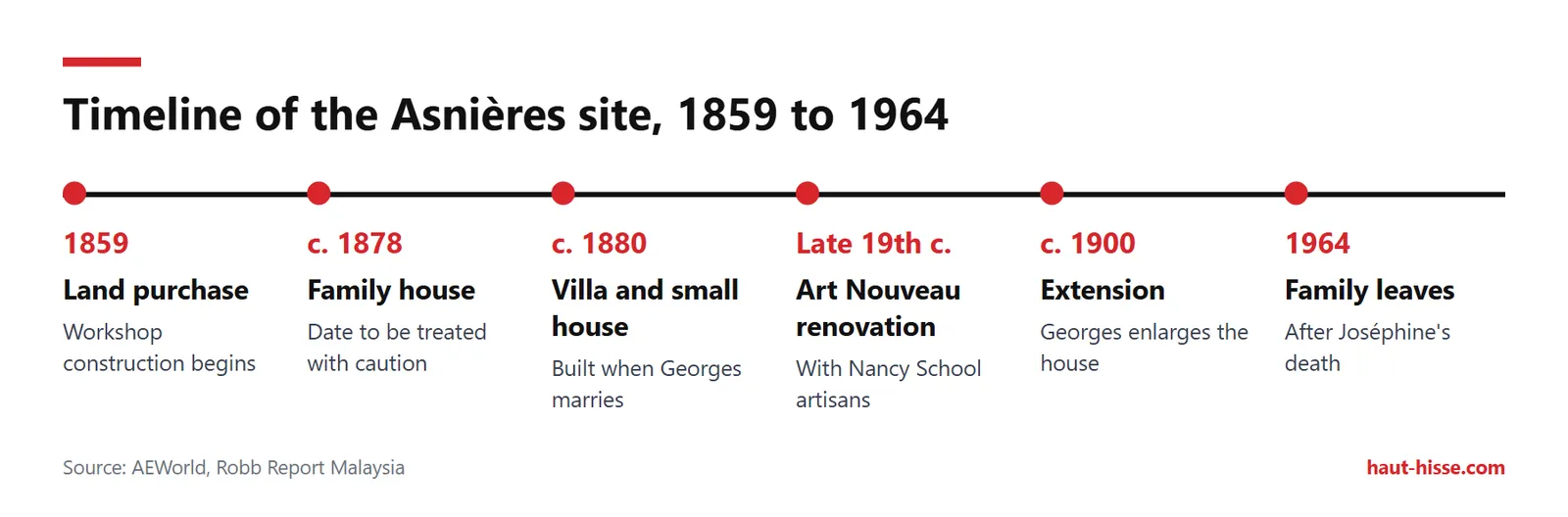
Around 1878, Louis Vuitton built a home next to the workshop, according to Robb Report Malaysia. However, AEWorld places the arrival of Louis and his wife Émilie on the site in the 1870s. The 1878 date should therefore be approached with caution.
Around 1880, upon Georges’s marriage, Louis built a villa and a smaller home for the couple, according to AEWorld. At the end of the 19th century, Georges remodeled the house in the Art Nouveau style with artisans from the École de Nancy art movement. He enlarged it around 1900, adds the Malaysian magazine.
The family stopped living in the house in 1964 following the death of Joséphine, Georges’s widow. During public tours, Sortiraparis notes original stained-glass windows, wall decorations, and period furniture.
| Date | Event | Source |
|---|---|---|
| 1859 | Land purchased in Asnières; workshop construction begins | Sortiraparis, AEWorld |
| 1870s | Louis and Émilie settle on the property | AEWorld |
| Around 1878 | Family home built beside the workshop (date requires caution) | Robb Report Malaysia |
| Around 1880 | Villa and smaller home built for Georges’s marriage | AEWorld |
| Late 19th century | Art Nouveau redesign with École de Nancy artisans | AEWorld |
| Around 1900 | House expanded by Georges | Robb Report Malaysia |
| 1964 | The family vacates the residence | AEWorld |
Turning points: from 1859 to the end of the 19th century
Three major decisions shaped the history of the site.
- The land purchase in 1859. Cause: Louis Vuitton ran out of room on Rue Neuve-des-Capucines. Result: a new workshop near the Seine and the railway, starting with around twenty staff (Sortiraparis, ESCP).
- The reliance on river and rail transport. Cause: bulky poplar wood had to arrive in large volumes. Result: it was brought in by barge, while the Saint-Lazare rail connection linked the workshop back to Paris (LVMH, Robb Report Malaysia).
- Workshop apprenticeships for family heirs. Cause: an initiative by Georges Vuitton. Result: the sons learned manufacturing before managing retail boutiques (AEWorld).
What does the historic Asnières workshop produce today?
The workshop brings together saddlers, cabinetmakers, leather artisans, and locksmiths. They manufacture rigid trunks, rare and exotic leather items, and special bespoke orders, according to LVMH.
Traditional woodworking and assembly methods remain intact alongside contemporary materials like carbon fiber, according to Robb Report Malaysia. Woodcraft remains the core craft on site, just as it was in 1859. Current employee numbers are not disclosed.
On Instagram, LVMH highlights Louis Vuitton’s trunk-making savoir-faire in Asnières, the Family House, and announces Les Journées Particulières on October 16-18, 2026.
Visiting Asnières: admission rules and address
Visits to the workshops and the family residence are not open year-round. They take place during special public events at 17 Rue de la Comète in Asnières-sur-Seine.
During the Journées Particulières event, the workshops opened from October 16 to 18, according to Sortiraparis. Admission rules for that edition included:
- Free entry for visitors aged 8 and older.
- Photo identification required at reception.
- Friday from 2:00 pm to 7:00 pm, Saturday from 9:00 am to 7:00 pm, Sunday from 9:00 am to 5:00 pm.
- Last entry at 6:00 pm, 6:00 pm, and 4:00 pm, respectively.
- Full advance registration required, with all slots booked, according to LVMH.
The gallery inside the family home displayed a curated selection of pieces celebrating 130 years of the Monogram canvas. Nothing indicates that walk-in visits are allowed outside these scheduled events; prospective visitors should check future announcements from LVMH.
The Visites privées channel shares a YouTube video titled “The Louis Vuitton Workshops – Private Tours”.
What the Asnières move shows: manufacturing near water and rail
The 1859 relocation demonstrates that an artisan can scale by designing production facilities around transport logistics rather than store addresses. A larger floor plan, river access for timber, and rail access for distribution formed a coherent system.
As an analytical takeaway, separating manufacturing from retail may have facilitated growth. The Vuitton sons mastered the craft at the workshop before managing retail stores, as noted by AEWorld.
Similar operational principles appear across other business histories. An analysis of Costco’s business model illustrates another approach to supply-chain design, whereas the account of Kodak’s bankruptcy shows what happens when operational setups fall out of step with market shifts.
The limits of this history are clear. No surviving datasets measure exact historical costs, shipping lead times, or market share. Relocating to Asnières alone does not explain the broader rise of LVMH. What remains clear is that the Asnières workshop continues to produce trunks more than a century and a half after opening.
Frequently asked questions
Who founded the Asnières workshop?
The workshop was established in 1859 by Louis Vuitton after he bought land in Asnières. His son Georges later expanded the family home on the property and remodeled it in the Art Nouveau style in the late 19th century, according to AEWorld.
Did Baron Haussmann’s renovations push Louis Vuitton out of Paris?
There is no documentation supporting this. The recorded reasons for the move are space constraints on Rue Neuve-des-Capucines, river access via the Seine, and railway connections. Any link to Haussmann’s construction projects remains an unconfirmed hypothesis.
What wood is used to make Louis Vuitton trunks?
LVMH notes the use of poplar wood for the trunks, which the Seine allowed suppliers to deliver directly to Asnières. Robb Report Malaysia adds that traditional woodcraft methods are still practiced at the workshop.
How many craftsmen work at the Louis Vuitton workshop in Asnières?
The workshop employed roughly twenty people when it opened in 1859, according to ESCP Business School. Current workforce figures are not publicly disclosed.
Does the Asnières workshop still produce trunks today?
Yes. According to LVMH, the workshops still produce rigid trunks, rare and exotic leather goods, and special bespoke orders, combining traditional woodworking skills with modern materials like carbon fiber.
How these articles are prepared: our editorial policy

