



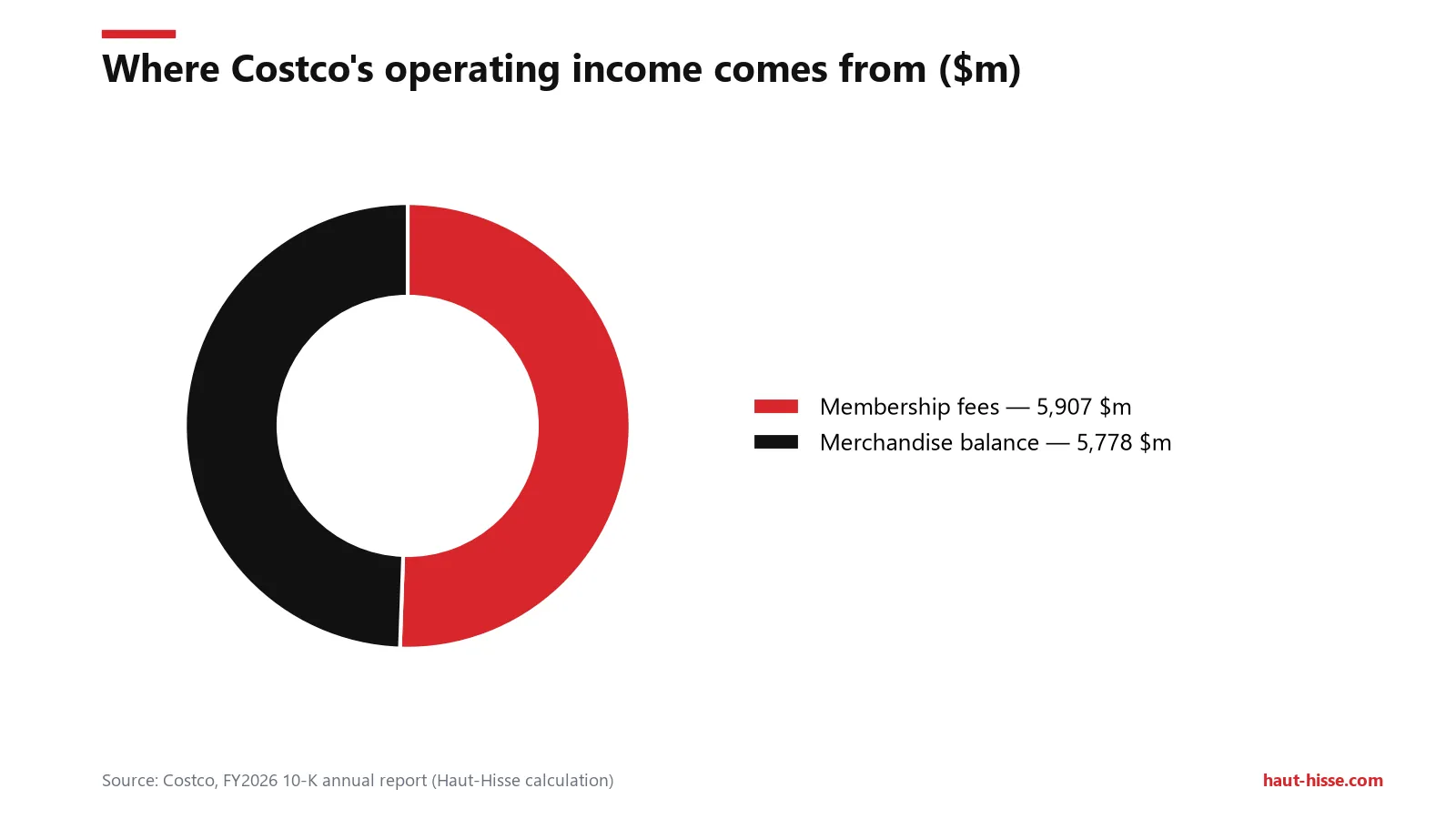
Understanding how Costco makes money requires looking at its membership cards. According to the annual 10-K report for the fiscal year ended August 30, 2026, filed with the SEC, membership fees generated $5.907 billion—roughly 50.6% of operating income from just 1.9% of total revenue. Merchandise sales, sold at an 11.09% gross margin, generated roughly $5.8 billion.
Key takeaways
- Membership fees accounted for about half of Costco’s operating income in its latest fiscal year, not almost all of it.
- Warehouse merchandise sales remain profitable after purchasing costs and operating expenses.
- Inventory is more than fully financed by accounts payable.
- The fixed-price hot dog serves as a loss leader that drives customer retention.
How Costco makes money, line by line
In the latest fiscal year, Costco’s operating income split almost evenly between membership fees and the net operating profit from warehouse aisles.
In 2024, CFO Gary Millerchip told investors, “I also want to confirm the $1.50 hot dog price is safe,” as reported by OPB/NPR. A statement about a hot dog price from an executive leading a company with over $300 billion in revenue highlights the question of where its profits actually come from.
Many analyses confuse the picture by mixing up revenue and net earnings. FinanceBuzz, for example, cites $4.8 billion in membership fees for fiscal year 2024, representing about 2% of revenue. The text provides neither the gross margin nor the share of profit, giving an order of magnitude without clarifying what cards contribute to the bottom line.
The 10-K annual report for the fiscal year allows that breakdown to be reconstructed. The editorial calculation begins with net sales and membership fees, then subtracts merchandise costs and selling, general, and administrative (SG&A) expenses.
| Income statement line | Amount ($M, latest fiscal year) | Meaning |
|---|---|---|
| Net sales | 297,247 | What members pay at checkout |
| Merchandise costs | 264,279 | Purchase cost of goods sold |
| SG&A expenses | 27,190 | Wages, warehouses, operations |
| Warehouse merchandise profit | about 5,778 | Retail sales profit, editorial calculation |
| Membership fees | 5,907 | Membership card revenue |
| Operating income | 11,685 | Sum of merchandise profit and membership fees |
Membership fees represent a very small percentage of total revenue but roughly half of operating income. Merchandise profits remain modest relative to net sales (editorial calculation). The common claim that Costco makes “almost no profit on warehouse sales” is therefore incomplete. Aisles deliver real profit, slightly lower than fee income.
Net income for the fiscal year increased markedly compared to 2025 (editorial calculation).
The 2024 fee increase: the model’s strongest lever
Membership fees form the core of Costco’s financial engine: $5.323 billion in 2025 and $4.828 billion in 2024, according to the fiscal 2025 10-K, following a price increase that took effect on September 1, 2024, in the United States and Canada. Fee revenue climbed again in the latest fiscal year.
Membership fee income has expanded by about a tenth each year, slightly outpacing net sales (editorial calculation).
The baseline fee remains low. According to the latest 10-K, annual membership rates vary by country and include a free card for a household member. Spread across the total paying member base, average fee revenue works out to a few dozen dollars per member annually (editorial calculation, accounting for higher-tier cards and international rates).
The relative weight of fees also shifts across the year. Over the first half of the fiscal year (24 weeks), The Motley Fool noted $2.68 billion in membership fees compared to roughly $2.4 billion in operating profit from retail sales. Over the full fiscal year, the gap narrows, with membership fees barely exceeding merchandise profits.
A renewal rate above 92% in North America
The renewal rate—the percentage of members who renew when their subscription expires—exceeds 92% in the United States and Canada and sits slightly lower worldwide, according to the latest 10-K.
This metric directly supports profitability: a renewed membership delivers fee revenue without customer acquisition costs. In the second quarter of the fiscal year, The Motley Fool reported a 92.1% renewal rate in North America, down 10 basis points year over year (one basis point equals 0.01 percentage points). Management attributed about one-third of membership fee growth at the time to the 2024 price hike.
Executive members account for 75% of sales
As of August 30, 2026, Costco counted 84.1 million paid members and 150.4 million cardholders, including 42.3 million Executive members, according to the fiscal year 10-K. Cardholder totals include free household cards.
Executive members carry substantial weight: they generated approximately 75.2% of worldwide net sales in the latest fiscal year, up from 73.6% in 2025. According to the 2025 10-K, they earn a 2% reward on eligible purchases, generally capped at $1,250 per year, and their membership costs an additional $65 in the United States. Customers paying more for their cards also spend the most in warehouses.
An 11% gross margin: Costco versus Walmart
Costco recorded an 11.09% gross margin on merchandise in the latest fiscal year, compared to 11.12% in 2025. That is less than half of Walmart’s gross margin, estimated at 24.2% by French financial market portal Zonebourse.
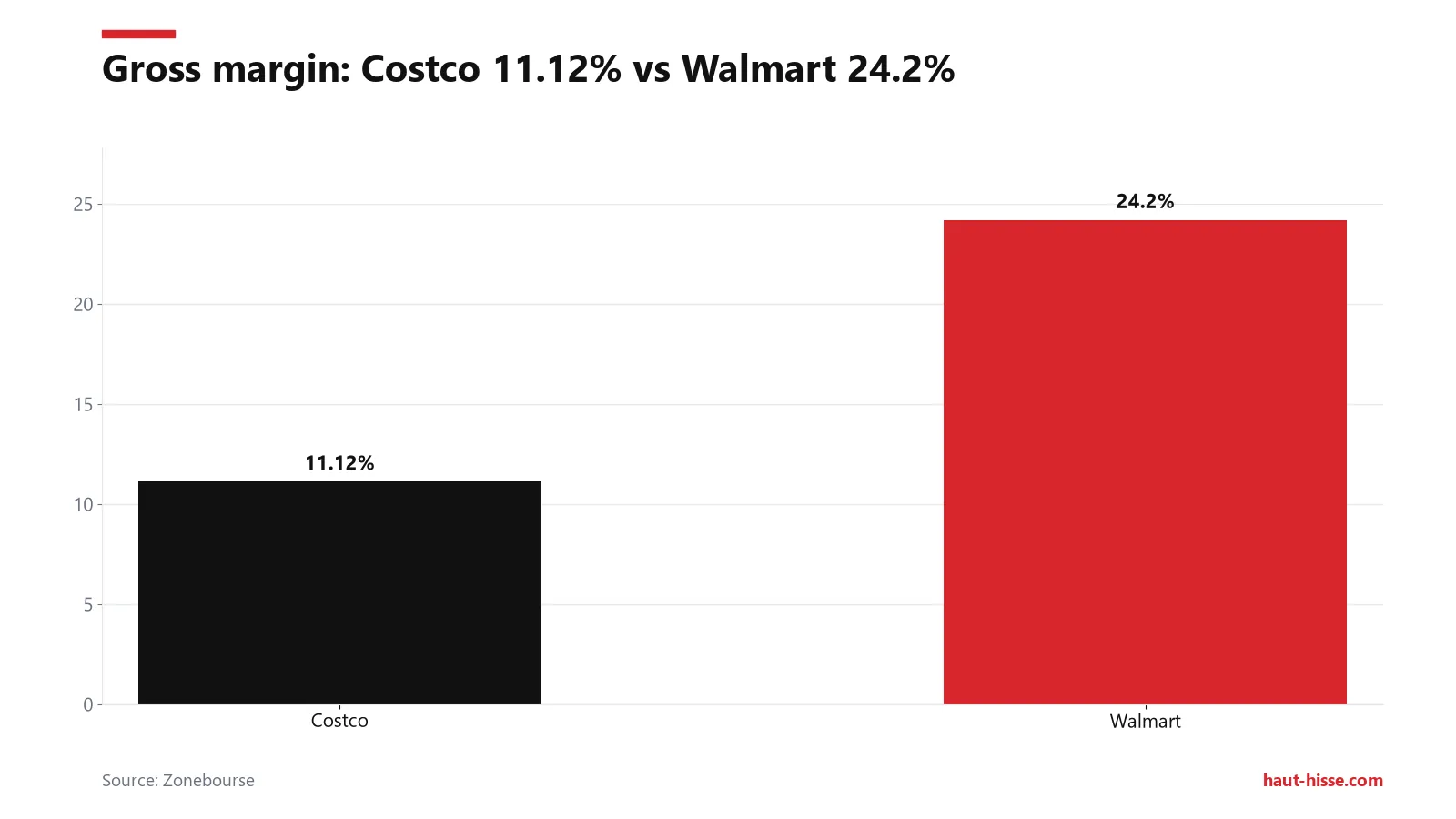
Gross margin reflects the portion of revenue remaining after purchasing goods, before paying operating expenses. For every $100 collected at the register, Costco retains roughly $11 before covering payroll, warehouse leases, and general overhead. Costco’s figures come from its 10-K, while Walmart’s comes from Zonebourse, comparing it against Costco’s margin in its latest fiscal year.
| Indicator | Costco | Walmart |
|---|---|---|
| Gross margin, latest fiscal year | 11.09% | Not compared here |
| Gross margin, fiscal year 2025 | 11.12% | 24.2% (latest fiscal year cited by Zonebourse) |
| Source of operating income, latest fiscal year | Roughly 50.6% membership fees, 49.4% warehouse sales | Not compared here |
The fiscal years compared are not strictly identical; the difference offers an order of magnitude rather than a direct match.
Why keep margins so low? This is an analysis rather than a documented company claim: the model works because Costco can sacrifice retail product margins. Shoppers return for low prices, and membership dues compensate the retailer upfront. Membership fees thus cover a share of earnings that product markups alone would not produce.
A reported markup cap also circulates widely. RetailWire, cited by TheStreet, reported that Costco caps markups at 14% on brand-name goods and 15% on private-label items. This cap is not mentioned in the 10-K and has no official corporate confirmation, meaning it should be viewed with caution.
Finally, gasoline represents a substantial share of total net sales, according to the 10-K. This figure reflects the sheer scale of the fuel operation, though its exact effect on total gross margins is not detailed.
Fewer than 4,000 SKUs per warehouse: curated scarcity
Costco carries fewer than 4,000 active SKUs per warehouse, compared to over 100,000 in a traditional hypermarket according to Zonebourse. This concentrates purchasing volumes and strengthens bargaining power.
According to its 10-K, the company limits its selection across its core warehouse business. A stock-keeping unit (SKU) is a distinct item in the catalog. Online, the fiscal 2025 report cites an average of 9,000 to 10,000 SKUs.
Zonebourse contrasts this strategy with the more than 100,000 SKUs found in a traditional hypermarket. The logic is arithmetic: by stocking fewer product variations, Costco buys each item in massive quantities, improving supplier terms. The publication also notes two warehouses operating in France.
This scarcity relies on a growing store base: 939 warehouses as of August 30, 2026, compared to 914 in 2025 and 890 in 2024, according to the latest 10-K. Every new warehouse provides another distribution outlet for an inventory that remains focused.
Kirkland Signature: Costco’s private label
Kirkland Signature is Costco’s proprietary private-label brand sold in its warehouses. The only numerical reference available is the reported 15% markup cap on private labels, cited by RetailWire via TheStreet and unconfirmed by the company. The 10-K does not detail Kirkland Signature’s exact share of overall sales or earnings.
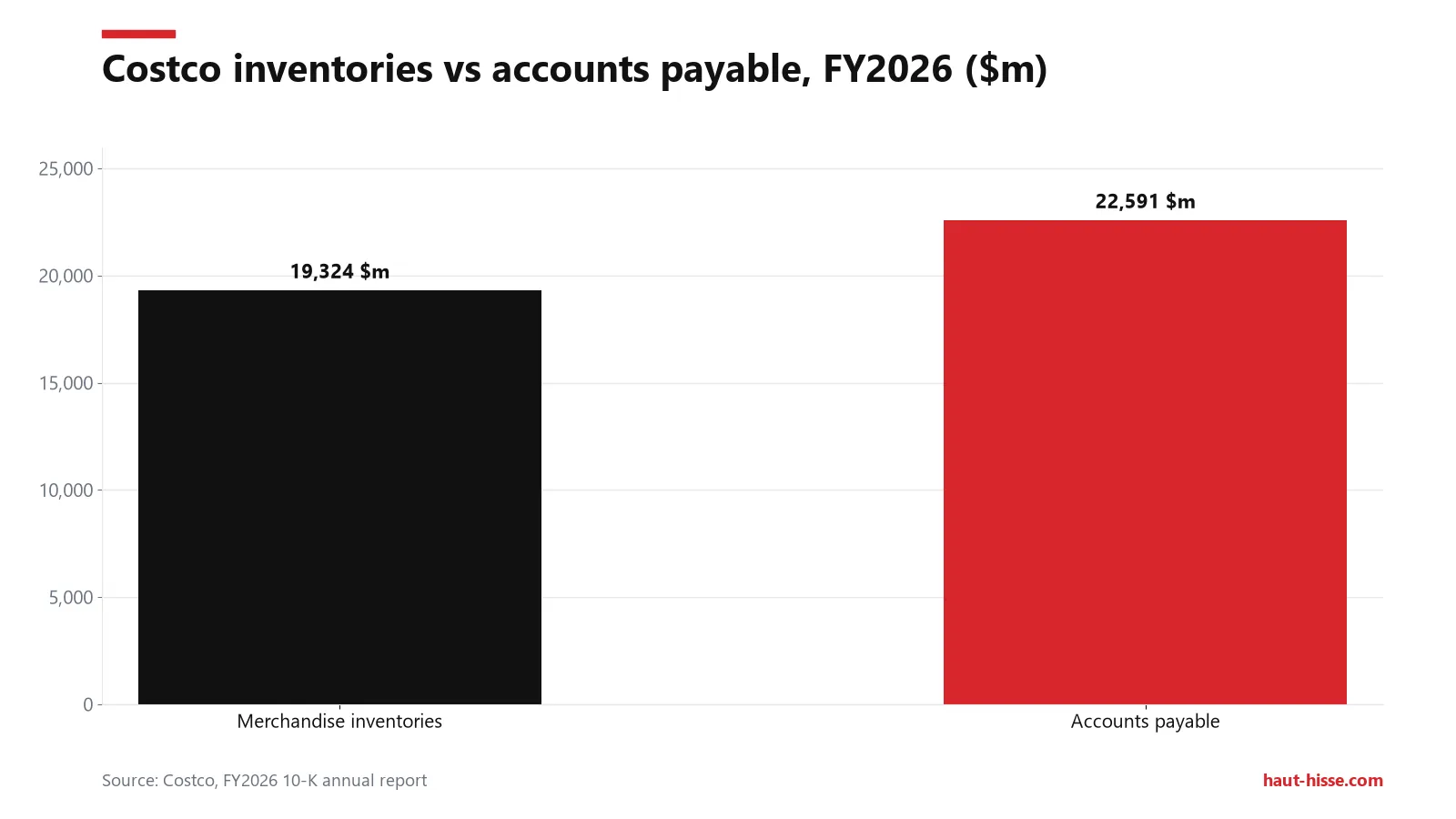
$19.3 billion in inventory, $22.6 billion in payables: precise turnover
At the close of the fiscal year, Costco’s inventory balance sat lower than its accounts payable, meaning suppliers financed more than the total stock resting in warehouse aisles.
Inventory turnover measures how many times per year inventory is sold and replaced. Faster turnover means stock spends less time sitting on shelves. According to Zonebourse, Costco turns inventory roughly 13 times a year—about 28 days of inventory on hand—often selling products before invoices come due. This figure comes from secondary market analysis rather than a line item in the 10-K.
The balance sheet shows this relationship in the 10-K: accounts payable exceeded inventory by several billion dollars in Costco’s favor (editorial calculation). In practice, Costco does not front the cash for its merchandise; it relies on supplier financing.
This setup drives operating cash flow. Cash flow from operations increased substantially compared to 2025 and surpassed operating income, according to the filing, though the document does not isolate how much cash flow stems directly from inventory turnover. The link is a plausible business mechanism rather than a proven standalone figure.
$1.50 since the 1980s: the hot dog as a loss leader
The hot dog and soda combo has sold for $1.50 since the mid-1980s, according to OPB/NPR. Industry analysts describe it as a loss leader used to build customer retention.
Nearly 200 million combos were sold during fiscal year 2023, according to OPB/NPR. Forrester analyst Brendan Witcher noted that Costco uses the deal to buy member loyalty: the discounted hot dog secures ongoing customer commitment.
Costco has also managed its production costs. According to OPB/NPR, the retailer has run its own hot dog manufacturing facilities since 2008 to reduce supply costs after previously using Hebrew National as its primary supplier.
Company executives have defended the fixed price publicly. In 2024, Gary Millerchip confirmed the combo’s price was safe, while former CFO Richard Galanti previously explained that Costco’s other revenue streams allow it to maintain those prices. No official reports specify the net financial loss per hot dog sold, leaving the exact dollar cost unconfirmed.
What Costco’s business model reveals—and its limits
Costco’s model operates on a reinforcing loop: thin product margins and a limited catalog attract members, membership fees subsidize low retail pricing, and supplier-financed inventory frees up working capital.
This structure is confirmed in the 10-K filing: membership dues and merchandise operating margins split operating income almost evenly. The model does not run solely on membership fees; it depends on pairing those fees with high-volume merchandise sales that remain profitable even on razor-thin markups.
Membership renewal rates represent the key vulnerability. This is an analysis rather than a market forecast: because North American renewal rates sit above 92%, a drop of even a few percentage points would directly hit half of the company’s operating earnings. The slight dip observed in the second quarter was small, but it represents the metric to watch.
The idea that Costco generates virtually all its earnings from membership dues is contradicted by the figures: in the latest fiscal year, card fees contributed about half of operating income. Fees can exceed that percentage in specific reporting periods, such as the first half of the fiscal year, but they do not make up the entire profit base.
A few analytical caveats remain. Inventory turnover rates and Walmart’s gross margin are sourced from Zonebourse rather than Costco’s SEC filings. The 14% and 15% markup caps lack official corporate confirmation. These figures outline how the model functions without providing an exact audited measurement.
Frequently asked questions
Is Costco profitable without membership fees?
Yes, from an accounting standpoint. Warehouse merchandise sales generate several billion dollars in operating profit, based on calculations from the 10-K. However, those thin retail margins depend heavily on the customer traffic that the membership card attracts. Without membership fees, the existing business setup would not function in its current form.
How many members does Costco have worldwide?
Costco has about 84 million paid members and approximately 150 million total cardholders when factoring in free household cards, according to the latest 10-K filing. More than 42 million are Executive members.
How much money does Costco make each year?
In its latest fiscal year, Costco’s operating income exceeded $11 billion and net income was close to $9 billion, up from fiscal 2025, according to its 10-K report.
Where do most of Costco’s profits come from?
Profits split almost equally: about half of operating income comes from membership fees and the other half comes from warehouse retail sales, based on calculations from the 10-K.
Sources
- Annual Report 10-K, Fiscal Year 2026 — SEC (EDGAR) / Costco Wholesale
- Annual Report 10-K, Fiscal Year 2025 — SEC (EDGAR) / Costco Wholesale (2025)
- Costco raised membership fees for the first time — The Motley Fool
- Costco or the art of making money while selling near cost — Zonebourse
- Costco hot dogs have cost $1.50 since the 1980s — OPB / NPR (2024)
- Costco reveals how it keeps prices low — Yahoo Finance / TheStreet
- How Costco makes money — FinanceBuzz
Prepared with the help of AI tools, then fact-checked and edited by the Haut-Hisse editorial team.


