



Understanding why prices end in 99 comes down to left-digit bias, a cognitive tendency to focus heavily on a number’s first digit. When shoppers see a price like €2.99, they read it as closer to €2 than to €3. However, research shows this effect varies widely depending on product type, brand positioning, and discount context.
Key takeaways
- According to Thomas and Morwitz (2005), the left-digit effect occurs when the leftmost digit changes (such as $2.99 to $3.00), as the first digit anchors attention.
- A 2024 meta-analysis found a positive but small and highly variable effect of 9-endings on consumer purchases.
- Ending a price in 9 is less effective alongside a “Sale” tag and can discourage shoppers from upgrading to higher-tier products.
- In luxury retail, prices ending in 50 or 80 serve as alternatives to 99, while the historical theory tied to preventing register theft remains unproven.
Why prices end in 99: The left-digit effect
Left-digit bias refers to the cognitive tendency to focus attention on the first digit of a number while partially ignoring subsequent digits. This psychological mechanism is the primary explanation for why consumers perceive a price ending in .99 differently from a rounded price just one cent higher. However, the magnitude of this effect remains debated: several replication studies found no effect, and a recent meta-analysis concluded the overall impact is small.
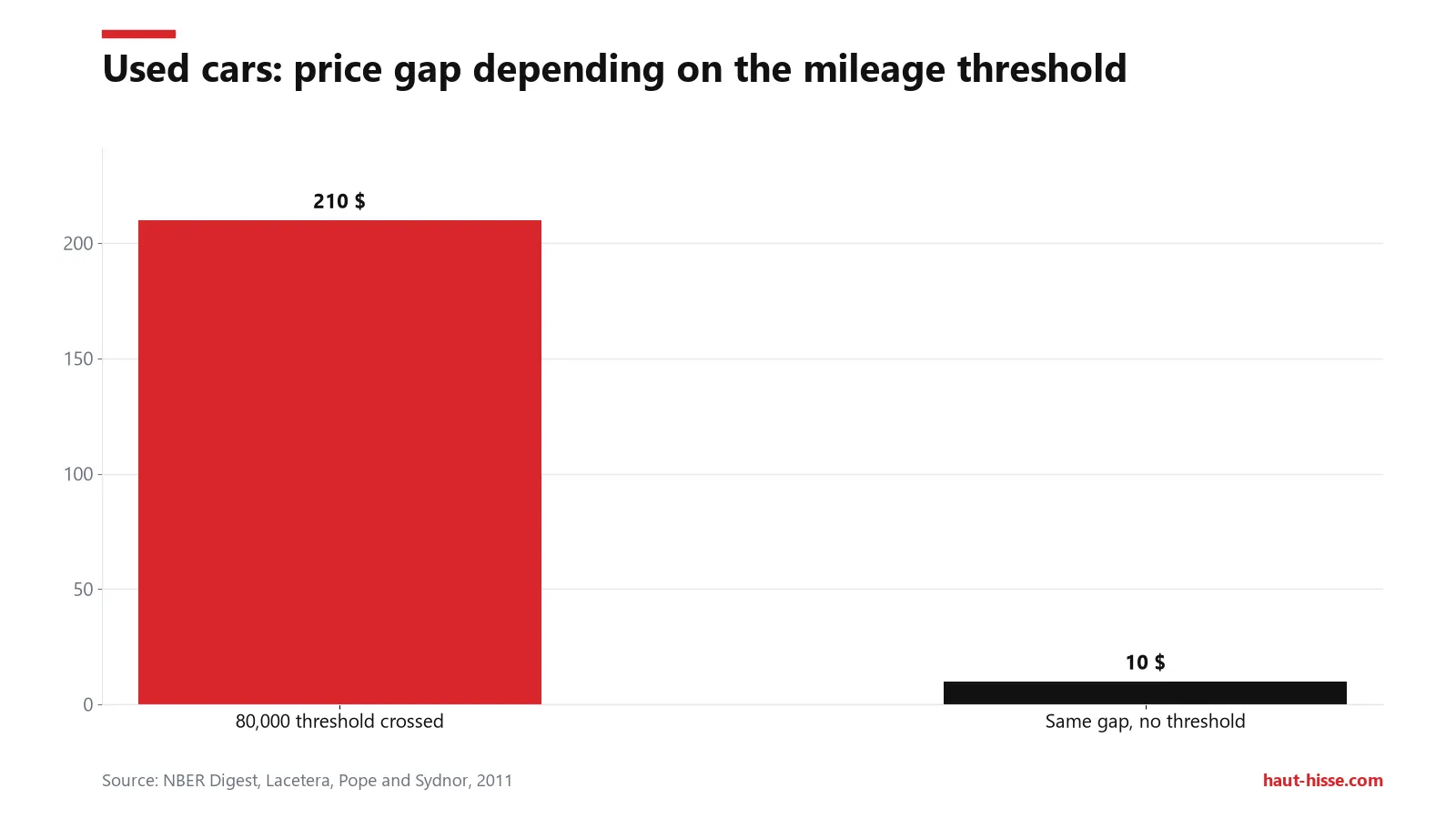
This phenomenon is detailed in research by the National Bureau of Economic Research (NBER), which analyzed left-digit bias beyond retail price tags. Across more than 22 million used-car auction sales in the United States, sale prices dropped sharply at each 10,000-mile threshold—by roughly $150 to $200 per threshold.
The price differences observed around these boundaries illustrate the effect:
| Comparison (mileage in miles) | Observed price difference |
|---|---|
| 79,900–79,999 vs. 80,000–80,100 | Roughly $210 higher for the former |
| 79,900–79,999 vs. 79,800–79,899 | Roughly $10 lower for the former |
The mileage difference is comparable in both cases, but only the first crosses a boundary where the leftmost digit changes.
Writing in the Journal of Consumer Research, Thomas and Morwitz demonstrated through five experiments that this perceptual distortion occurs only when the leftmost digit changes, such as between $2.99 and $3.00. The effect grows stronger when the two compared prices are close to one another. It is not limited to pricing and appears across other multi-digit numbers as well.
Left-to-right reading: Price underestimation or “round price minus a bit”?
Two competing hypotheses explain why 9-endings are so widespread, though field data primarily supports the second.
In 1997, Schindler and Kirby noted in the Journal of Consumer Research that ending digits 0, 5, and 9 were overrepresented in retail advertisements. They attributed 0- and 5-endings to the cognitive accessibility of round numbers. For 9-endings, they offered two potential explanations:
- Consumers view the price as a round figure minus a small amount (such as one cent).
- Consumers read numbers incompletely from left to right and retain the first round digit encountered, leading them to underestimate the total price.
Observed digit patterns largely support the second hypothesis.
This cognitive processing contrasts with how consumers evaluate round prices. Wadhwa and Zhang showed across five studies in the Journal of Consumer Research that round prices are processed more fluently, encouraging feel-based evaluations, whereas non-round prices prompt more analytical thinking.
In retail settings, Levy and co-authors established in the Review of Economics and Statistics (2011) that 9 is the most frequent ending digit across cents, dimes, dollars or euros, and tens. Their weekly scanner data and online price tracking also showed that 9-ending prices change less frequently than others. When they do change, the average price adjustment is larger.
Do $9.99 prices actually boost sales? Field and catalog evidence
Several field studies have observed a positive effect of 9-ending prices on demand, though the size of the impact varies by context.
| Study | Data | Finding |
|---|---|---|
| Anderson and Simester (2003), Quantitative Marketing and Economics | Three field experiments on catalog items | Prices ending in 9 increased demand in all three experiments |
| List, Muir, Pope, and Sun (2023), The Review of Economic Studies | 21 million Lyft riders, over 600 million sessions | About half the slope of the demand curve concentrates at dollar thresholds (e.g., from $14.00 to $13.99) |
| Strulov-Shlain (2023), The Review of Economic Studies | Scanner data from 25 US retail chains (~3,500 products) | A one-cent price increase from a .99 price is perceived like a increase of over 20 cents |
In the case of Lyft, the company did not use 99-cent pricing prior to the study. According to List and co-authors, if short-term effects persisted, adopting left-digit pricing could generate roughly $160 million in additional annual profits. Meanwhile, Strulov-Shlain estimated that studied US retailers forgo 1% to 4% of potential gross profit because their pricing rules react too coarsely to left-digit bias.
Regarding how common 9-endings are, Snir and Levy reported in a paper published via MPRA (2019) that 9-ending prices accounted for 40% to 95% of retail prices in scanner data from a major US chain (over 98 million observations). However, these findings come from a single chain and do not necessarily apply across all retail sectors.
By contrast, popular online articles often cite unnamed “studies.” A post by WiziShop, a French e-commerce platform (updated November 21, 2022), claimed a product priced at €1.99 converts “more than twice as well” as one priced at €2. The article cited no sales figures, methodology, or scientific source.
Varying effects by product and context: When 9-endings work, fail, or send a signal
The effectiveness of a 9-ending depends on consumer familiarity, product category, and promotional context.
The table below summarizes situations where 9-endings produce an effect, where that effect diminishes, and where brands opt for alternative price endings.
| Retail context | Impact of 9-ending | Proposed mechanism or explanation | Evidence level |
|---|---|---|---|
| New items | Stronger effect than on existing products | Authors suggest 9-endings work better when customers have limited price information | Real catalog experiments (Anderson and Simester, 2003) |
| Items marked with a “Sale” sign | Reduced effect | 9-endings are less effective when retailers add explicit sale indicators | Field experiments (Anderson and Simester, 2003) |
| Small price differences on expensive items; price-familiar shoppers | No effect observed | The threshold effect disappears in these contexts | Study by Goodman, Ohio State, 2021 |
| Upselling to a premium option | Discourages upgrading | Pricing just below a round threshold makes upgrading feel less appealing | Seven experiments and campus coffee sales (Kim, Malkoc, and Goodman, 2021) |
| Luxury goods | Prices ending in 50 or 80 rather than 99 or round figures | Reduces anticipated purchase guilt and reinforces luxury positioning compared to 9-endings | Experiment and regressions (Parguel, Fraccaro, and Macé, 2022) |
These findings suggest the 9-ending effect cannot be generalized across all retail settings. In their catalog experiments, Anderson and Simester noted that order increases were significantly stronger for new items than for products sold in previous years.
Meta-analyses and failed replications: A real but small effect
Systematic reviews describe a positive but small and highly variable effect that shrinks further when adjusted for publication bias.
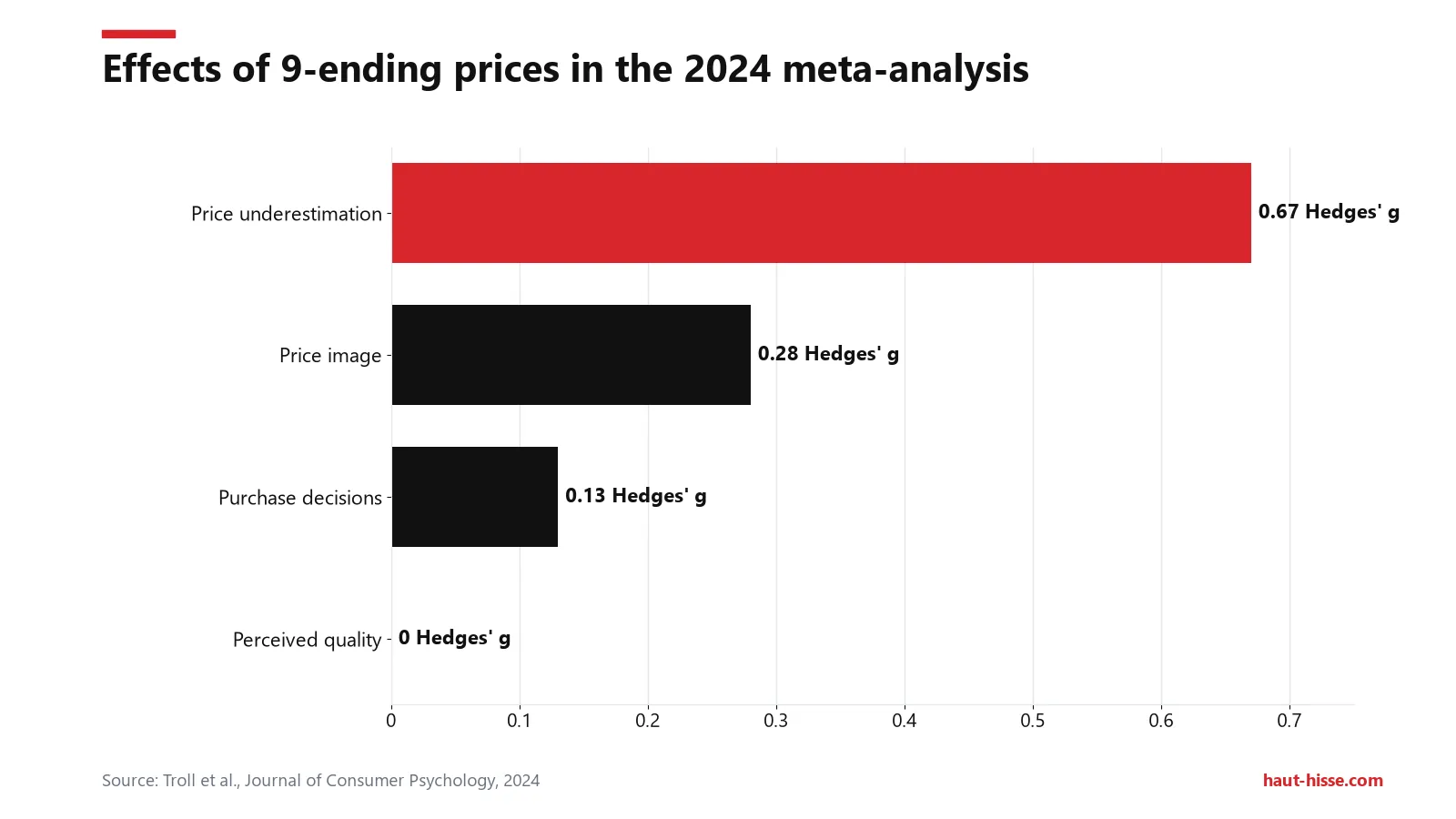
A pre-registered meta-analysis by Troll and co-authors published in 2024 in the Journal of Consumer Psychology compiled 69 studies (362 effect sizes, 40,541 participants) comparing “just-below” prices to round prices:
| Outcome measure | Effect size (Hedges’ g) | Confidence interval |
|---|---|---|
| Purchase decisions | g = 0.13 | 95%: 0.01 to 0.25 |
| Price image | g = 0.28 | 0.09 to 0.48 |
| Price underestimation | g = 0.67 | 0.04 to 1.30 (very wide) |
| Perceived quality | g = 0.00 | −0.17 to 0.18 |
Hedges’ g measures the standardized difference between two groups; a value of 0.13 represents a small effect.
The authors described the effects as small and highly heterogeneous. Their p-curve analyses revealed numerous non-significant findings, and publication bias corrections suggested true effect sizes are even smaller.
Several replication attempts mirror these conclusions:
- PLOS ONE (2022): An online experiment involving 4,788 lottery ticket purchase decisions across 266 participants found support for neither the left-digit effect nor round-price fluency.
- Data Colada (October 2020): A replication study evaluating a 2020 left-digit paper (original sample: 145 participants; replications: 1,099 and 1,555 participants) found an effect in the expected direction, but far smaller than originally reported. Detecting it reliably would require samples of 3,000 to 4,500 participants.
9-ending prices and quality perception: Bargain or cheap impression?
While 9-endings improve a store’s overall price image, their impact on perceived product quality depends on how quality is measured.
Explicit measures in Troll’s meta-analysis showed zero overall effect on perceived quality (g = 0.00). In contrast, Seitz and colleagues used implicit measures (IAT and GNAT tests) across four pre-registered laboratory experiments published in the Journal of Revenue and Pricing Management (February 28, 2026). They found strong implicit associations between 9-ending prices, lower perceived quality, and a discount-oriented price image—contrasting with meta-analytic findings using explicit ratings.
The bargain reputation of 9-endings has a clear commercial grounding. Snir and Levy noted that among discounted items, 9-ending prices are indeed lower. They suggest these items were initially cheaper before being raised without consumers taking notice.
When products are not on sale, regular 9-ending prices are actually higher than non-9 prices—by up to 18%, according to Snir and Levy (2019).
Round prices in luxury, sales, and upselling: The limits of 99-endings
Charm pricing reaches its limits in luxury goods, alongside discount cues, and during product upselling.
Round prices in luxury: “Compromise pricing”
In the Journal of Product & Brand Management (2022), Parguel, Fraccaro, and Macé identified a strategy called “compromise pricing.” Retailers set prices ending in 50 or 80—especially in the upper hundreds (such as €950 or €980)—rather than using 99-endings or perfectly round numbers. Their research combined a luxury watch experiment with sales data regressions from two online luxury fashion retailers.
The authors found that 50- and 80-endings reduce anticipated buyer guilt compared to round prices, while preserving a premium brand image better than 9-endings.
Sales: When discount tags reduce the 9-ending advantage
Prices ending in 9 are less effective when retailers explicitly add “Sale” markers, according to Anderson and Simester. Adding a discount sign reduces the additional impact of the missing cent.
Discount retailers can structure their business models around different principles; for instance, see how Costco makes money.
Upselling: The 2021 coffee study
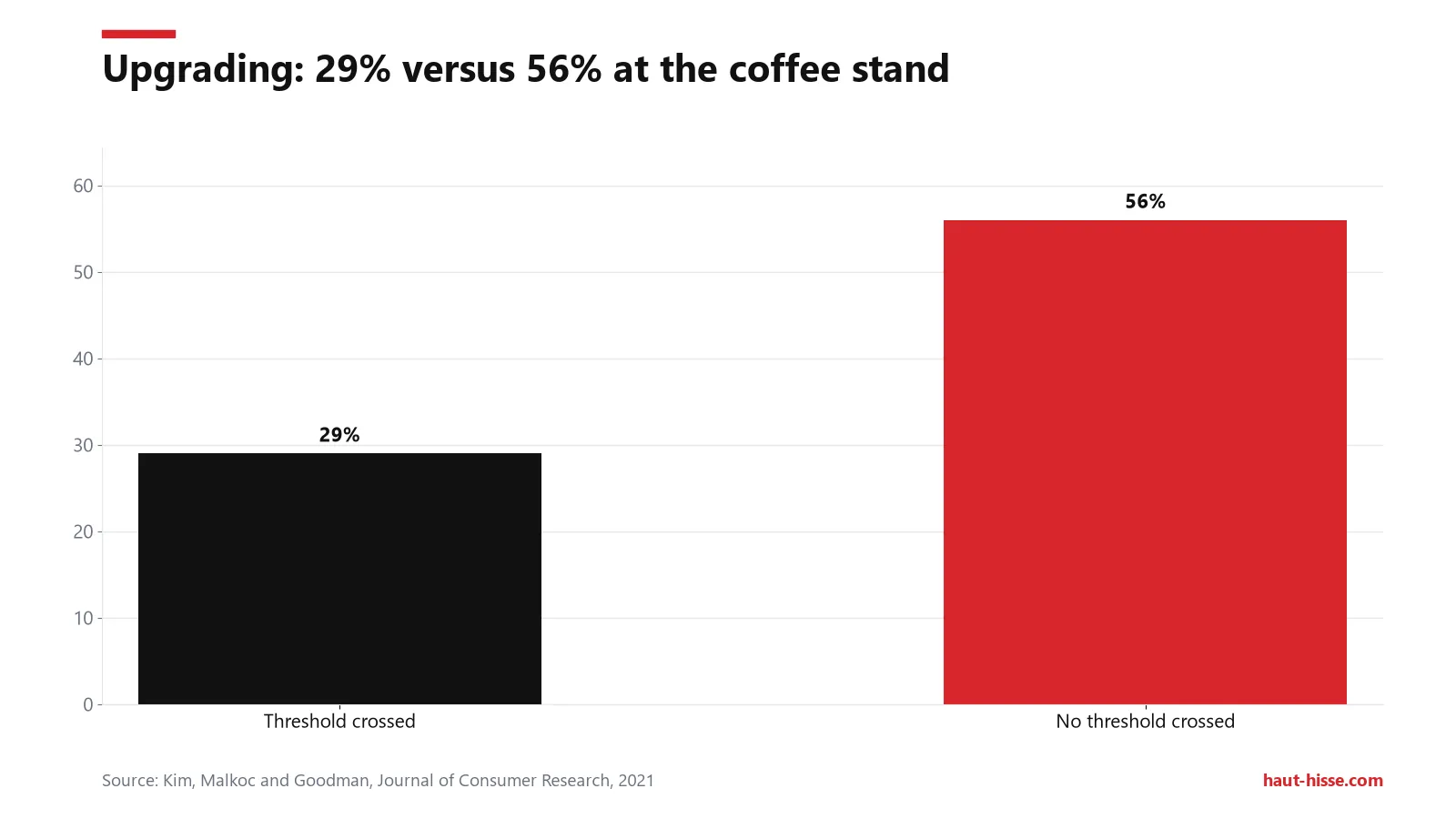
Setting an entry-level item’s price just below a round threshold can hurt sales of the larger or upgraded version. Kim, Malkoc, and Goodman demonstrated this in seven experiments reported by Ohio State University (August 26, 2021). At a campus coffee shop:
- When a small coffee cost $0.95 and a large cost $1.20, fewer than half of customers chose the large cup.
- When the small coffee was priced at $1.00 and the large at $1.25, a clear majority chose the large cup.
Although the price gap was identical ($0.25) in both scenarios, the first forced consumers to cross the $1.00 threshold when upgrading. Goodman noted that this backfire effect does not occur for minor price differences on expensive items or among consumers highly familiar with product pricing, such as frequent hotel bookers.
Historical origins and deceit claims: What the evidence shows
The popular story attributing 99-cent pricing to theft prevention at cash registers remains unverified.
According to retail lore attributed to early US department stores, odd pricing forced clerks to open the cash drawer to make change, preventing them from pocketing bills. Writing in The E-Sylum, a publication of the Numismatic Bibliomania Society (September 5, 2004), the editor noted that early cited examples “may well be urban legend” due to a lack of contemporary documentation.
Regarding consumer deception, the 2024 meta-analysis demonstrated that the net effect of charm pricing on purchase decisions is small. Meanwhile, Snir and Levy’s research showed that retailers sometimes raised 9-ending prices over time without consumers realizing it.
Practical tips: Reading a price without being led by the first digit
The following steps offer a practical framework for price evaluation based on the cited research:
- Read the cents portion of a price before focusing on the main dollar or euro figure.
- Compare full amounts down to the cent, particularly when prices cross round thresholds (e.g., $2.99 vs. $3.00).
- Check whether a promotional sign is present: research by Anderson and Simester indicates that 9-endings add little extra value when an item is already marked “Sale.”
Frequently asked questions
Why do prices end in 9?
Data collected by Levy and co-authors showed that 9 is the single most common ending digit in retail. Researchers attribute this prevalence primarily to left-to-right reading habits, which cause consumers to anchor on the first digit (see Schindler and Kirby, 1997).
When does 99-cent pricing fail?
It is less effective alongside “Sale” signs. The threshold effect also disappears for minor price differences on high-ticket items and among buyers familiar with standard market pricing. Additionally, pricing an entry-level item just under a round number can discourage customers from upgrading to a premium model.
What pricing structure do luxury brands prefer?
Parguel, Fraccaro, and Macé showed that luxury retailers frequently use prices ending in 50 or 80, particularly in upper-hundred ranges. These endings reduce buyer guilt compared to round prices while maintaining a higher brand positioning than 9-endings.
What does research say about prices ending in 9?
Field studies show that 9-endings can increase demand in specific scenarios, but a comprehensive 2024 meta-analysis rated the overall impact as small (g = 0.13) and highly variable across contexts.
Sources
- Left-Digit Bias in Used Car Auctions — NBER (2011)
- Penny Wise and Pound Foolish: The Left-Digit Effect in Price Cognition — Journal of Consumer Research (2005)
- Patterns of Rightmost Digits in Advertised Prices: An Examination of Nine-Ending Prices — Journal of Consumer Research (1997)
- Effects of $9 Price Endings on Retail Sales: Evidence from Field Experiments — Quantitative Marketing and Economics (2003)
- The Left-Digit Bias at Lyft — The Review of Economic Studies (2023)
- Strulov-Shlain study on left-digit bias — The Review of Economic Studies (2023)
- A Meta-Analysis on the Effects of Just-Below versus Round Prices — Journal of Consumer Psychology (2024)
- Investigating the Left-Digit and Rounding Effects on Financial Decision-Making — PLOS ONE (2022)
- Left-Digit Bias: A Very Large Replication — Data Colada (2020)
- Why 9-Ending Prices Are So Common — MPRA (2019)
- Price Rigidity and the 9-Ending Effect — Review of Economics and Statistics (2011)
- Ending Prices with 99 Can Backfire on Sellers — Ohio State University (2021)
- Implicit Evidence for Price-Ending Effects on Quality and Image Perceptions — Journal of Revenue and Pricing Management (2026)
- Compromise Pricing in the Luxury Sector — Journal of Product & Brand Management (2022)
- Psychological impact of prices ending in 99€ — WiziShop (2022)
Prepared with the help of AI tools, then fact-checked and edited by the Haut-Hisse editorial team.


