

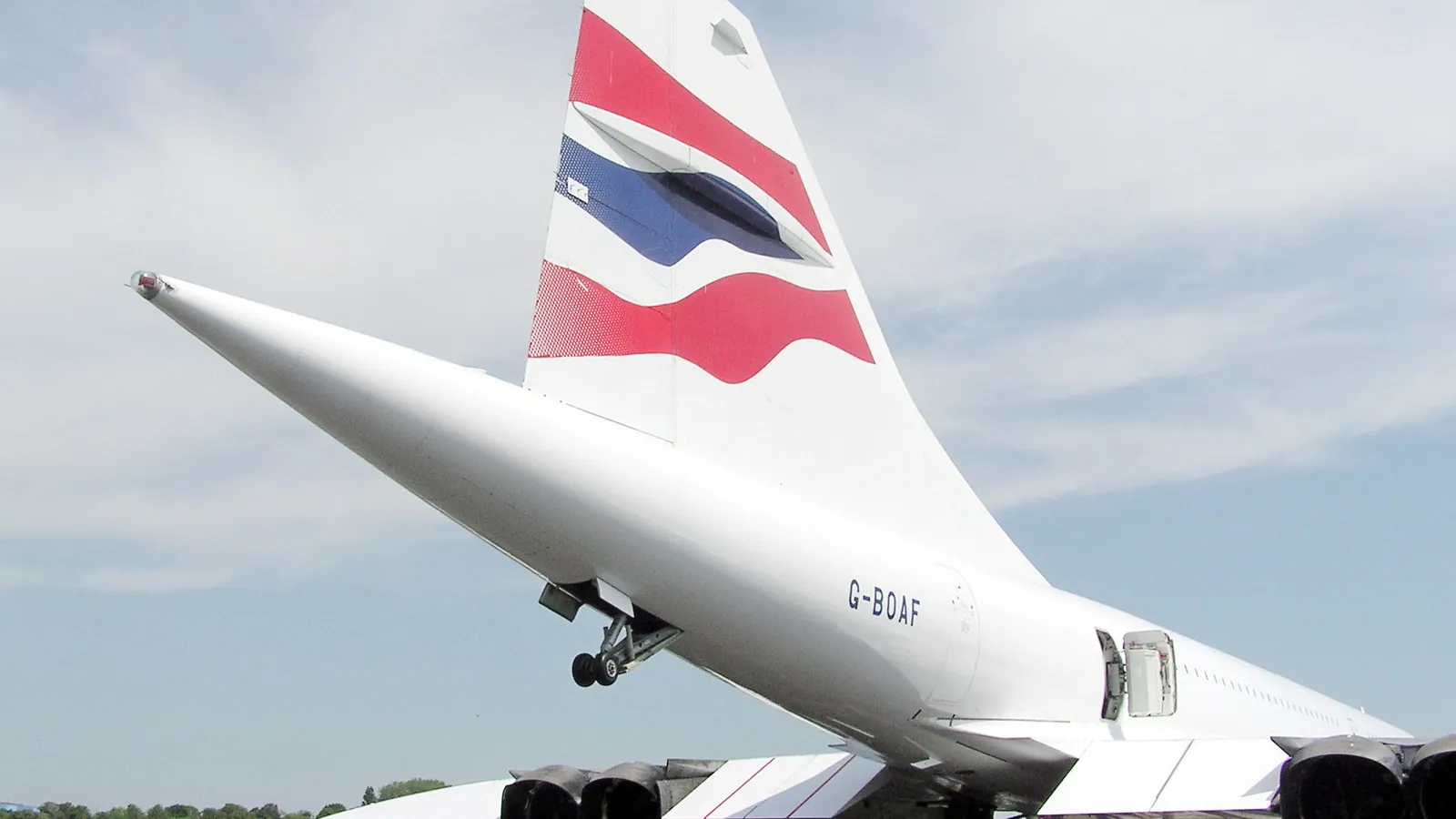
This is why Concorde stopped flying: a chain of causes, not a single event. The crash at Gonesse in 2000 forced the whole fleet to be grounded and led to costly modifications. Then falling revenue and rising maintenance costs pushed Air France and British Airways to announce its retirement on 10 April 2003.
Only sixteen production aircraft, for a programme estimated at around 13 billion euros: well before 25 July 2000, Concorde stood on fragile financial ground. That detail changes how its end should be read, since it is so often reduced to a single crash. The article follows the timeline from the accident to the 2001 modifications and the airlines’ finances, and compares the competing accounts of how much each cause weighed.
Key takeaways
- The Gonesse crash (25 July 2000, 113 deaths) started the chain, but it did not decide the grounding on its own.
- On 5 September 2001, the British and French authorities imposed seven modifications. Service resumed on 7 November 2001.
- On 10 April 2003, Air France and British Airways cited falling revenue and rising maintenance costs.
- Airbus, which held the airworthiness certificate, did not want to keep supporting the aircraft after October 2003. Accounts differ on how much weight that refusal carried.
Why Concorde stopped flying: a small fleet and an expensive program
Only 16 production aircraft were built. The program was very costly, and its business model was fragile even before the crash.
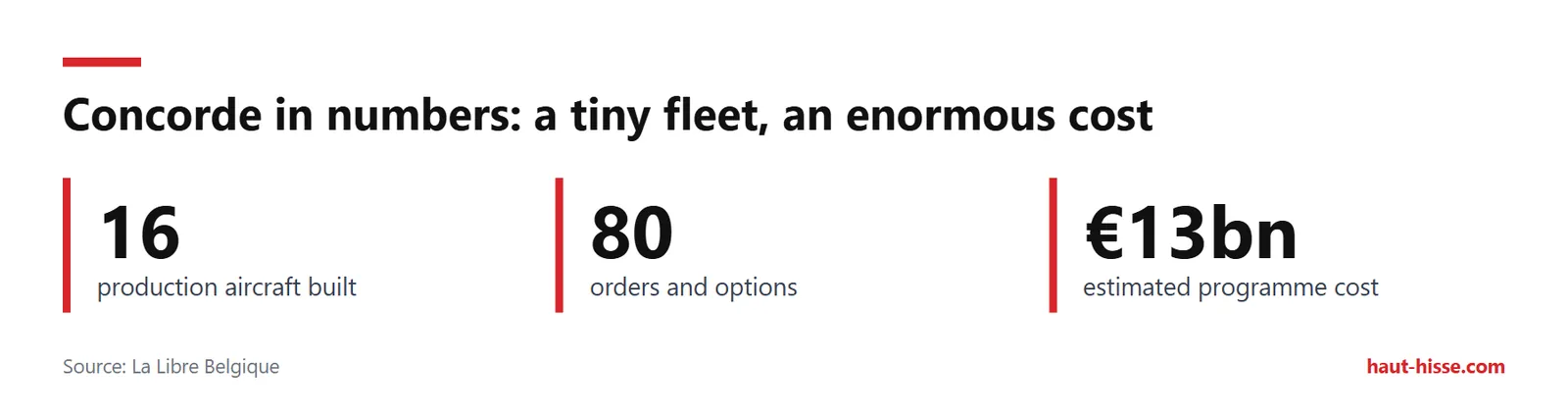
According to La Libre Belgique, the program looked like this:
| Item | Figure | Source |
|---|---|---|
| Production aircraft | 16 | La Libre Belgique |
| Prototypes and development aircraft | 2 prototypes and 2 development aircraft | La Libre Belgique |
| Orders and options | 80 aircraft | La Libre Belgique |
| Program cost | About €13 billion (€20 billion according to historian Claude-Alain Sarre) | La Libre Belgique |
The program’s cost is therefore estimated at about €13 billion, according to La Libre Belgique, for just 16 production aircraft.
The market closed early. According to L’Essentiel de l’Éco, Pan Am and TWA cancelled their options on 31 January 1973. On 27 March 1973, the Federal Aviation Administration (FAA), the US civil aviation authority, banned civil supersonic flights over US territory. The same outlet adds a “protectionist” reading. That interpretation has not been demonstrated and remains an opinion, not a fact.
The Gonesse crash in 2000: what happened?
On 25 July 2000, Air France’s Concorde F-BTSC, charter flight AFR 4590 to New York, crashed at Gonesse shortly after takeoff from Roissy-Charles-de-Gaulle.
The Bureau d’Enquêtes et d’Analyses (BEA), France’s agency for investigating air accidents, puts the death toll at 113: 100 passengers, 9 crew members and 4 people on the ground.
Authorities reacted quickly. According to a summary of the report published by Migflug Afterburner, a joint recommendation from the BEA and the Air Accidents Investigation Branch (AAIB), the British accident investigator, led to the suspension of the individual airworthiness certificates of all Concordes on 16 August 2000. That suspension grounded the entire fleet.
The table below gives the timeline for the day of the accident (local time), as summarized by Migflug Afterburner. V1 is the decision speed: beyond it, the takeoff is normally no longer aborted.
| Time | Event | Source |
|---|---|---|
| 16:42:31 | Start of takeoff roll | Migflug Afterburner (summary of BEA report) |
| 16:43:03.7 | V1 speed | Migflug Afterburner (summary of BEA report) |
| 16:43:13.4 | Fire alert transmitted by the tower | Migflug Afterburner (summary of BEA report) |
| 16:43:21.9 | Takeoff | Migflug Afterburner (summary of BEA report) |
| 16:44:31.6 | End of the cockpit voice recording | Migflug Afterburner (summary of BEA report) |
BEA report findings: the technical chain behind the accident
According to the BEA, a metal strip that fell onto the runway destroyed a tyre, and a piece of that tyre ruptured fuel tank 5. This is the technical cause of the accident, separate from the causes of Concorde’s retirement.
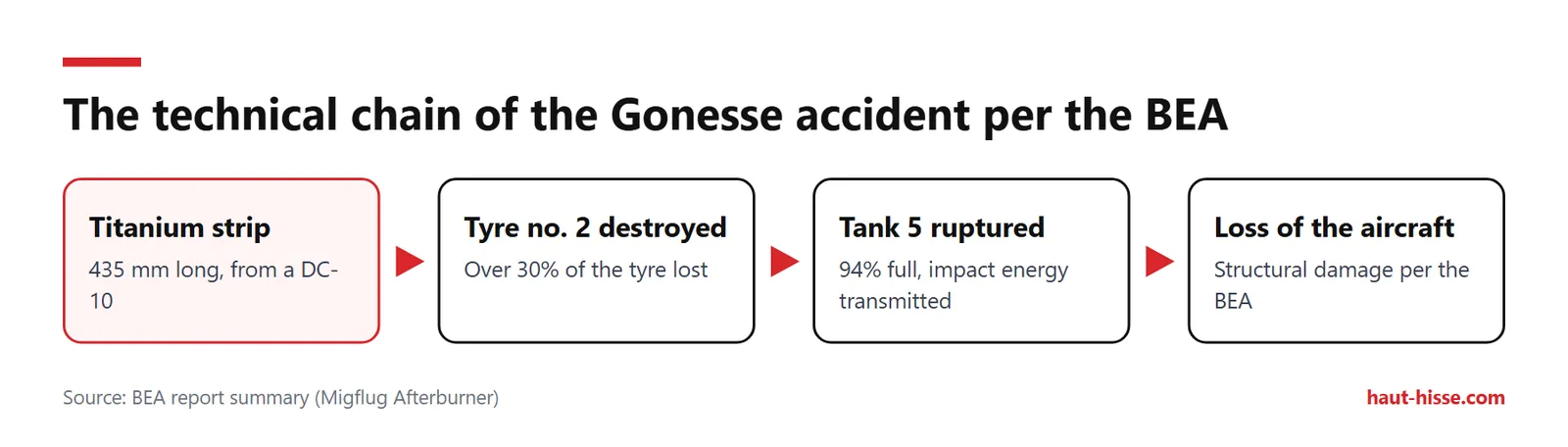
According to the summary of the report published by Migflug Afterburner, the chain unfolded as follows:
- A titanium strip from a Continental Airlines DC-10 remained on the runway. It measured 435 mm long, 29 to 34 mm wide and about 1.4 mm thick.
- Concorde’s No. 2 tyre was destroyed. More than 30% of the tyre was lost.
- A piece of tyre struck fuel tank 5, which was about 94% full. The BEA ruled out direct puncture: the tank ruptured because the impact energy was transmitted through the structure.
- According to the BEA, as cited by Migflug Afterburner, the structural damage to the aircraft would have led to its loss.
According to the same summary, the BEA also found that the strip had been neither manufactured nor installed in line with the manufacturer’s procedures.
One point remains disputed. Migflug Afterburner reports that the BEA considers the hydrodynamic pressure wave (a pressure wave in the fuel caused by the impact) a contributing factor only, and not sufficient on its own. The British accredited representative disagreed with this separation of mechanisms.
The BEA published five investigation documents:
| Date | Document |
|---|---|
| 1 September 2000 | Preliminary report |
| 15 December 2000 | First interim report |
| 23 July 2001 | Second interim report |
| 19 December 2001 | Final meeting of the inquiry commission |
| 16 January 2002 | Final report |
Courts later settled liability. In 2010, the Pontoise court sentenced Continental to a €200,000 fine and €1 million in damages. On 29 November 2012, the Versailles Court of Appeal acquitted the airline of criminal charges. However, it found Continental civilly liable and ordered it to pay Air France €1 million for damage to its image, based on the chain that began with the strip.
The final report in French is the authoritative version. For detailed conclusions and recommendations, see the BEA’s official report.
The 2001 safety modifications and the return to service in November 2001
On 5 September 2001, the UK Civil Aviation Authority (CAA) and France’s Direction générale de l’Aviation civile (DGAC) imposed seven modifications. Concorde resumed commercial service on 7 November 2001.
The CAA is Britain’s civil aviation regulator. The DGAC is its French counterpart. According to Heritage Concorde, they issued airworthiness directives that day. These are mandatory orders requiring a modification, sent to airlines and manufacturers. The seven measures were:
- a Kevlar (a very strong synthetic fibre) liner in the tanks;
- Michelin tyres with the NZG reference on the eight main wheels;
- shielding of the landing gear wiring;
- removal or reshaping of the water deflector, the part in front of the wheels that diverts water off the runway;
- a revised anti-skid procedure;
- tyre-deflation detection;
- cutting off the brake fans during takeoff and landing.
According to the same source, these measures were tested before the return to service:
| Date | Test or decision | Source |
|---|---|---|
| May 2001 | Testing of the NZG tyres on F-BTSD | Heritage Concorde |
| 16 July 2001 | Supersonic check flight of G-BOAF (British Airways), between Heathrow and the RAF base at Brize Norton | Heritage Concorde |
| 5 September 2001 | CAA and DGAC airworthiness directives | Heritage Concorde |
| 7 November 2001 | Resumption of commercial service | Futura-Sciences |
According to Air France, as quoted by Futura-Sciences, maintenance costs have risen “very sharply since the supersonic was returned to service.” This is the first economic link in the chain. The modifications made the aircraft safer, but operating it cost more.
The impact of September 11, falling business travel and maintenance costs
After the return to service, business travel declined and maintenance costs rose. Air France described an operation that had become loss-making.
The impact of September 11
Concorde returned to service in the aftermath of 11 September 2001, a period marked by weaker demand for premium travel. British Airways also cited a global drop in that demand to justify its withdrawal. The exact share of the attacks in this decline has not been quantified, and it would be misleading to assign them a specific portion.
Rising maintenance costs
According to Futura-Sciences, Air France says maintenance costs have risen “very sharply” since November 2001. The same source reports that the airline considered the operation to be “heavily and structurally loss-making.”
Falling business travel
According to Futura-Sciences, Air France also pointed to “a drop in business travel that particularly weighed on Concorde’s results.” Its chairman and CEO, Jean-Cyril Spinetta, judged that continuing operations was “unreasonable.”
Was Concorde profitable?
Not in its final years, according to the airlines. The available data are summarized below:
| Indicator | Figure | Source |
|---|---|---|
| Seats sold by British Airways before the 2003 announcement | A little under half | Heritage Concorde (citing The Times) |
| Seats sold by Air France before the 2003 announcement | About a fifth | Heritage Concorde (citing The Times) |
| BA cabin refurbishment during the grounding | £14 million | Heritage Concorde |
| Write-down booked by BA, year ended March 2003 | £84 million | Aerocorner |
| Maintenance needs estimated by Airbus over 2 to 5 years | £40 million | Heritage Concorde (citing The Times) |
For every ten seats offered, that works out to fewer than five sold at BA and two at Air France. BA had also pointed to the global fall in premium demand.
For a broader look at margins and fixed costs, another Haut-Hisse article explains Costco’s business model.
The 10 April 2003 announcement and Airbus’s role: who made the decision?
On 10 April 2003, Air France and British Airways announced the retirement of their Concordes. Airbus, which held the airworthiness certificate, did not want to keep supporting the aircraft beyond October 2003.
Both airlines gave the same reasons: falling passenger revenue and rising maintenance costs, according to Heritage Concorde. According to The Times, as cited by that source, Airbus refused to transfer the certificate and had estimated maintenance needs at £40 million over two to five years.
Accounts differ on who really made the decision. BA first presented it as a joint decision. Air France said it had been taken in close consultation with Airbus. BA’s chairman, Lord Marshall, told The Times that his airline would have preferred to continue if the French partner had shared the extra maintenance cost.
Two levels need to be kept apart. What is established: the joint announcement, the reasons given, and Airbus’s refusal as reported by the press. What belongs to analysis: the relative weight of each cause. The documents cited do not allow it to be measured precisely.
Concorde’s last flight dates
Air France flew its last service on 30 May 2003. British Airways flew its last paying flight on 24 October 2003, and G-BOAF flew for the last time on 26 November 2003.
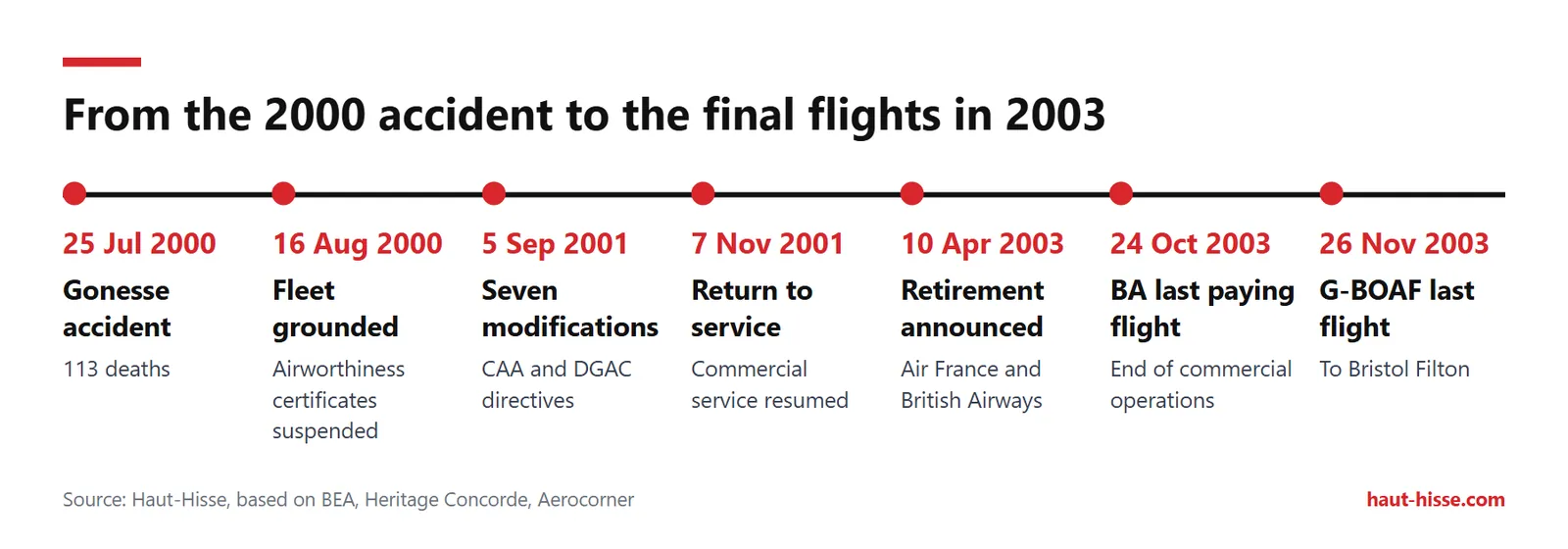
The operating dates rely on Aerocorner.
| Date | Event | Source |
|---|---|---|
| 10 April 2003 | Retirement announced by Air France and British Airways | Heritage Concorde |
| 30 May 2003 | Last Air France service | Aerocorner |
| 24 October 2003 | Last paying British Airways flight | Aerocorner |
| 26 November 2003 | Last flight of G-BOAF, to Bristol Filton | Aerocorner |
One discrepancy exists for Air France: its last flight was announced for 31 May, and sources vary between 30 and 31 May.
Did the crash cause the retirement? Disagreements over the main cause
The crash was the trigger for a chain of causes, but not the single explanation. Analyses differ on the weight of the accident, the economics and Airbus’s refusal.
The most defensible ranking follows chronological order:
- the technical cause of the accident, established by the BEA;
- the modifications imposed in 2001, which made operations more costly;
- the decline in profitability and business travel;
- the 2003 decision and Airbus’s refusal to support the aircraft.
A contrary view exists. L’Essentiel de l’Éco argues that the retirement was economically unavoidable, with a break-even point of about 130 sales according to the article. For this outlet, Airbus’s refusal to renew or transfer the certificate was decisive, and the accident was not the main cause. This is a media thesis, not an established fact.
Could Concorde have kept flying? BA said it wanted to continue if the costs were shared, while Airbus refused to support the aircraft after October 2003. Everything therefore depended on an agreement over the certificate and on funding maintenance.
Two questions should be kept apart: the cause of the accident (the strip, according to the BEA) and the causes of the retirement (costs, revenue, the certificate). On how prices and margins can obscure costs, see why prices end in 99.
Frequently asked questions
Why couldn’t Concorde fly over the United States?
The FAA banned civil supersonic flights over US territory on 27 March 1973, according to L’Essentiel de l’Éco. Concorde therefore could not fly at supersonic speed over US land. The “protectionist” reading of that decision has not been demonstrated.
How many Concordes were built?
Sixteen production Concordes were built, after 2 prototypes and 2 development aircraft, according to La Libre Belgique. The program had 80 orders and options. According to the same source, its cost is estimated at about €13 billion.
When was Concorde’s last commercial flight?
British Airways flew its last paying flight on 24 October 2003, according to Aerocorner. Air France ended its operations on 30 May 2003, a date some sources place on 31 May. G-BOAF flew for the last time on 26 November 2003.
Could Concorde fly again?
That would require overcoming the obstacles described above: an airworthiness certificate held by Airbus, which refused to transfer it in 2003, and high maintenance costs. Restoring an aircraft this complex would also require industrial backing.
Sources
- Accident to the Concorde registered F-BTSC operated by Air France — BEA (2002)
- Final report F-SC000725 — BEA (2002)
- Air France 4590: the Concorde crash at Gonesse — Migflug Afterburner (n.d.)
- CAA and DGAC modifications — Heritage Concorde (2001)
- Concorde retirement — Heritage Concorde (2003)
- Concorde: the end of a great adventure — Futura-Sciences (2003)
- Why did Concorde stop flying? — Aerocorner (n.d.)
- The beginning of a myth — La Libre Belgique (2003)
- The death of Concorde: twenty years of lying by omission — L’Essentiel de l’Éco (2026)
- Concorde crash: Continental Airlines acquitted but must pay compensation — Webmanagercenter (2012)
Prepared with the help of AI tools, then fact-checked and edited by the Haut-Hisse editorial team.


