


Published
The Fermi paradox is the tension between a galaxy of about 200 billion stars that should hold many civilizations and the silence we observe. Enrico Fermi’s question at Los Alamos in 1950 was “Where is everybody?” How much force it carries depends on how the Drake equation is calculated.
The same Drake calculation can return a mean of 27 million civilizations per galaxy and a median of 0.32, depending on how its uncertainty is handled. Tim Urban’s popular 2014 version, built on single guesses, lands near 100,000. Whether the silence counts as a paradox turns on which of those numbers you trust.
Key takeaways
- The Fermi paradox asks why we see no aliens when the galaxy is old and large enough for interstellar travel to have visited us already.
- Fermi’s remark followed a New Yorker cartoon about aliens stealing trash cans; no written record exists, so accounts differ.
- Drake’s equation multiplies seven factors, and the last ones (fl, fi, fc, L) are speculative.
- Sandberg, Drexler and Ord (2018) found a mean of 27 million civilizations per galaxy but a median of 0.32, so the paradox can dissolve.
- Breakthrough Listen’s 2019 search of 1,327 stars found no true technosignature, which rules out only very powerful transmitters nearby.
Contents
- What is the Fermi paradox in simple terms?
- What did Fermi actually say at Los Alamos in 1950?
- What is the Drake equation and which factors do we actually know?
- How many alien civilizations are in the Milky Way: 100,000, 27 million or 0.32?
- What is the solution to the Fermi paradox? The main explanations
- Has alien life been found? What the searches have turned up
- Frequently asked questions
What is the Fermi paradox in simple terms?
It is the gap between the expectation that intelligent life should be common and the fact that we have detected none. Interstellar travelers, if they exist, should already have visited us.
Gabriel Chardin, writing for the journal of CNRS (France’s national research organization) in 2015, put the numbers behind that expectation: the Milky Way holds about 200 billion stars, and exploring much of it would take less than a million years, about one ten-thousandth of the galaxy’s age. A civilization that set out at any point in that history would have had time to arrive.
Michael Hart turned the intuition into a formal argument in the Quarterly Journal of the Royal Astronomical Society. If extraterrestrials had colonized the galaxy, they would be here; they aren’t, so there are no other civilizations. Geoffrey Landis suggests “Fermi–Hart” as the more accurate name, since Hart’s paper carried the argument.
Behind the argument sits a multiplication: many stars, times some chance of life, times enough time. Each of those inputs is uncertain, and the “paradox” is only as strong as the product. A French-language explainer from ScienceEtonnante walks through the same question of whether we are alone in the universe.
The name credits Fermi, but what he actually said over lunch is murkier than the textbook version.
What did Fermi actually say at Los Alamos in 1950?
At lunch in the Fuller Lodge cafeteria in Los Alamos, Fermi reportedly asked “Where is everybody?” after a New Yorker cartoon about aliens stealing trash cans.
Fermi was at the table with Teller, Konopinski and York, and Alan Dunn’s cartoon is dated May 20, 1950. Nobody wrote the exchange down, so the line survives in two forms: Teller’s “Where is everybody?” and Konopinski’s “Don’t you ever wonder where everybody is?” Eric Jones’s 1985 inquiry suggests the conversation did happen.
The line is often read as a general puzzle about silence. Three people present later reported something narrower: Fermi was talking about interstellar travel. If aliens exist and can fly between the stars, they should have visited us already. Fermi never published on the subject and died four years later.
The label came after him. David Viewing stated the paradox explicitly in 1975, Hart published his paper the same year, and Carl Sagan named it the “Fermi paradox” in 1976.
Two questions follow from that gap. What do the numbers actually say? And has anyone really listened for an answer? Fermi gave no calculation; Drake supplied one eleven years later, and its inputs vary wildly in quality.
What is the Drake equation and which factors do we actually know?
Frank Drake presented N = R* × fp × ne × fl × fi × fc × L in 1961 at a meeting in Green Bank, West Virginia, to estimate the number of civilizations currently emitting detectable signals in the Milky Way. Carl Sagan was among those present. Only the first factors are measured.
The seven factors run from the easiest to the hardest to constrain:
| Factor | What it stands for | How well it is known |
|---|---|---|
| R* and fp | Rate of star formation; fraction of stars with planets | Known with some certainty |
| ne | Planets per star that could support life | Uncertain, now estimated from Kepler data |
| fl | Fraction of those planets where life appears | Speculative |
| fi | Fraction where life becomes intelligent | Speculative |
| fc | Fraction that produce detectable signals | Speculative |
| L | How long a civilization keeps emitting | “Purely speculative” |
The planet factors improved because of a telescope. Kepler launched on March 6, 2009, and was retired on October 30, 2018, leaving more than 2,600 confirmed planets outside the solar system. NASA says it showed that the sky holds more planets than stars, which strengthens fp.
For ne, the most recent figure comes from Bryson and colleagues. In a study NASA announced on October 29, 2020, about 50% of Sun-like stars could host a rocky planet (0.5 to 1.5 Earth radii) in the habitable zone under the conservative estimate, and about 75% under the optimistic one. The paper in The Astronomical Journal (2021) gives 0.37–0.60 such planets per Sun-like star with the conservative habitable zone and 0.58–0.88 with the optimistic one.
Those are extrapolations. Kepler observed about a quarter of one percent of the sky, and lead author Steve Bryson calls the result “far from a final value.” So even the best-measured planetary factor comes as a range, not a point.
Jill Tarter described the equation as “a wonderful way to organize our ignorance.” It cannot account for possibilities nobody has considered, such as life very different from Earth’s. Later extensions add the cost and duration of interstellar travel (Dyson), the sites where life can arise (Brin) and a refinement of fl (Fogg).
With ne now given an observational value, the guesses that remain (life, intelligence, lifetime) decide everything, and two famous calculations treat them differently.
How many alien civilizations are in the Milky Way: 100,000, 27 million or 0.32?
It depends on how uncertainty is handled. Tim Urban’s point-value cascade gives about 100,000; Sandberg, Drexler and Ord’s ranges give a mean of 27 million but a median of 0.32.
On May 21, 2014, Urban’s Wait But Why post started from 100 to 400 billion stars in the Milky Way and reached about 1 billion Earth-like planets under his assumptions. He then applied 1% for life and 1% for intelligence. Those rates are his own assumptions, not measurements. With the low star estimate the arithmetic is 1 billion × 1% × 1% = about 100,000 intelligent civilizations. Against that number, silence is a real puzzle.
Four years later, Anders Sandberg, Eric Drexler and Toby Ord of the Future of Humanity Institute at Oxford argued on arXiv (submitted June 6, 2018) that the paradox comes from using point estimates in the Drake equation. With uncertainties spanning “multiple orders of magnitude,” they find a substantial prior probability that no other intelligent life exists in the observable universe.
Their ranges include R from 1 to 100, fp and ne from 0.1 to 1, fi from 0.001 to 1, fc from 0.01 to 1, and L from 100 to 10 billion years, the last one log-uniform. When the lifetime alone spans eight orders of magnitude, a few extreme draws dominate the average. The result is a mean of 27 million civilizations per galaxy but a median of 0.32*.
“the median is now only 0.32 – less than one civilization per galaxy like our own.” — Sandberg, Drexler and Ord (2018)
The table compiles the same calculation under three treatments, plus the authors’ odds of being alone.
| Calculation | Result | Basis |
|---|---|---|
| Urban, 2014, point values | About 100,000 | 1 billion Earth-like planets × 1% life × 1% intelligence |
| Sandberg et al., 2018, mean | 27 million per galaxy | Uncertainty ranges; pulled up by extreme values |
| Sandberg et al., 2018, median | 0.32 per galaxy | Same ranges; the typical outcome is under one civilization |
| Chance we are alone in the Milky Way | 52% before, 53% to 99.6% after | Before and after accounting for the lack of observation |
| Chance we are alone in the observable universe | 38% before, 39% to 85% after | Same two steps |
The treatment changes the nature of the gap with silence. Under point values, the question is where 100,000 civilizations went. Under ranges, a typical draw produces none, and the large mean comes from rare, enormous outcomes. The authors add a caution: this does not prove we are alone, only that it would be very plausible.
If the silence may be expected, the next question is what to make of the other explanations, since one of them predicts something worse for us.
What is the solution to the Fermi paradox? The main explanations
There is no accepted solution. Stephen Webb cataloged about 50 in 2002, in three families: “they are here,” “they exist but haven’t communicated,” and “they don’t exist.” David Brin had listed 24 in 1985, John Ball proposed the zoo hypothesis in 1973, and Frank Tipler made his argument in 1981.
The most discussed framing is the Great Filter. In 1996, Robin Hanson wrote that the observed silence implies “a great filter between death and expanding lasting life” (his page also carries the date 1998). He lists nine steps, from “the right star system” through RNA, the prokaryote cell, the eukaryote cell, sexual reproduction, multicellular life and big-brained animals, to “where we are now” and a “colonization explosion.” The filter could sit at any of them. The question is where we stand relative to it.
That is where the news gets uncomfortable. A common hope is that finding alien life would be good news. Hanson argues the opposite:
“The easier it was for life to evolve to our stage, the bleaker our future chances probably are.” — Robin Hanson (1996)
If life arises easily, the filter is more likely ahead of us. Hanson also holds that the Great Silence forces a revision of at least one standard view in biology, astronomy, physics or social science. He finds social explanations, such as a common zoo, implausible because they would require near-universal coordination.
Geoffrey Landis offers an explanation that needs neither a filter nor coordination. His percolation model (JBIS 51, 1998) assumes a maximum distance over which direct interstellar colonization is feasible. Voids of uncolonized systems can then remain even when colonization is widespread, so silence does not imply absence.
Chardin’s preferred answer, which he calls the most probable explanation, is that civilizations destroy themselves before reaching interstellar travel, with life acting as an accelerator of instability. That is his opinion, not a finding. Two other popular ideas, the dark forest and the rare Earth hypothesis, are addressed in the FAQ below.
These explanations can’t all be tested, but part of the question can: we can listen.
Has alien life been found? What the searches have turned up
No. Breakthrough Listen’s June 18, 2019 study of 1,327 nearby stars found no true technosignature, only human interference. That is about 80% of its 1,702-star sample. Tens of millions of signals were narrowed to a handful, all human-generated.
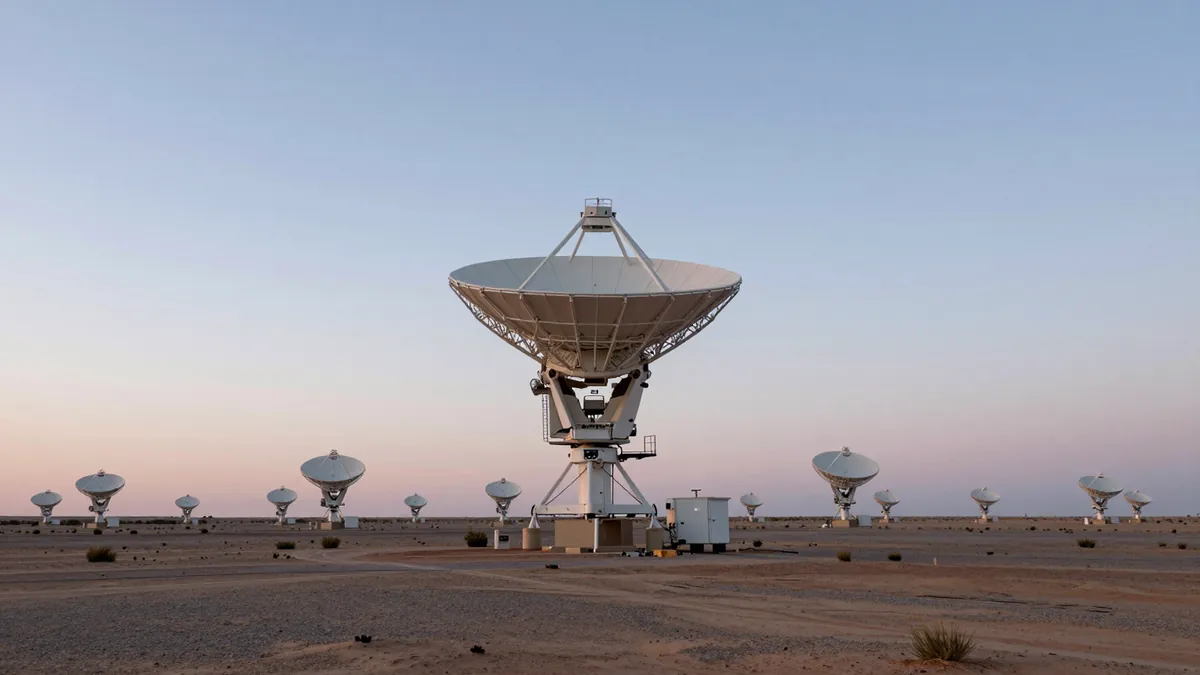
The paper by Price and colleagues gives the breakdown: 1,138 stars observed at Green Bank and 189 at Parkes, between 1.10 and 3.45 GHz, over three years. After removing events that looked terrestrial, no candidate signals remained. The sensitivity sets upper limits on transmitter power of about 2×10¹² W at Green Bank and 9×10¹² W at Parkes. The authors describe it as the most comprehensive technosignature search in that band to date, as of 2019. The silence rules out only very powerful transmitters in that neighborhood and band.
The project is aiming much further. Breakthrough Listen targets the million nearest stars, and its instruments could detect a 100 W laser, the energy of a normal household bulb, from 25 trillion miles away. They could also pick up a common airplane radar from one of the 1,000 nearest stars. The first data release (DR1) holds about 219 TB of data products, and the open archive reached almost 1 petabyte in 2019.
The best-known anomaly predates all of this. The “Wow!” signal reached the Big Ear radio telescope at Ohio State University on August 15, 1977. It lasted 72 seconds, was narrowband and appeared in only 1 of 50 channels. Jerry Ehman spotted it on a printout a few days later and wrote “Wow!” beside it. It never repeated despite follow-up searches. A recent paper proposes a magnetar flare interacting with a cold hydrogen cloud, but a single unrepeated event cannot support an extraterrestrial origin.
Kurzgesagt’s video “The Fermi Paradox — Where Are All The Aliens?” gives a visual summary of the puzzle these searches are testing.
The silence is thin evidence so far, which leaves open how people reason well from so little data: how do you reason from fragile estimates to decisions when each guess feeds the next one?
Frequently asked questions
Was the Fermi paradox solved?
No. There is no accepted solution, only a long catalog of proposals. Sandberg, Drexler and Ord argue the paradox may dissolve once uncertainty is treated with ranges instead of point estimates, but they stress that this does not prove we are alone.
Is the dark forest theory true?
It is a speculative proposal, not an established result. Nothing in the searches to date tests it, and it competes with explanations such as the Great Filter, the zoo hypothesis and Landis’s percolation model.
Did AI solve the Fermi paradox?
Nothing established says so. The missing inputs are still the odds of life, of intelligence and the lifetime of civilizations (fl, fi, fc, L), which no instrument has measured. The latest large radio search found no technosignature.
Why is intelligent life so rare?
It isn’t established that it is. Sandberg, Drexler and Ord’s ranges give a median below one civilization per galaxy like ours, and Hanson’s Great Filter places a hard step somewhere between dead matter and expanding life, either behind us or ahead of us.
What is the most likely reason for the Fermi paradox?
There is no consensus. Chardin favors self-destruction before interstellar travel, as an opinion. Sandberg, Drexler and Ord suggest the silence may simply be expected once uncertainty is counted. Hanson’s filter says the answer depends on where we sit relative to it.
How these articles are prepared: our editorial policy

