



Second-order thinking means asking not just what a decision produces immediately, but what it triggers down the line, across other people and over time. Contrasting with reflexive first-order reactions, it helps spot unintended consequences and perverse effects before they become costly to reverse.
A policy can deliver its immediate intended outcome while completely failing its broader purpose. That direct result may be accurate, but it reveals nothing about how people will alter their behavior in response to a new rule, subsidy, or tax. The following analysis defines the concept, connects it to the sociology of perverse effects, reviews real-world case studies, and outlines a four-question framework alongside its practical limits.
Key takeaways
- Second-order thinking examines the consequences of consequences by factoring in time and the reactions of other actors.
- Investor Howard Marks calls it “second-level thinking,” building on Robert K. Merton’s 1936 foundational work on unintended consequences.
- Real-world cases, from automotive diesel subsidies to colonial Hanoi’s rat bounty, illustrate how well-intentioned interventions can backfire.
- A four-question framework with fixed time limits helps prevent analysis paralysis during complex evaluations.
What is second-order thinking?
Second-order thinking is the ability to evaluate a problem beyond its immediate effects, following outcomes through to second-, third-, and nth-order consequences. Investor Howard Marks describes this approach as “second-level thinking.”
Farnam Street, a platform focused on mental models, defines it as thinking through a problem to second, third, and nth orders of consequences. The site cites Marks, who argues that first-level thinking is “simplistic and superficial, and just about everyone can do it.”
It functions as a mental model—a conceptual lens for decision-making rather than a patented system or formalized procedure. Nor is it related to positive thinking: optimism describes an attitude, whereas consequence analysis evaluates what will actually occur. For instance, reviewing Napoleon Hill’s concepts around positive thinking helps separate personal mindset from rigorous analytical evaluation.
First-order vs. second-order thinking: what is the difference?
First-order thinking is fast and addresses only the immediate issue at hand. Second-order thinking is deliberate: it accounts for interactions among participants and the compounding effects of time, as outlined by Farnam Street.
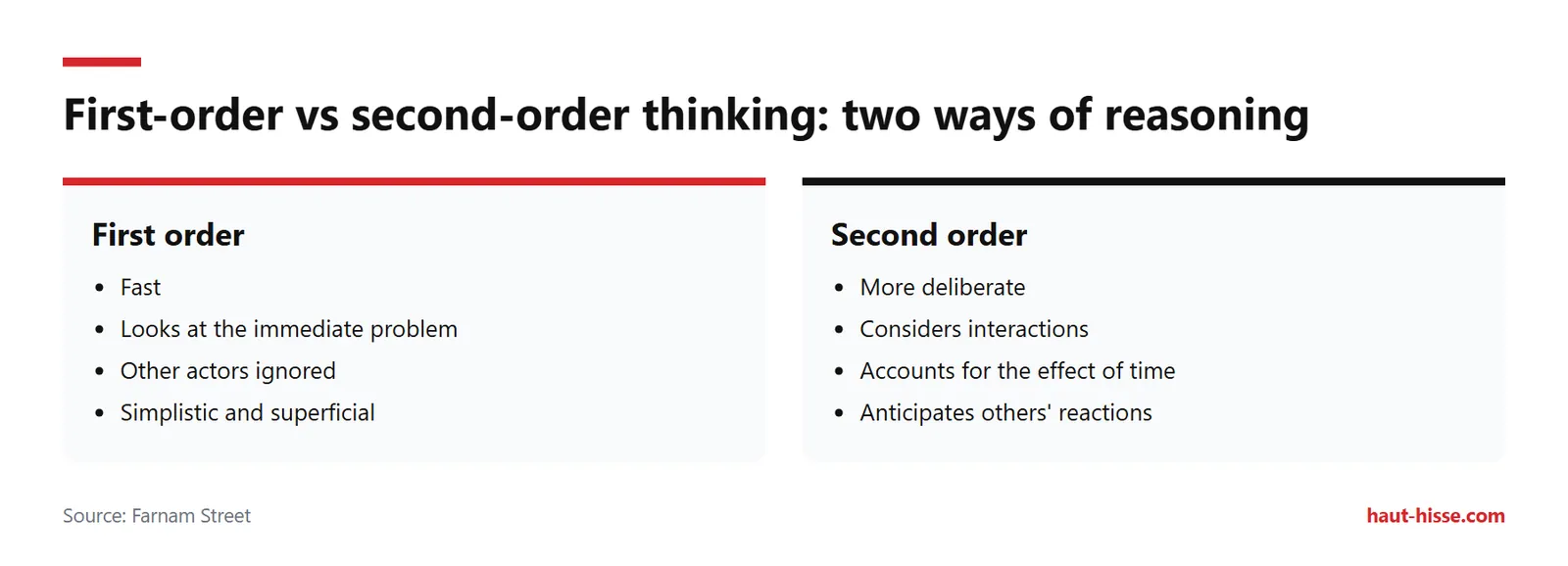
The table below contrasts both approaches across four core dimensions.
| Dimension | First-order thinking | Second-order thinking |
|---|---|---|
| Time horizon | Immediate outcome | Medium- and long-term aftermath |
| Core question | “What happens right away?” | “And then, what does that trigger?” |
| Other actors | Ignored or assumed passive | Anticipates how others will adapt |
| Speed | Nearly instantaneous | Slower, requires sustained attention |
Farnam Street illustrates this through a geopolitical example: a nation that funds and arms rebel factions to force regime change may watch those same groups gain power and fight against their benefactor for decades. The first-order effect (weakening the regime) succeeded, but the second-order effect (creating a permanent adversary) went unexamined.
Second-order thinking is not universally better for every scenario. It demands time and focus, both of which are finite. Farnam Street notes that many favorable outcomes require absorbing an immediate upfront cost. Because few people look that far ahead, there is less competition around choices that offer delayed payoffs.
Second-order consequences: from Merton to perverse incentives
American sociologist Robert K. Merton formalized the study of unintended consequences in 1936. Perverse effects represent a distinct subset within this dynamic.
Merton and unintended consequences
Merton published “The Unanticipated Consequences of Purposive Social Action” in the American Sociological Review (Vol. 1, No. 6, 1936, pp. 894–904). This paper is widely recognized as foundational: deliberate action taken toward a specific goal frequently produces secondary effects its author never planned.
An unintended consequence can be neutral, positive, or negative. A renovated neighborhood inadvertently drawing unanticipated local businesses is a familiar example. This distinction matters because second-order thinking is not simply pessimism; it searches for blind spots regardless of outcome valence.
Perverse effects in sociology: Boudon’s model
A perverse effect occurs when an initiative generates results directly opposed to its primary objective. A measure begins with good intentions, participants adapt their behavior, and the systemic outcome runs contrary to the original goal. This concept offers a qualitative framework rather than a mathematical formula.
Every perverse effect is an unintended consequence, but not every unintended consequence is perverse. French sociologist Raymond Boudon demonstrated that perverse effects stem from aggregated rational behavior: each individual acts logically on their own behalf, yet the cumulative total of these self-interested choices yields an unwanted collective result.
Why decisions favor short-term effects
Immediate outcomes are concrete and emotionally satisfying, whereas long-term developments require deliberate imagination. First-order thinking stops at the visible horizon.
The underlying behavioral mechanism prioritizes what is near, concrete, and certain. Incurring an immediate cost today for an uncertain, distant reward is psychologically difficult, even when the underlying calculation favors it. Farnam Street identifies an advantage here: individuals willing to accept this trade-off encounter far fewer competitors.
Retail practices such as “99” pricing leverage this preference for immediate perception: the leading digit carries disproportionate cognitive weight, as outlined in the analysis of why prices end in 99.
Three distinct levels must be separated. The preference for immediacy is an empirically established bias. Its connection to any single specific decision remains correlational. Meanwhile, the colloquial claim that “people never think long-term” is merely an informal generalization. Hyperbolic discounting—the tendency to sharply discount future gains relative to the present—drives much of this short-term bias: the further away a cost or benefit lies, the less weight it holds during decision-making.
Examples of perverse incentives: diesel, green subsidies, and Hanoi rats
Several documented cases demonstrate policies that functioned as intended in the first order, only to fail in the second: automotive dieselization, ecological vehicle subsidies, and colonial Hanoi’s rat bounty.
| Case | First-order effect | Second-order effect |
|---|---|---|
| Dieselization | Favorable tax rates direct consumer purchases | A single engine type dominates the national fleet |
| Green bonus-malus | Subsidies incentivize electric vehicle sales | Deadweight effect, increasing net costs to public finances |
| Hanoi rats | A cash reward paid per killed rat | Suspected fraud; incentivized proof over actual eradication |
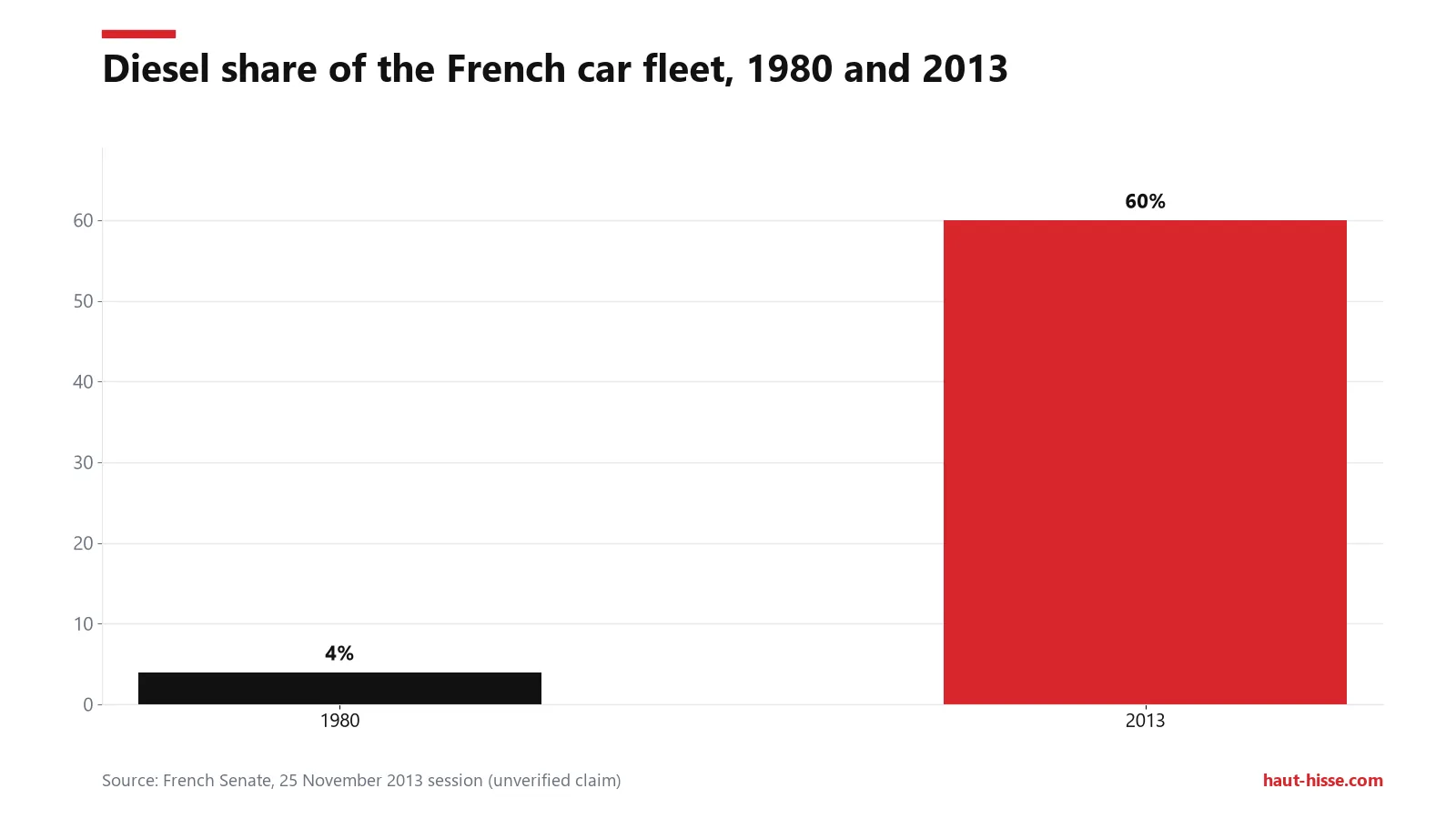
Dieselization. During a session in the French Senate on November 25, 2013, a senator stated that diesel’s share of private cars grew from 4% in 1980 to 60%, and reached 70% among new registrations. She calculated diesel’s tax advantage over gasoline at roughly 30%. While derived from legislative debate rather than an independent audit, the underlying mechanism was clear: preferential tax treatment shifted purchasing patterns heavily toward a single engine technology.
The ecological bonus-malus. Operating in France since 2008, this system subsidizes cleaner vehicles while taxing higher-emission models. According to the Institut des politiques publiques (IPP, a French public policy institute) in its June 2026 Budget Outlook, approximately 80% of electric vehicle buyers in 2022 and 2023 would have completed their purchase without the subsidy. This demonstrates a windfall or deadweight effect: public funds subsidize purchases that would have occurred anyway.
The same IPP study highlights that wealthier households purchase the highest volume of electric vehicles and exhibit the lowest price sensitivity to the subsidy. Behavioral changes occur predominantly among low- and middle-income demographics, prompting the researchers to recommend targeting subsidies strictly toward lower-income households. Spillover effects on energy taxes also drove net public expenditure well beyond the headline budget.
The Hanoi rats. In 1902, French colonial administrators offered a 1 cent bounty for every rat killed, requiring the tail as proof of elimination. Tailless rats were soon spotted alive in the city, suggesting residents caught rats, severed the tails for cash, and released them to reproduce, based on research by historian Michael G. Vann (a 2003 paper and 2019 book) reported by Wikipedia. The policy inadvertently rewarded physical proof rather than overall eradication.
The cobra effect: the Delhi legend and historical evidence
German economist Horst Siebert coined the phrase “cobra effect” in his 2001 German book Der Kobra-Effekt. It describes an incentive that aggravates the exact condition it was designed to fix. Yet the historical anecdote behind the term—involving colonial cobra breeders in Delhi—is disputed.
According to the same Wikipedia source, a 2025 inquiry by the Friends of Snakes Society found no colonial records documenting cobra farming operations in British India. The narrative appears to originate from an 1873 newspaper article that framed the story with “it was alleged.” Furthermore, an 1887 Bombay Natural History Society report characterized breeding captive cobras as “highly improbable.”
These case studies illustrate a mechanism. They do not demonstrate that the original policy was fundamentally ill-conceived: an initiative can produce disappointing second-order consequences while still remaining defensible relative to the cost of complete inaction.
Applying second-order thinking: a 4-question framework
Four sequential questions help test a decision before implementation: who reacts, what follows, across what timeframe, and how to verify outcomes afterward. This sequence reflects an editorial synthesis drawn from Farnam Street, rather than a validated clinical methodology.
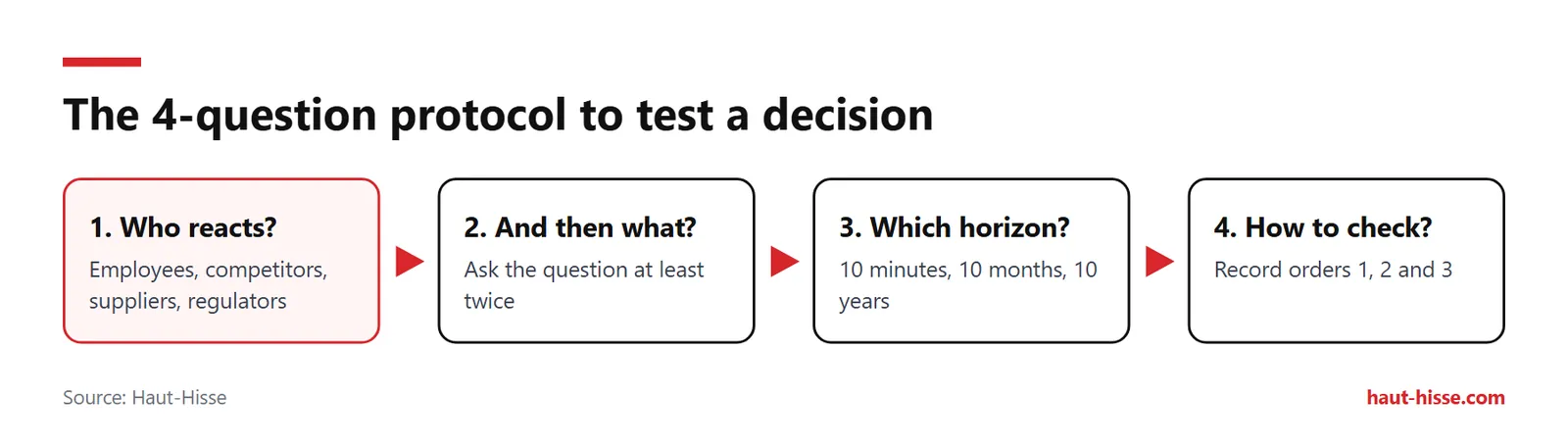
- Who will react? For an organizational decision, map the external ecosystem first: employees, competitors, suppliers, and regulators. Outline what each party stands to gain or lose, and how they might respond.
- And then what? Ask “and then what?” at least twice regarding the primary intended outcome. If the immediate answer is “sales will increase,” determine how competitors will adjust, and how customers will subsequently respond.
- Over what timeframe? Assess consequences across 10 minutes, 10 months, and 10 years. An outcome that appears positive across a 10-minute horizon can turn negative at 10 months.
- How will you check? Document anticipated first-, second-, and third-order consequences in writing, and review them at regular intervals. Comparing original expectations against real outcomes refines analytical judgment over time.
Consider an analogy with vehicle subsidies: before rolling out a discount or incentive, identify who directly captures the value. If most beneficiaries planned to purchase regardless, the initiative incurs high expenditures for minimal incremental change. Question 1 identifies this deadweight risk before capital is deployed.
Limits of second-order thinking and analysis paralysis
Second-order thinking cannot forecast the future with certainty. Beyond two or three tiers, compounding variables introduce significant noise, and excessive evaluation can quickly stall execution.
- Uncertainty multiplies with each order. Any third-order projection is an unproven hypothesis and must be handled as such.
- Analysis paralysis occurs when searching for a pristine decision devoid of trade-offs, rather than selecting an acceptable path forward. Two practical constraints prevent this: establishing strict time boundaries (such as a one-hour limit for a team review) and defining an impact threshold below which secondary reviews are skipped entirely.
| Decision type | Appropriate approach |
|---|---|
| Reversible and low-cost | Move fast, observe results, adjust |
| Irreversible or high-stakes | Work through the 4 questions within a fixed time box |
| Moderate impact | Evaluate questions 1 and 2 only |
Misapplication also arises from unverified narratives. Citing the Delhi cobra story as proof of perverse incentives relies on an entertaining yet contested myth. Verified, documented case studies—such as the EV subsidy deadweight loss—offer firmer ground for analysis.
Maintaining a written log of expected outcomes (orders 1, 2, and 3) serves to recalibrate forecasts rather than generate endless speculative scenarios. The direct effect of this framework on decision quality has not been evaluated in controlled empirical studies.
Frequently asked questions
Who coined the term second-order thinking?
There is no single identified inventor. Investor Howard Marks coined the term “second-level thinking,” while Farnam Street popularized the concept as second-order thinking. In academic sociology, Robert K. Merton analyzed the unintended consequences of purposive action as early as 1936.
Which mental models help improve decision-making?
Second-order thinking pairs effectively with the framework of reversible versus irreversible decisions, along with stakeholder mapping. Framework selection depends on the stakes: low-impact decisions require little deliberation, while the four-question framework is best reserved for consequential, high-commitment choices.
Is second-order thinking an established concept?
Yes, as a mental model: it describes an analytical reasoning method rather than a measurable psychological phenomenon. The real-world consequences it attempts to anticipate—such as subsidy deadweight losses—are thoroughly documented, although the framework’s direct impact on decision accuracy lacks formal empirical verification.
How do you avoid analysis paralysis when making a decision?
Establish a strict time limit before starting and determine clear impact criteria. For reversible decisions, take immediate action and adjust based on feedback. For high-stakes choices, restrict projections to two layers of consequences, document your core assumptions, and commit to a choice when the deadline arrives.
Sources
- Second-Order Thinking — Farnam Street
- The Unanticipated Consequences of Purposive Social Action, American Sociological Review — Robert K. Merton (1936)
- Perspectives budgétaires, chapitre 4 — Institut des politiques publiques (2026)
- Compte rendu de la séance du 25 novembre 2013 — Sénat (2013)
- Perverse incentive — Wikipedia (2025)
Prepared with the help of AI tools, then fact-checked and edited by the Haut-Hisse editorial team.


