




Published · Updated
Learning how to discipline your life is less about strengthening willpower than about designing an environment where the right behavior is the easiest option. That means reducing friction, automating repetitive decisions and setting “if…then” rules. This approach saves mental energy and works as well for daily life as it does for your budget.
Knowing how to discipline your life isn’t enough to actually do it. In the June 2023 OECD/Banque de France survey (the OECD is the Organisation for Economic Co-operation and Development, and the Banque de France is France’s central bank), 76% of French people say they track their finances, yet 37% have been overdrawn in the past 12 months, and only 45% set long-term financial goals. This guide looks at the limits of willpower, choice architecture, if-then plans, automatic saving, how long a habit really takes, getting back on track after a false start, and what a budget doesn’t cover.
Key takeaways
- People with high self-control rely more on habits than on one-off effort, according to Galla and Duckworth (2015).
- Forming a habit takes about 66 days on average, with predicted ranges of 18 to 254 days, according to Lally et al. (2010).
- An if-then rule has a medium-to-large effect on goal attainment, according to a 2006 meta-analysis.
- Over-indebtedness is mostly explained by unexpected life events, according to the Banque de France: a budget doesn’t protect you from everything.
How do you discipline yourself when willpower alone isn’t enough?
Willpower alone is a fragile foundation. Disciplined people rely more on habits, and the image of willpower as a tank that empties has been weakened by a large-scale replication. Two mechanisms help explain these difficulties: the excessive weight given to one-off effort, and present bias.

The limits of willpower alone
Galla and Duckworth ran six studies with 2,274 participants (2015). Their conclusion: good self-control comes from beneficial habits rather than from voluntarily resisting one-off temptations. Disciplined people don’t fight harder. They put themselves in situations where they have less to fight.
The size of this result needs context:
- the correlations are modest: r = 0.31 between self-control and the automaticity of study habits, and r = 0.33 for meditation;
- they don’t prove causation;
- they rely on participants’ self-reports.
“Ego depletion” refers to the idea that self-control draws on a limited resource that runs down over the course of the day. What the replication found:
- The test: a preregistered replication across 23 labs (N = 2,141);
- The result: an almost zero effect (d = 0.04);
- The scope: it tested a standardized protocol, not the original task;
- The conclusion: the reservoir model is weakened, but the value of habits is not called into question.
Present bias: why effort and saving get postponed
Present bias means overweighting an immediate reward compared with one that arrives later. O’Donoghue and Rabin (1999), in the American Economic Review, show that “naive” agents procrastinate on activities with an immediate cost, such as saving or sorting out their accounts, and act too early on activities whose reward is immediate.
Recognizing your bias reduces procrastination, according to the same authors, but it can increase premature actions on immediate pleasures. Knowing you’re impatient doesn’t protect you from an impulse purchase today. That’s why external rules and systems work better than good resolutions.
The same OECD/Banque de France survey also points to a persistent short-term orientation: spending rather than saving. These trade-offs have knock-on effects, which our article on the second-order effects of our decisions explains.
One popular belief is worth setting aside: “writing down your goals increases your chances of success by 42%.” A French self-discipline article repeats this claim, for example, but it rests on weak evidence. Better not to rely on it, any more than on the positive-thinking formulas covered in our article on Napoleon Hill’s secrets of positive thinking.
Choice architecture and friction: how to make good behavior easy
Choice architecture means organizing the decision environment so the option you want takes the least effort. Friction is the extra effort added to an action, which reduces how often you take it.
The mechanism rests on inertia: faced with a choice, the default option often wins. Richard Thaler sums this up in the Chicago Booth Review: if an employee has to return a form by mail, participation drops. A single extra step is enough to discourage some people.
Madrian and Shea provide an example. Their study (QJE, 2001) looks at a large US employer that switched from voluntary enrollment (opt-in) to automatic enrollment (opt-out) in a 401(k) plan, a US workplace retirement savings scheme. Economic conditions didn’t change, and participation rose markedly.
Defaults have their limits, though. Many new employees kept the default rate and allocation, which may not suit them. A default is a lever, not a guarantee, and this US context does not transfer directly to French products.
The mechanism works in both directions. Some examples, with no figures attached:
- add friction to unwanted behavior: remove saved cards from shopping sites, delete shopping apps, log out after each session;
- remove friction from good behavior: schedule a transfer, lay out your workout clothes the night before.
Impulse spending exploits the same logic. Prices ending in 99 are a classic example: our article on why prices end in 99 breaks down this decision trap.
On r/getdisciplined, andrewranzinger suggests making the action “stupid easy” and repeating it every day.
If-then plans: what is an implementation intention?
An implementation intention is an “if this situation, then this behavior” plan that specifies when, where and how to act. A 2006 meta-analysis gives it a medium-to-large average effect on goal attainment.
This meta-analysis, by Gollwitzer and Sheeran (Advances in Experimental Social Psychology, 94 independent tests), proposes two mechanisms:
- the opportunity to act becomes more mentally accessible: you notice it;
- the goal-directed response is automated: you no longer have to deliberate when the moment comes.
That said, don’t latch onto a single figure. A more recent meta-analysis (Sheeran, Listrom and Gollwitzer, 2025; 642 tests) reports effects ranging from d = 0.27 to d = 0.66, depending on the type of outcome: cognitive, affective or behavioral.
How to write an if-then rule
A good rule has three parts:
- A precise trigger: an observable event, not a vague intention (“when my salary lands,” rather than “as soon as possible”).
- A tiny action: a step that takes less than two minutes.
- A place or time: the setting in which the step happens.
Two examples, presented as illustrations rather than thresholds validated by a study:
- “If my salary is paid, then I set up the transfer to savings that same day.”
- “If I’m tempted by an unplanned purchase, then I wait for a delay I set in advance before adding it to my basket.”
Vague plans (“I’ll pay more attention”) fail because no specific moment triggers them. This also answers the question of discipline without motivation: the rule triggers the action without waiting for the urge. The “if” does the work that motivation wouldn’t.
In his video “How to Be Effortlessly Disciplined: 5 Mindset Shifts”, Ali Abdaal presents five research-based methods, including implementation intentions, rather than raw willpower.
Automating savings: how to save every month without thinking about it
Automating savings means turning a costly monthly decision into a one-time setting. Save More Tomorrow experiments and commitment accounts show large effects, with context-specific limits.
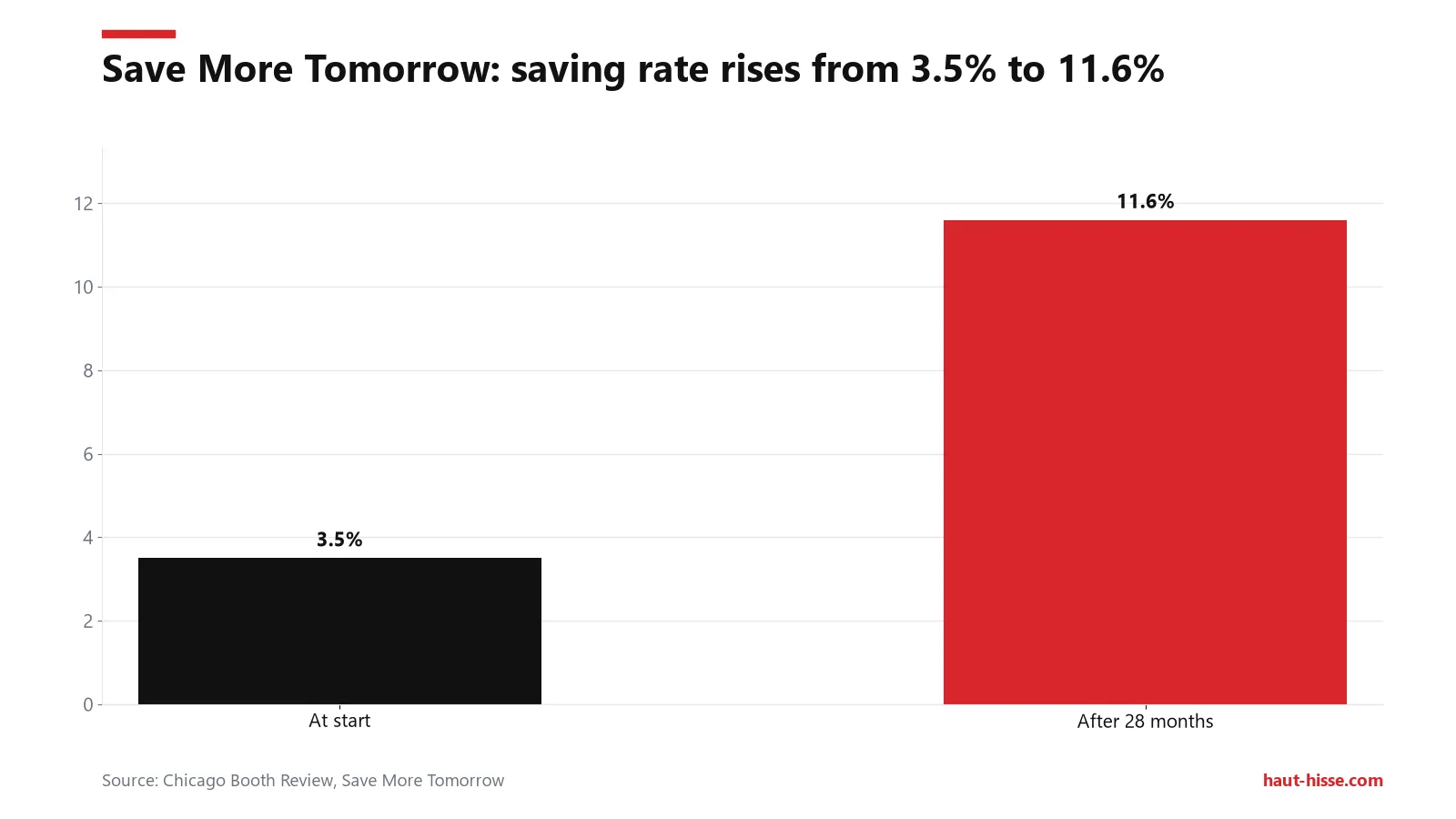
In the Save More Tomorrow (SMarT) program, designed by Thaler and Benartzi, savings rate increases are scheduled in advance and coincide with pay rises. According to Thaler in the Chicago Booth Review, the first increase came about three months after the offer was made. Employees never see their take-home pay fall.
According to the Chicago Booth Review (2004), the first implementation (1998, a mid-sized manufacturing company) produced these results:
- Average savings rate: from 3.5% to 11.6% in 28 months;
- Enrollment: of 207 employees who refused an immediate 5% effort, 162 (78%) joined the gradual program;
- Retention: 98% stayed after two pay rises and 80% after three.
A commitment account, which restricts withdrawals, was tested in the Philippines. In the Ashraf, Karlan and Yin (2006) study:
- 202 of 710 invited clients (28.4%) opened the account;
- after twelve months, balances in the treatment group had risen by 81 percentage points more than in the control group.
The table below compares the levers and their limits.
| Lever | What the study shows | Limit |
|---|---|---|
| Default enrollment (Madrian and Shea) | Participation rose markedly with automatic enrollment | Many keep the default rate and allocation; US context |
| Scheduled increases tied to pay rises (SMarT) | Net rise in average savings rate over 28 months | A single company in the first implementation |
| Commitment account (Ashraf et al.) | Strong rise in balances in the group invited to open the account | Fewer than 3 in 10 clients accept; Philippine context |
| If-then transfer plan | Applies the implementation-intention mechanism | Application example, with no measurement of its own |
These results don’t transfer mechanically to a French employee, and nothing guarantees a gain. Locking money away can also hurt liquidity: you may not be able to access it when you need it. The principle that transfers, without personalized advice, is that savings work better when they’re deducted before you see them. Compare this with your own friction: how many steps separate your salary from your savings today?
How long does it take to build a habit?
There is no fixed duration. In the reference study by Lally et al. (2010), maximum automaticity was reached on average in about 66 days, with predicted ranges of 18 to 254 days.
Per the British Psychological Society’s summary, 96 volunteers repeated a daily behavior and 82 completed the 84 days of follow-up. The article appeared in the European Journal of Social Psychology, 40(6), 998-1009.
This study does not support the myth of 21 or 30 days. The 254-day figure is a projection: the study lasted only 84 days, and about half the participants had not reached a sufficient automaticity score by the end.
Two other findings are useful:
- a single missed day had no notable effect, whereas many repeated misses reduced the maximum automaticity reached;
- physical exercise took about 1.5 times as long to plateau as eating or drinking habits.
Limitation: automaticity was self-reported.
A few simple routines help anchor a habit:
- attach the new action to an existing cue (your morning coffee, coming home from work);
- make it tiny at the start;
- repeat it in the same context.
In practice, plan for a margin of several months rather than judging yourself against a 21-day timeline.
How do you discipline your budget day to day, step by step?
A disciplined budget rests on simple expense tracking, automatic rules and a regular check-in. Tracking alone isn’t enough, as French surveys show.
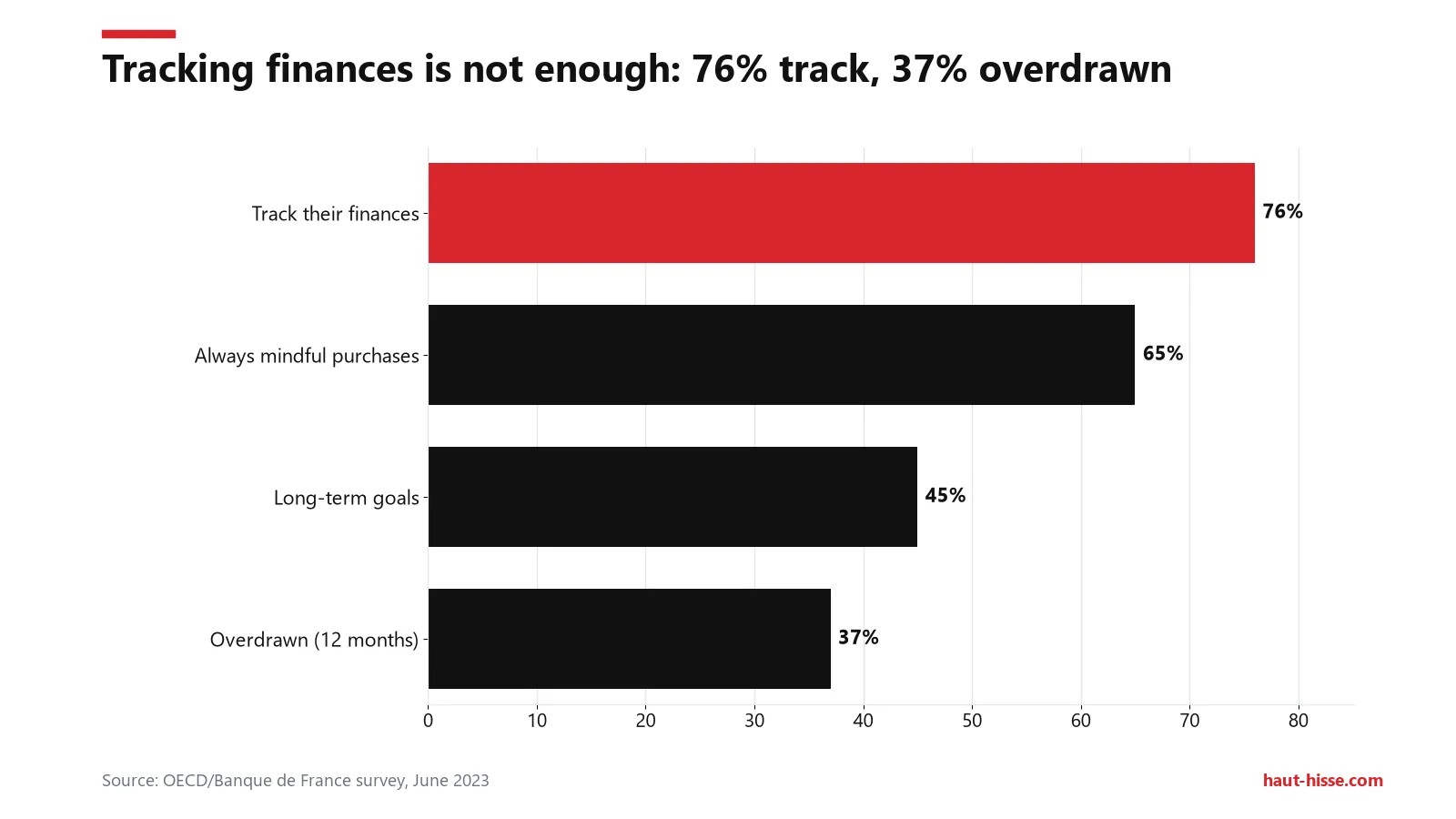
Conducted with about 2,200 adults, the June 2023 OECD/Banque de France survey paints a mixed picture:
| What adults reported (June 2023) | Share |
|---|---|
| Track their finances | 76% |
| Say their purchases are always thought through | 65% |
| Have been overdrawn in the past 12 months | 37% |
| Have struggled to make ends meet at the end of the month | 39% |
| Could not cover an unexpected expense equal to one month’s income without borrowing or help | 25% |
| Put money into a livret, a French regulated savings account, in the past 12 months | 51% |
France’s financial literacy score is 12.45/20, placing it 14th out of 39 OECD countries.
Here is a sequence of steps that applies the mechanisms covered above:
- Track your spending for one to three months, without judging it.
- Sort your spending into fixed costs, variable costs and wants.
- Schedule savings transfers for payday, so the money is set aside before you see it.
- Add an if-then rule against impulse buying, such as the waiting period mentioned above.
- Remove the payment friction that makes spending easy, such as saved cards.
- Set a short, regular budget check-in on a fixed date.
So if you want to stop overspending, the answer lies in the mechanism (friction, delay, automation) rather than in a specific amount or product. The right savings level depends on your situation, and these studies don’t point to a universal threshold.
How do you get back on track after a setback or false start?
An isolated setback changes little in the long run. It’s repeated misses that erode a habit. That’s why a no-guilt recovery plan is useful, one that draws on the fresh start effect.

The data from Lally et al. support this: missing one opportunity has no notable effect on habit formation, whereas many misses reduce maximum automaticity. A false start is therefore not a failure, as long as it doesn’t repeat indefinitely.
The fresh start effect refers to the rise in motivation after a temporal landmark. Dai, Milkman and Riis (Management Science, 2014) show that three indicators rise after the start of a week, a month or a year, or after a birthday:
- gym attendance;
- Google searches for “diet”;
- goal commitments.
One limitation: this effect describes a rise in motivation, not a guarantee of persistence. The Penn Today article (2018), in which Katherine Milkman describes the concept as heightened motivation after socially significant dates, doesn’t give any figures either.
A relapse plan has three steps:
- spot the trigger without judgment (fatigue, a trip, a tight month-end);
- cut the behavior down to its minimal version;
- schedule the restart for the next landmark, such as Monday or the start of the month.
You can turn this into an if-then rule: “If I skip two days, then I restart at the smallest step the next day.” When motivation drops, the rule and automation take over, so there’s no need to wait for the urge to return.
Emergency savings and life shocks: what a disciplined budget can’t fix
A well-kept budget doesn’t protect you from life shocks. According to the Banque de France, over-indebtedness is mostly caused by unexpected events (job loss, separation, illness), not by budget management alone.
In its over-indebtedness typology, the Banque de France sets out the following picture for 2025:
| Indicator (mainland France, 2025) | Value |
|---|---|
| Over-indebtedness applications filed | 148,013 (+9.8% year on year) |
| Share of first-time applications | about 66% |
| Total debt of affected households | about €5 billion (+11.1%) |
| Share of consumer credit in that debt | 44% |
| Over-indebted people living below the poverty line | 62% |
For households in general, the 2023 OECD/Banque de France survey points the same way: 25% of adults could not cover an unexpected expense equal to one month’s income without borrowing or getting help.
The message is not about blame. A cash reserve matters, but discipline has structural limits: low income, bad luck and changes in circumstances. Disciplining yourself doesn’t replace a safety margin, and lacking one doesn’t prove a character flaw.
The automation described above can also feed this reserve: a transfer scheduled for payday follows the same logic. No return is promised, and investments carry risks, including the risk of losing capital. The right amount for an emergency fund depends on each person’s situation and can’t be set by a general rule.
Frequently asked questions
What’s the difference between motivation and discipline?
Motivation is the urge to act, and it varies with mood and circumstances. Discipline is the ability to act despite that variation. It relies less on repeated effort than on habits, rules and an environment that makes action simple.
How do you stay disciplined when you have no motivation?
Separate the action from the urge. An if-then rule triggers the action at a specific moment, whatever your state of mind. Making the action tiny, such as two minutes, reduces the starting effort and lowers the risk of putting it off.
How do you reduce impulse spending?
Add friction between the urge and the payment: remove saved cards, delete shopping apps, and set a waiting period before you check out. Each extra step gives the urge time to fade.
How do you stay disciplined every day without burning out?
Limit the number of decisions you have to make. Automate what repeats (transfers, reminders), set if-then rules and make good actions easy to access. Your effort then goes into setting up the system, not into each day.
How these articles are prepared: our editorial policy

