


Published
ChapsVision will replace Palantir at the DGSI, France’s domestic intelligence service, for processing large volumes of data, Prime Minister Sébastien Lecornu announced on June 16, 2026. Palantir responds that its contract remains “fully in force,” according to Euronews. The transition timetable has not been made public.
What Palantir actually does fits in one sentence: this American company sells software that connects an organization’s internal databases so it can analyze them and make decisions. According to its annual report, it generated $4.5 billion in revenue in 2025, with 54% from governments and 46% from businesses.
Between 2023 and 2025, Palantir’s net income rose more than sevenfold, according to the same report. Yet the company is still described in loose terms, from “surveillance giant” to artificial intelligence startup.
Key takeaways
- Palantir makes data integration and analysis software and presents itself as a data processing contractor, not a supplier of mass surveillance tools.
- In 2025, the public sector made up more than half of revenue, and the United States nearly three-quarters.
- GAAP net income rose more than sevenfold between 2023 and 2025.
- The DGSI contract was renewed through 2028, then Matignon (the prime minister’s office) announced its replacement by the French firm ChapsVision.
2003: Palantir is founded with backing from a CIA-linked fund
Origins and founders
Palantir was founded in 2003, notably by Alex Karp and Peter Thiel, with help from a fund linked to the CIA. Its name comes from the “seeing stone” in The Lord of the Rings, according to franceinfo, the French public news outlet. Alex Karp is its CEO, according to franceinfo.
Funding from In-Q-Tel (CIA)
According to Wikipedia, initial funding included In-Q-Tel, the CIA-linked fund, for about $2 million, and Founders Fund for about $30 million.
These origins explain part of the suspicion, but not the business model. To separate the label from the reality, it helps to focus on the concrete effects of an activity, as our article on second-order thinking suggests.
2016: the DGSI picks Palantir after the November 2015 attacks
The DGSI has used Palantir since 2016, after the November 2015 attacks. Its contract was then renewed in 2019 and 2022, according to franceinfo. This first French contract durably embedded the company in domestic intelligence.

2020: The IPO and the question of what Palantir actually does
Palantir listed on the New York Stock Exchange (NYSE, ticker PLTR) in September 2020 through a partial IPO, according to Wikipedia. What the company sells is, however, less mysterious than its reputation: software that connects databases.
Definition: what is Palantir?
Palantir Technologies is an American software company specializing in data integration and analysis for governments and businesses. It sells platforms, not data.
How the software works
Palantir makes platforms that plug into a client’s existing systems, link them together in an Ontology, and then let users analyze and act. The cliché of a company that “sees everything” does not describe this mechanism.
In its 10-K, Palantir presents Foundry as its platform for data management, business logic, analytics and workflows (automated task chains). The Ontology is the layer that models the objects specific to the client’s activity and their relationships, on top of databases that remain separate. Software of this kind is “middleware”: it sits between systems that do not talk to each other.
Day to day, an organization pulls data from separate systems together, queries it, and then triggers decisions or processes from this unified view. Palantir describes itself as a data processing contractor that does not supply mass surveillance tools, according to RTS, the Swiss public broadcaster. This position is contested, as discussed below.
On the r/PLTR forum, a thread titled “What is Palantir? (Part 1 DD)” brings together users who explain how the software sits on top of existing systems.
2023: AIP joins Gotham, Foundry and Apollo
AIP, the generative artificial intelligence platform, was first deployed in 2023 and complements Gotham (defense and intelligence), Foundry (data and workflows) and Apollo (updates). The table below summarizes the four products described in the 2025 10-K.

| Product | Use | Main customers | Source |
|---|---|---|---|
| Gotham | Near-real-time situational awareness to support operational decisions | Defense and intelligence | 10-K |
| Foundry | Data management, logic, Ontology, analytics, workflows | All commercial customers, many public-sector customers | 10-K |
| Apollo | Continuous delivery: updates, security patches, configurations | Deploys Gotham and Foundry | 10-K, Wikipedia |
| AIP | Connecting third-party language models, building AI agents | First deployed in 2023 | 10-K |
The difference between Gotham and Foundry therefore lies in the audience. Foundry manages databases for organizations and companies. Gotham cross-references varied data for defense and intelligence, including, according to franceinfo, biometric data, social media conversations, phone calls and satellite images. This list comes from the press, not from the annual report.
Foundry succeeded Metropolis, an older company product, according to Wikipedia. Apollo, for its part, delivers the other two platforms into client environments.
Does Palantir mostly sell to governments? A revenue breakdown
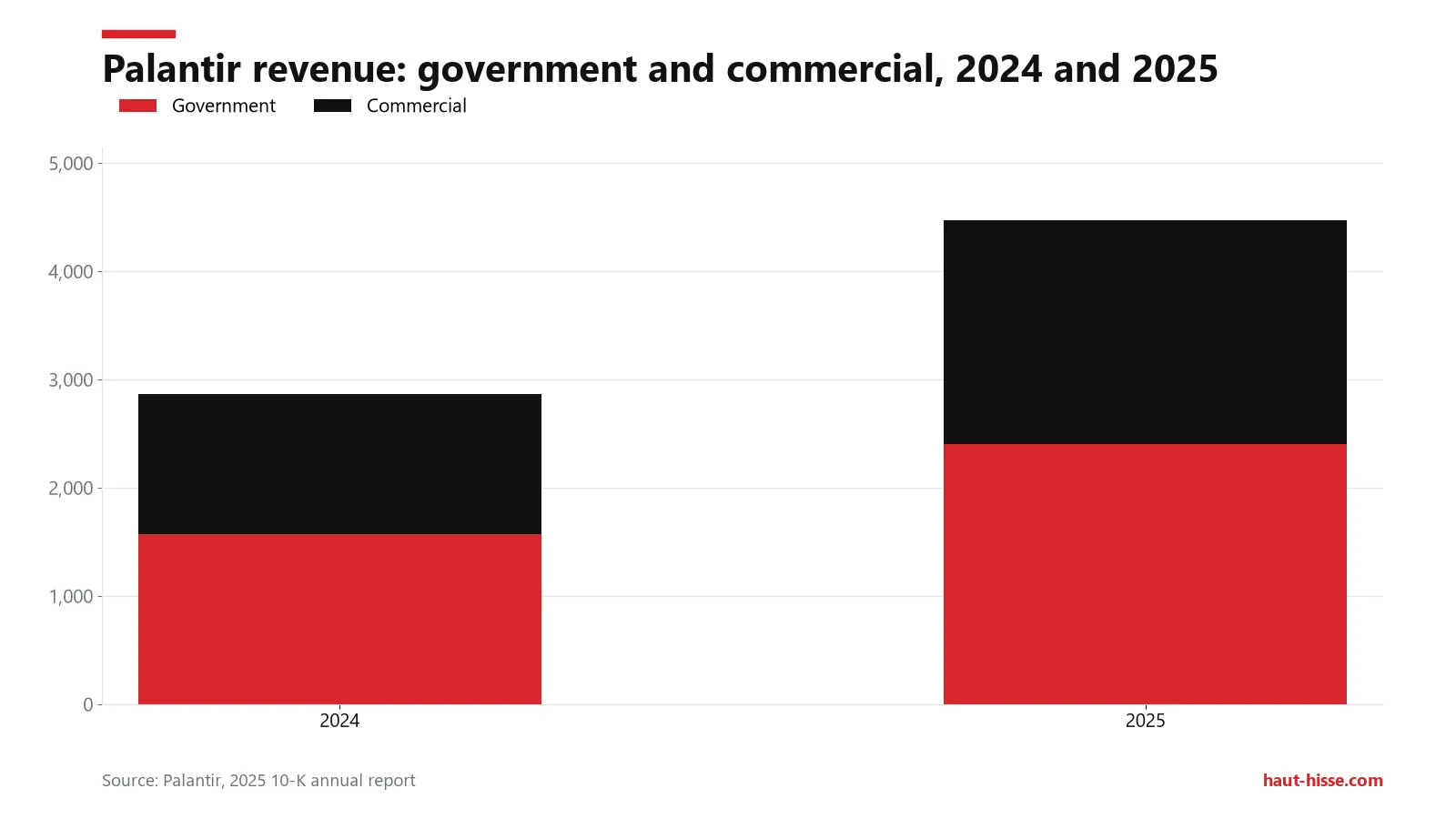
In 2025, the public sector accounted for 54% of Palantir’s revenue, commercial customers for 46%, and the United States for 74%, according to the 10-K filed with the US Securities and Exchange Commission (SEC). The table below compiles the report’s main figures, in rounded millions of dollars.
| Indicator ($M) | 2023 | 2024 | 2025 |
|---|---|---|---|
| Total revenue | 2,225 | 2,866 | 4,475 |
| of which government | not reported | 1,570 | 2,402 |
| of which commercial | not reported | 1,296 | 2,073 |
| Operating income | 120 | 310 | 1,414 |
| GAAP net income | 217 | 468 | 1,635 |
| Operating cash flow | 712 | 1,154 | 2,134 |
Our own calculation from this table shows that every segment grows by more than half between 2024 and 2025. Commercial revenue grows slightly faster than government revenue, without overtaking it in volume.
The annual report also gives the concentration of customers. Palantir had 954 at December 31, 2025, and its top three accounted for a little under a sixth of 2025 revenue, a share close to 2024’s. The top twenty customers generated an average of $93.9 million over twelve months, versus $64.6 million a year earlier, according to the same 10-K.
Backlog is not the same as recognized revenue. According to the 10-K, total remaining contract value reached $11.2 billion at the end of 2025, including $6.8 billion commercial and $4.4 billion public. That is an amount to be received, not revenue already collected.
For the third quarter of 2025, Palantir announced about $1.18 billion in revenue (+63%), including $633 million from government, and 911 customers.
August 2025: the US Army signs a $10 billion framework agreement
The US Army signed a framework agreement in August 2025 worth up to $10 billion over 10 years, according to RTS. This figure is a potential ceiling: it says nothing about the revenue actually billed.
Government customers
Governments brought in $2,402 million in 2025, versus $1,570 million in 2024, according to the 10-K shown in the table above. On the public side, the press cites the FBI, the Pentagon, ICE and the US Army, according to RTS.
According to franceinfo, public clients include the FBI, the Department of Defense, ICE (U.S. Immigration and Customs Enforcement, with a $30 million contract), the Los Angeles police and the Israeli army. France would be Palantir’s second-largest European market, after the United Kingdom.
Commercial customers
Commercial revenue reached $2,073 million in 2025, versus $1,296 million in 2024, according to the 10-K. RTS names private-sector clients Airbus, Stellantis and Ferrari. Foundry is the platform for all commercial customers, according to the 10-K, which puts the remaining value of commercial contracts at $6.8 billion at the end of 2025.
The annual report gives the customer count (954) and how concentrated it is. Press reports name the customers.
For readers in Belgium, the question is mainly one of data protection; for readers in Canada, it is public contracts. No verifiable figure in this article measures Palantir’s activity in either country. For a look at how an industrial group depends on a few large customers or on a broad base, our analysis of how Costco makes money offers a useful counterpoint.
From 2023 to 2025, net income rises more than sevenfold
GAAP net income (under US accounting standards) rose from $217 million in 2023 to $1.63 billion in 2025, according to the 10-K, driven by revenue growth. The report documents this shift year by year.
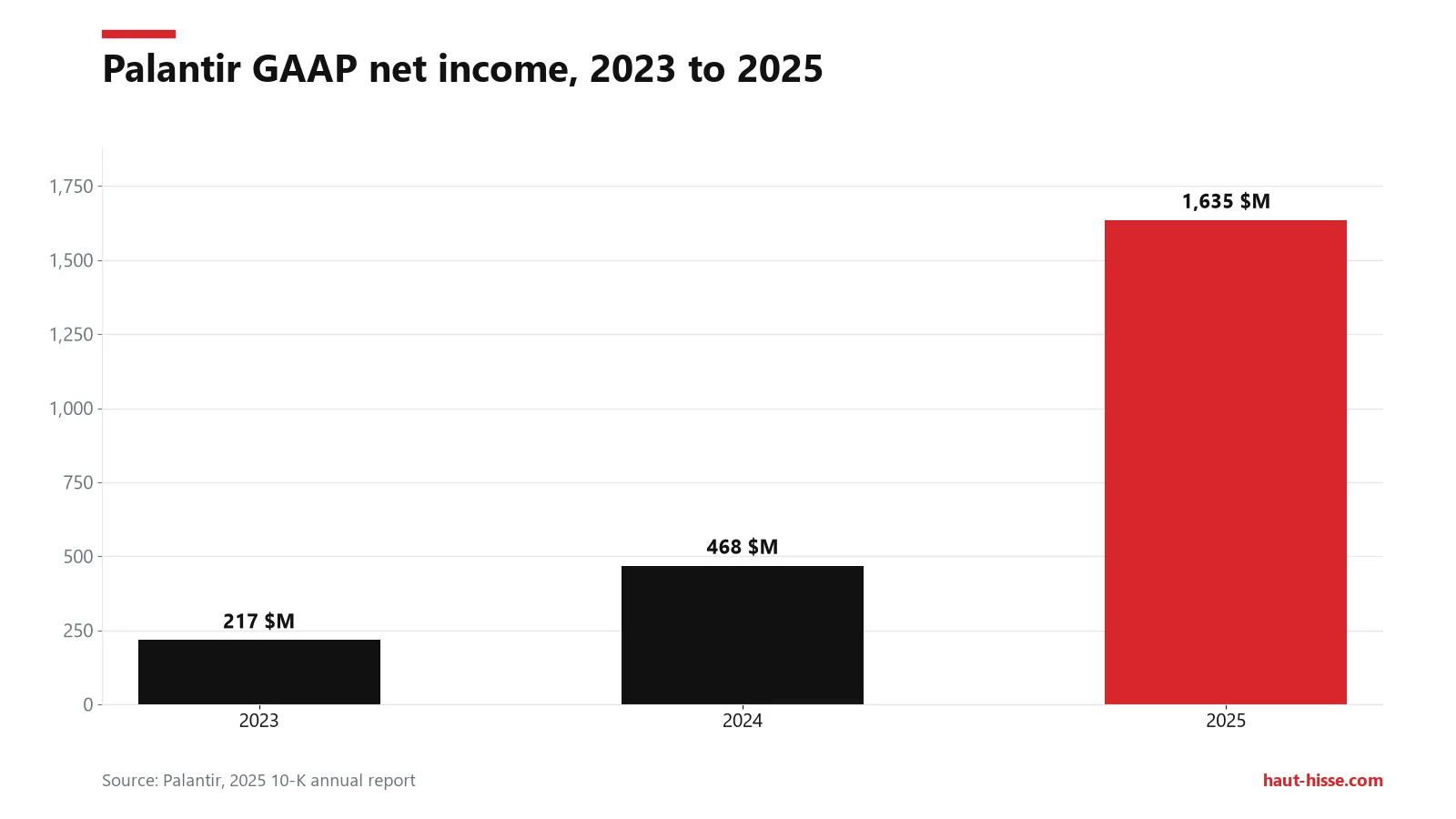
The chain shows in the table above. Revenue doubles in two years, operating income rises from $120 million to $1.41 billion, and operating cash flow from $712 million to $2.13 billion. Using figures from the 10-K, our own calculation gives a net margin of about 36.5% in 2025 (1,634 out of 4,475), versus about 10% in 2023.
The accounts don’t explain the precise causes of this shift here, whether cost control or product mix. The same caution applies to stock market moves, which can’t be deduced from an annual report.
The report also flags limits. Many contracts, especially public ones, can be terminated for convenience, meaning without fault by the supplier. The use of AI and large language models also creates risks of errors, ethical problems and reputational damage. The story of Eastman Kodak shows that high profitability does not durably protect a business model.
2025: Amnesty and Palantir disagree over surveillance
Palantir describes itself as a data processing contractor that does not supply mass surveillance tools, a claim that NGOs contest. So it helps to separate the official description from the alleged uses.
On the description side, the 10-K presents software, and Gotham as a defense and intelligence platform. On the critical side, Amnesty International warns of a “high risk of human rights violations,” while Palantir calls that description “factually incorrect,” according to RTS. These positions conflict: neither can be presented as established fact without examining actual uses at each client.
The reputational risk is itself recognized in the annual report’s risk factors. The company acknowledges that its contracts with governments and its use of AI expose its image.
The video by Réel média, “Palantir, the surveillance giant that knows you by heart (really, by heart),” offers a critical view. It expresses the outlet’s analysis, not a finding from the company’s accounts.
December 15, 2025: the DGSI extends Palantir, then announces its replacement
The DGSI’s contract was renewed on December 15, 2025, through 2028, pending a sovereign tool, and ChapsVision was announced as its replacement on June 16, 2026.
Here is the timeline, according to franceinfo and Euronews:
- 2016: first contract with Palantir
- 2019 and 2022: renewals
- December 15, 2025: renewal through 2028, “pending the deployment of a new sovereign tool”
- June 16, 2026: announcement by Sébastien Lecornu
ChapsVision takes over the DGSI’s mass data processing. The prime minister justified this choice in these terms:
“We cannot accept new strategic dependencies in the digital sphere” (Sébastien Lecornu, according to Euronews)
Palantir says its contract remains “fully in force.” The transition timetable is not public, and no end date for its use can be given. A technical comparison between the two tools is not available either.
What Palantir’s history shows
Palantir shows that a software company can become very profitable by plugging into its clients’ systems, but that this position creates a dependency that eventually gets challenged. The more central the tool is to a state, the more the question of sovereignty arises, as the DGSI case illustrates.
The model has limits. The annual report notes that many public contracts can be terminated for convenience, and that AI exposes the company to risks of errors, ethical problems and reputational damage. Criticism from NGOs such as Amnesty remains allegations that Palantir disputes, and it is not yet known what the French transition to ChapsVision will cost or how long it will take.
Frequently asked questions
What does Palantir really do?
Palantir sells software that links an organization’s existing databases so it can analyze them and make decisions. It describes itself as a data processing contractor that does not supply mass surveillance tools, a position that critics dispute.
Is Palantir just a database?
No. Palantir sells platforms, not data. Its software sits on top of existing systems, and the Ontology layer models the objects and relationships of each client’s activity while the underlying databases stay separate.
How does Palantir make money?
Palantir sells its software platforms to governments and businesses. In 2025, it reported $4.48 billion in revenue, with 54% from the public sector and 46% from commercial clients, and GAAP net income of $1.63 billion, according to its 10-K. That gives a net margin of about 36.5% (our own calculation).
Why is Palantir so controversial?
Its work for governments and for defense and intelligence clients draws scrutiny, as do the kinds of data it reportedly handles, according to franceinfo. Its early funding came partly from a CIA-linked fund, and Amnesty International warns of human rights risks. Palantir disputes these characterizations.
Who is Palantir’s competitor?
In France, ChapsVision is the company announced in June as Palantir’s replacement at the DGSI, according to Euronews. That announcement concerns one specific client, not the whole market.
Why does the DGSI use Palantir rather than a French solution?
The contract dates from 2016, after the November 2015 attacks. It was extended to 2028 “pending the deployment of a new sovereign tool,” according to franceinfo. Since that announcement, the state plans to switch to ChapsVision.
Who is behind Palantir?
Alex Karp (CEO) and Peter Thiel are among the company’s 2003 founders, according to franceinfo. Its initial funding came notably from In-Q-Tel, a CIA-linked fund, and from Founders Fund, according to Wikipedia.
How these articles are prepared: our editorial policy

