


Published
On 28 September 2022, the Lille commercial court, which handles business insolvency cases, spent three hours deciding Camaieu’s future. The continuation plan called for closing 208 stores and cutting 500 jobs. The judges rejected it because the conditions were not met, Le Journal des Entreprises reports.
The Camaieu bankruptcy stems less from fast-fashion competition alone than from debt inherited from leveraged buyouts (LBOs), which are acquisitions financed with borrowed money. Dividends, restructurings, Covid, rent and a cyberattack then wore the brand down, and the Lille court refused to keep it going.
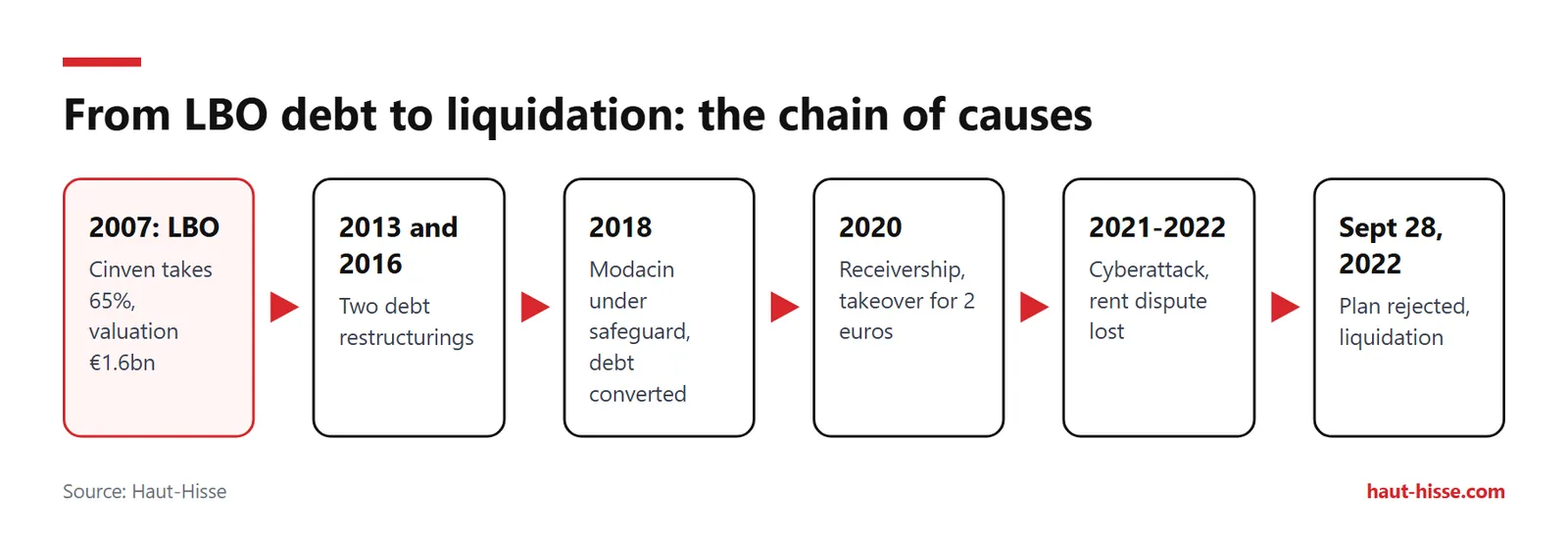
Camaieu did not run short of customers or stores. It ran short of financial leeway. This chain of causes runs from 2005 to 2022, from investment funds entering the shareholder base to the liquidation, through three restructurings and two shocks.
Key takeaways
- Cinven took control of Camaieu in 2007 and paid out dividends well above net profit.
- The debt was restructured in 2013 and 2016, then largely converted into equity in 2018.
- Taken over for €2 in 2020, Camaieu suffered a cyberattack in 2021 and lost a rent dispute in 2022.
- At the September 2022 hearing, the court rejected the plan because the shareholder could justify only a small part of the missing funds.
28 September 2022: three hours in court before a liquidation already on the table
The Lille commercial court rejected Camaieu’s continuation plan, ending a brand that still employed 2,714 people in August 2022, according to the National Assembly, the lower house of France’s parliament.

Two numbers settle the case. The shareholder could justify only €14 million against €90 million missing, according to La Voix du Nord as cited by Le Journal des Entreprises.
The toll is heavy. All 511 stores closed and around 2,600 employees were laid off. Unions cite more than 5,000 jobs affected once contractors are counted, RetailDetail reports.
The situation was already deteriorating in summer 2022. Payment cessation (formal insolvency) was set at 1 July 2022 and declared on 25 July. Court-supervised restructuring (redressement judiciaire) opened on 1 August, according to the National Assembly.
2005-2007: how Cinven’s LBO loaded Camaieu with debt
In 2007, the fund Cinven bought 65% of Camaieu in an LBO, two years after Axa Private Equity, now Ardian, had come in. The deal valued the brand at €1.6 billion, according to Wikipedia.
A leveraged buyout (LBO) is an acquisition financed largely with debt, which the acquired company then carries itself. Interest and repayments therefore weigh on the company’s results. Unquote lays out the sequence: Ardian acquired the company in 2005, then Cinven took 65% of the share capital in 2007.
Dividends paid to the funds: €267 million taken out by Cinven
Cinven then took out €267 million in dividends, almost three times net profit, plus another €48 million, according to Wikipedia, which does not give the exact year. Those €48 million have nothing to do with the €48 million advance requested from the state in 2022.
One possible reading, which is analysis rather than fact: money taken out of the company no longer funds stores or collections, while the debt still has to be repaid. The case recalls the bankruptcy of Kodak, another market leader that failed to reinvent itself.
2013-2018: why debt restructurings did not save Camaieu
Between 2013 and 2018, Camaieu’s debt was pushed back, then converted into equity, without the company regaining financial leeway. Sales, meanwhile, declined.
2013 and 2016: two restructurings in three years
In 2013, Cinven restructured the debt, with repayment pushed back to 2018, according to Wikipedia.
Ardian and Centerbridge agreed, on 28 September 2016, to convert half of the €1 billion debt into equity. The debt fell from 10 times to 5 times EBITDA, which stands for earnings before interest, taxes, depreciation and amortization, a measure of operating profit before those costs. Repayment was pushed back to 2019. This was the second restructuring in three years. EBITDA for 2016 was forecast at €80 million, against €115 million in 2015. After the deal, Ardian and Centerbridge held about 55% of the share capital, while Cinven, Polygon and Boussard & Gavaudan held 45%.
2018: the Modacin holding under safeguard proceedings
On 15 October 2018, the holding company Modacin was placed under sauvegarde, a French court-supervised protection procedure that shields a company from creditors while it reorganizes. On 19 December, a large part of the debt was converted into equity in favor of creditors. Wikipedia summarizes the situation this way: “the money Camaieu earns only goes to paying the interest on its debt.”
Why the Camaieu bankruptcy is not just about fast fashion
The clothing industry slump is real, but it hit the whole sector. It explains a tough backdrop, not Camaieu’s collapse on its own.

INSEE, France’s national statistics office, measures the scale of the decline. Between 2014 and 2021, the number of clothing stores fell 17.9%, against 5.5% for retail as a whole. In 2020, clothing sales volume dropped 22.6%. Over 2019-2023, it only regained its pre-crisis level, against a 7.8% rise for retail as a whole.
These figures describe the sector. They do not mention Zara or Shein, and no specific cause can be attributed to them. One analytical hypothesis: a shrinking market makes debt heavier to carry. Camaieu’s sales decline between 2011 and 2017 also predates Covid.
The popular narrative points to fast fashion and shopping malls. It sets aside the debt inherited from the LBOs. For the other side of clothing prices, see why luxury costs so much.
2020: court-supervised restructuring, then a €2 takeover by Michel Ohayon
On 26 May 2020, Camaieu entered court-supervised restructuring after sales collapsed during lockdown. On 17 August, the Lille court approved its takeover by Michel Ohayon.
May 2020: the first court-supervised restructuring
Between March and April 2020, revenue collapsed, according to Wikipedia. The brand entered that shock with its debt already restructured twice.
August 2020: 511 stores taken over for €2
Michel Ohayon’s Financière immobilière bordelaise (FIB) took over 511 stores and 2,619 employees, with an investment commitment. The National Assembly notes that the takeover was carried out by Hermione People and Brands (HPB), owned by FIB, for €2.
Michel Ohayon therefore paid €2 for Camaieu. That figure says nothing about the real cost of the deal. From August 2020, Camaieu belonged to HPB, a subsidiary of FIB.
2021-2022: cyberattack, rent dispute and the rejected continuation plan
After the takeover, two blows came in quick succession: a cyberattack in 2021, then a rent dispute lost before France’s Court of Cassation, the country’s highest court of appeal, at the end of June 2022.
Summer 2021: the cyberattack that blocked orders
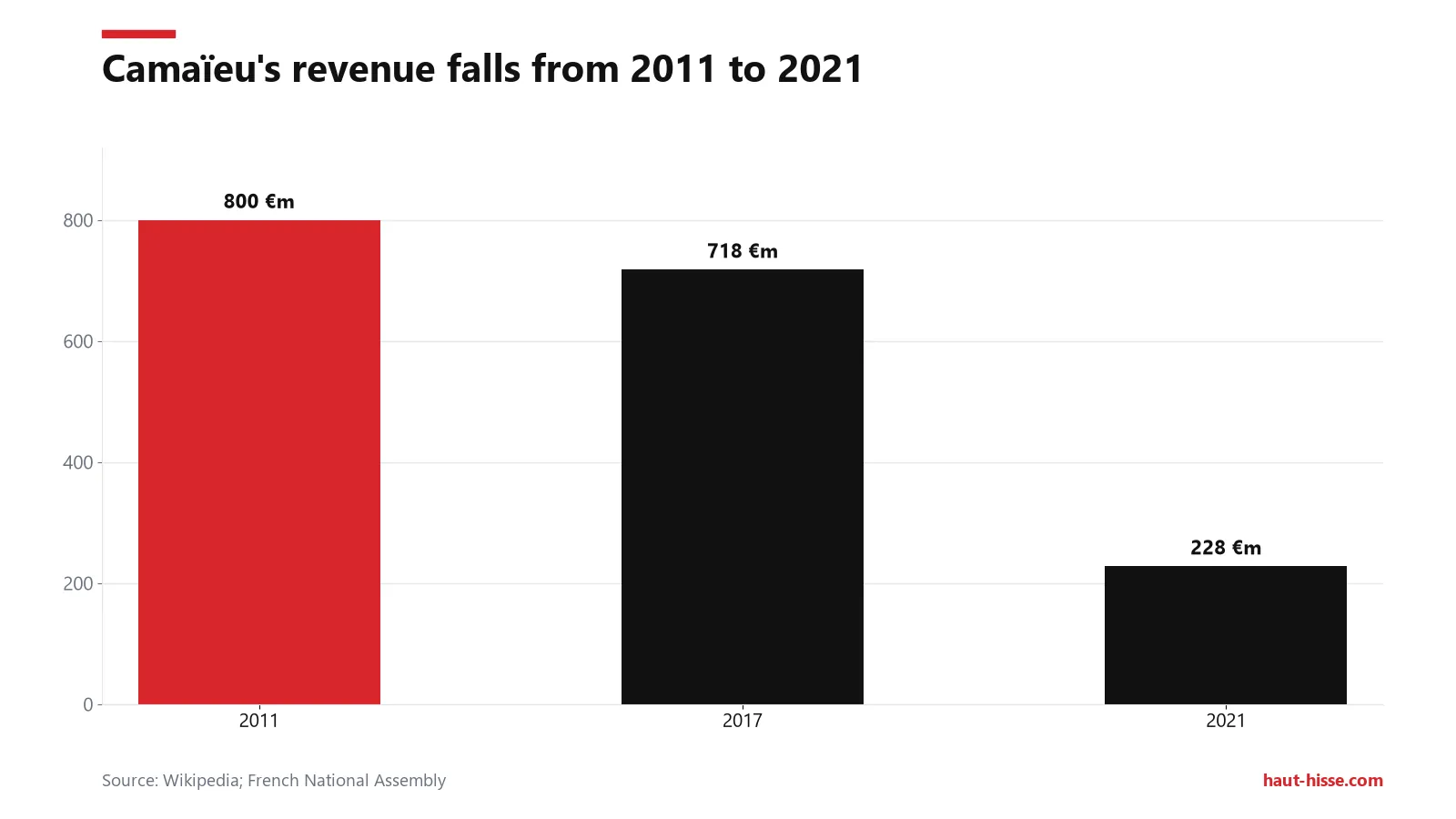
A cyberattack blocked the company from June to October 2021 and cost about €40 million in revenue, according to the National Assembly. Revenue reached €228 million in 2021, against €718 million in 2017, per Wikipedia.
End of June 2022: the Court of Cassation and the rent dispute
Le Journal des Entreprises lists among the causes a dispute with shopping center landlords, lost when the Court of Cassation ruled at the end of June 2022. HPB’s head cited a large rent debt and state aid.
Two years after the takeover, the debt reached about €250 million, according to Aestigia. The site also reports a union member’s criticism of the new shareholder: that it neglected Camaieu while buying other struggling companies.
Why did Michel Ohayon’s takeover fail in 2022?
The plan ran into money problems. The shareholder requested a state advance that the government considered unrealistic, and the court did not consider the financing established.
The shareholder said it needed €79.2 million over eight months. It offered to inject funds if the state approved a €48 million advance, RetailDetail reports. Industry Minister Roland Lescure judged the plan not very well thought out, according to the same outlet.
The court therefore rejected the continuation plan at the 28 September hearing, for lack of financing shown to match the need.
Debt figures vary with the scope used. The liabilities the court recorded, as reported by the National Assembly, are far below the amounts the press cited at liquidation. Nothing allows these estimates to be settled.
The stock auctions on 2 November 2022 raised far less than the theoretical value of the lots, according to Wikipedia.
After liquidation: who bought the Camaieu brand?
Celio bought the Camaieu brand at auction on 7 December 2022 for €1.8 million, without taking over staff or premises, according to FashionUnited. The original stores therefore did close.
On 29 August 2024, “be camaieu” reopened in 12 stores in Lille and Brussels, with 700 products at an average price of €30. The goal is about fifty stores within three to four years. The new chain shares the old name and colors but does not take over the liquidated company’s staff or premises.
Lena Situations’ video on Camaieu’s comeback after the liquidation picks up the story.
What the Camaieu collapse shows: a dated chain of causes, not a single culprit
The liquidation came from a pile-up: LBO debt, restructurings, shocks from 2020 to 2022, then insufficient financing for the takeover. Each link reduced the room for the next.
The table below places financial decisions, shocks and sector figures on one timeline, with their sources.
| Date | Event | Key figure | Source |
|---|---|---|---|
| 2007 | Cinven LBO | Valuation of €1.6 billion, dividends taken out | Wikipedia |
| 2013 and 2016 | Two debt restructurings | Debt cut from 10 to 5 times EBITDA in 2016 | Unquote |
| 2014-2021 | Sector decline | Clothing stores: -17.9%, against -5.5% for retail | INSEE |
| 2018 | Modacin safeguard | Debt largely converted into equity | Wikipedia |
| May 2020 | Court-supervised restructuring | Clothing sales down 22.6% over 2020 | INSEE |
| 17 August 2020 | Takeover by HPB, owned by FIB | €2 | National Assembly |
| June-October 2021 | Cyberattack | About €40M of revenue lost; €228M of revenue for the year | National Assembly |
| End of June 2022 | Rent dispute lost | Court of Cassation ruling | Le Journal des Entreprises |
| 1 August 2022 | Court-supervised restructuring opened | Payment cessation set at 1 July, declared 25 July; 2,714 employees | National Assembly |
| 28 September 2022 | Plan rejected | €14M justified against €90M missing; liquidation | Le Journal des Entreprises |
Two readings stand out from this timeline. First, the sector was contracting well before the 2020 takeover. Over 2019-2023, clothing sales only regained their pre-crisis level, against a 7.8% rise for retail as a whole, according to INSEE. Second, the €2 takeover price contrasts with the size of the liabilities at the opening of the restructuring. The court put them at €97.6 million against €5.9 million of available assets, according to the National Assembly. HPB’s head cited about €69 million of rent debt and €9.6 million of state aid.
That liability figure differs from the €240 million cited by the press at liquidation, reported by RetailDetail. The scope behind each figure still needs clarifying, and nothing allows settling between them.
The mechanism is simple: debt that absorbs interest leaves little room to invest or to absorb a shock. The exact weight of each cause cannot be measured, and these cause-and-effect links remain interpretations, not proof. For a comparison with a retailer whose financial balance rests on other choices, see how Costco makes money.
Frequently asked questions
Why did Camaieu go bankrupt?
The article’s reading is that the main cause was debt inherited from leveraged buyouts, not fast-fashion competition alone. Cinven’s 2007 buyout, dividends paid out and two debt restructurings in 2013 and 2016 left the company heavily indebted. Covid, rent disputes and a 2021 cyberattack then wore it down. In September 2022, the court rejected the continuation plan because the financing needed to match the company’s requirements was not shown.
How many stores did Camaieu close?
Camaieu closed all 511 of its stores, according to RetailDetail. The company employed 2,714 people in August 2022, according to the National Assembly. Unions estimate that more than 5,000 jobs were affected once contractors are counted.
Who bought Camaieu after liquidation?
Celio bought the Camaieu brand at auction on 7 December 2022 for €1.8 million. The purchase did not include staff or premises.
Where can I buy Camaieu clothes?
Clothes sold as “be camaieu” are available in the stores that reopened from 29 August 2024. FashionUnited counted 12 of them, in Lille and Brussels, with 700 products at an average price of €30. The goal is about fifty stores.
How these articles are prepared: our editorial policy

