


Published
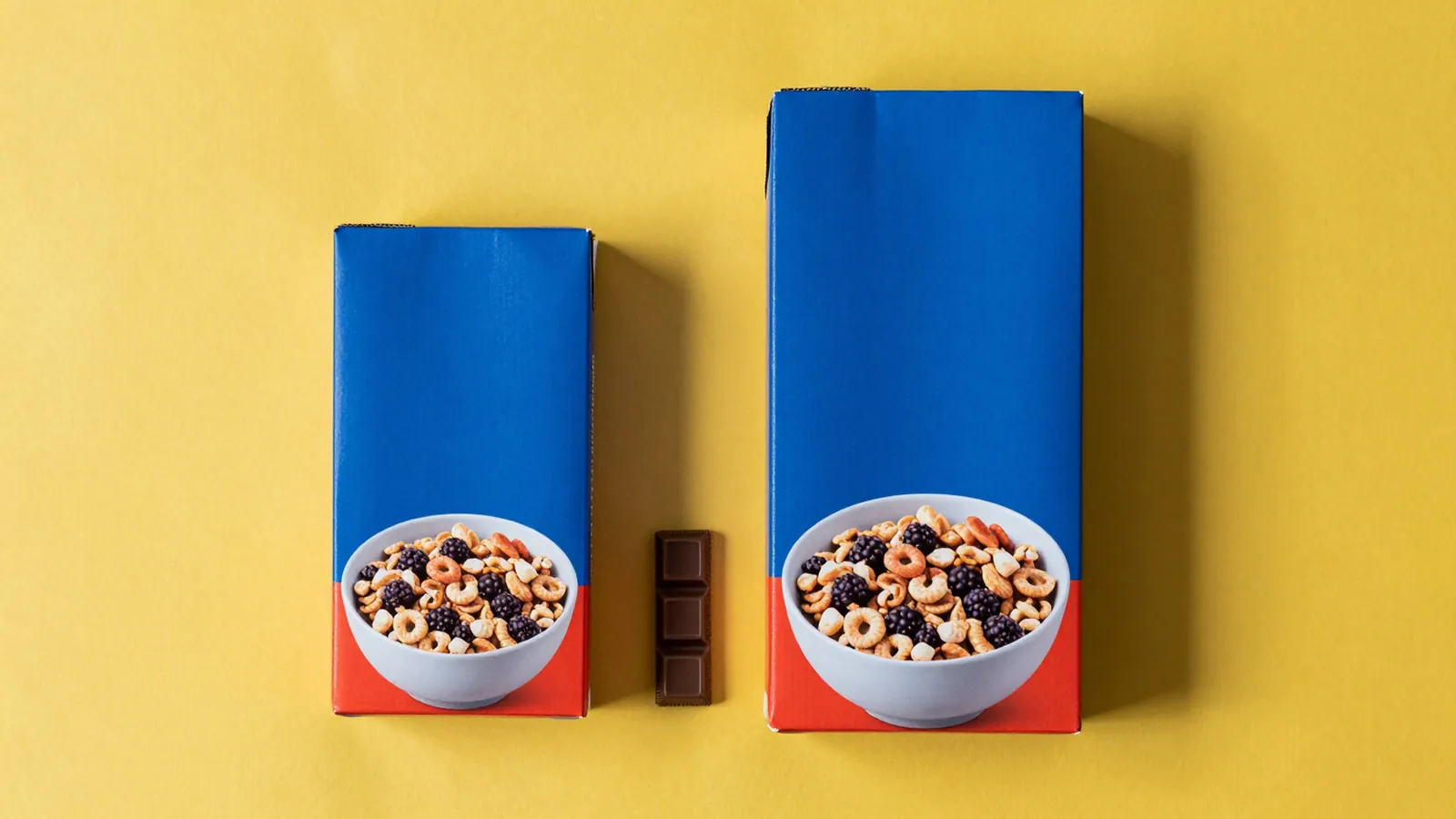
Shrinkflation is when a manufacturer shrinks a package while the price stays the same or rises. Nestlé’s Chocapic cereal in France went from 430 g to 375 g, and its price per kilo rose 37%, per UFC-Que Choisir, a French consumer group. The Office for National Statistics defines it as smaller packs at an unchanged price.
A Milka bar that went from 100 g to 90 g lost 10% of its weight, yet its price per kilo rose about 64%. Headline percentages understate some cases like this one. In France the practice was explicitly allowed until a 2024 labeling rule that most stores ignored in its first week.
Key takeaways
- Chocapic fell from 430 g to 375 g (about -13%), yet its price per kilo rose 37% (UFC-Que Choisir, May 2024).
- Milka’s bar went from 100 g to 90 g and from €1.35 to €1.99: that is €13.50/kg to €22.11/kg, about +64%, not the +60% the source page states.
- Before 2024, France did not ban shrinkflation as long as the actual weight or volume and the price per kilo or liter were displayed.
- Since July 1, 2024, French retailers must flag shrinkflation on shelf labels. In a July 2024 survey of 423 stores, UFC-Que Choisir saw no notice in 95% of them.
What are real shrinkflation examples, and how much did the price per kilo rise?
The French cases below pair a smaller pack with a price-per-kilo rise far larger than the weight loss alone suggests. Chocapic, Lion, Friskies, Milka, Lindt and Kiri are the documented ones. UFC-Que Choisir collected four of them in a May 6, 2024 article, and the table reproduces its readings.
| Product | Pack change | Price per kilo |
|---|---|---|
| Chocapic (Nestlé), shelf in late March 2024 | 430 g → 375 g (about -13%) | +37% |
| Chocapic, large box (May 2024) | 750 g → 645 g | +20% |
| Lion (Nestlé) | 750 g → 675 g | +29% |
| Friskies kitten chicken kibble (Purina) | 2 kg → 1.5 kg | +26% to +67%, depending on the retailer |
The shopper in these cases meets a pack that is lighter and a unit price that has moved, often both at once. In late March 2024 the 375 g Chocapic format was on shelves, and UFC-Que Choisir’s readings put its price per kilo 37% higher. Lion’s 29% came after 43% inflation over two years, the article states, so the smaller pack landed on top of earlier increases.
Friskies shows a different effect. The bag is the same 1.5 kg everywhere, yet the per-kilo rise runs from 26% to 67% depending on the retailer, so the same shrink does not cost every shopper the same.
These figures are French shelf readings, not US ones. The ONS describes shrinkflation as manufacturers reducing the package size of household goods while keeping the price the same. Several French cases go further, because the price rose too, as Milka’s did. Whether any of this was illegal when the boxes shrank is a separate question, answered further down. Those percentages come from shelf readings; the Milka case shows the weight loss explains only a small part of the jump.
How do you calculate the real price increase after a pack shrinks?
Divide price by weight before and after, then compare the two per-kilo prices. Milka’s bar shows the gap: a 10% weight cut sits inside a rise of about 64%.
The method takes three steps:
- Divide the pack price by its weight in kilograms before the change.
- Do the same with the new price and new weight.
- Divide the new per-kilo price by the old one and subtract 1.
For Milka, the bar went from 100 g to 90 g and from €1.35 to €1.99 on average. So 1.35 ÷ 0.100 = €13.50/kg, and 1.99 ÷ 0.090 = €22.11/kg. The ratio, 22.11 ÷ 13.50, is 1.638: a rise of about 64%. The page that reports the case states +60%; the arithmetic gives about +64%.
Two effects are stacked here, and they multiply instead of adding. Weight alone accounts for 11.1 points: 100 ÷ 90 = 1.111, so the same price on a lighter bar already lifts the kilo price by 11.1%. The rest comes from the bar price moving from €1.35 to €1.99, a factor of 1.474 (1.99 ÷ 1.35). Then 1.111 × 1.474 = 1.638. That is why a 10% weight cut can hide inside a +64% kilo price.
The same logic works when the count or the portion changes instead of the weight. The table recomputes four cases from their published inputs, with UFC-Que Choisir’s measured Chocapic figure for comparison.
| Product | Before → after | Recalculated change |
|---|---|---|
| Milka | 100 g at €1.35 → 90 g at €1.99 | €13.50/kg → €22.11/kg, about +64% (published: +60%) |
| Lindt Les Pyrénéens | 30 → 24 portions; price +4% since 2020 | About +30% per portion (1.04 ÷ 0.80 = 1.30) |
| Kiri | About 20 g → 18 g per portion, portion price constant | About +11% per kilo (20 ÷ 18 = 1.11) |
| Chocapic | 430 g → 375 g | +14.7% per kilo from weight alone (430 ÷ 375); measured: +37% |
Lindt’s Les Pyrénéens fell from 30 to 24 portions, a 20% cut, while the box price rose 4% since 2020. Dividing the price factor by the content factor gives the per-portion change. For Kiri, the portions weigh 18 g against about 20 g before, a reduction since early 2021. At a constant portion price, the cost per kilo rises about 11%.
The Chocapic row shows the same pattern in another form. Weight alone would lift its kilo price by 14.7%, yet the measured rise is 37%, so the pack price must have moved as well.
The shelf’s per-kilo line is what makes these comparisons possible. The Ministry of Economy said in 2022 that displaying the unit price lets consumers compare products. The math only works if the label gives you the numbers, so what does a shopper actually look for on the shelf?
How can you spot shrinkflation on a store shelf?
Compare the unit price (per kilo or per liter) on the label with what you remember, and check the weight on the pack. In France, since 2024 a retailer notice may also say the quantity changed.
The check takes four steps:
- Read the net weight on the pack and compare it with the previous one.
- Read the unit-price line on the shelf label.
- Compare that unit price with the earlier pack’s.
- Compute the ratio: new unit price ÷ old unit price.
Chocapic’s 375 g format, on shelves in late March 2024, is the kind of change step 1 catches. UFC-Que Choisir’s readings put its per-kilo price up 37%.
Products sold by the portion hide the change differently. Lindt’s Les Pyrénéens went from 30 to 24 portions, so the box looks familiar while the count drops. Kiri’s portions weigh 18 g, so the weight sits on each portion, not on the box. For these, divide the box price by the number of portions, or by the grams, before and after.
France now adds a printed prompt. The mandatory notice, as the INC (the French national consumer institute) describes it, begins “For this product, the quantity sold went from X to Y”. It then gives the rise in the unit price as a percentage or in euros, in the same character size as the unit price. The notice has the same job as steps 1 to 4, done by the store.
A shelf notice only exists because the law changed in 2024; before that, the practice was explicitly allowed.
In this video, a supermarket expert urges shoppers to be aware of shrinkflation, echoing the advice to read labels carefully.
Is shrinkflation legal? In France it was allowed until 2024
In France, shrinkflation was not banned: a 2022 ministerial answer said it was permitted as long as the actual weight or volume and the unit price were displayed. The rule that changed this came in 2024.
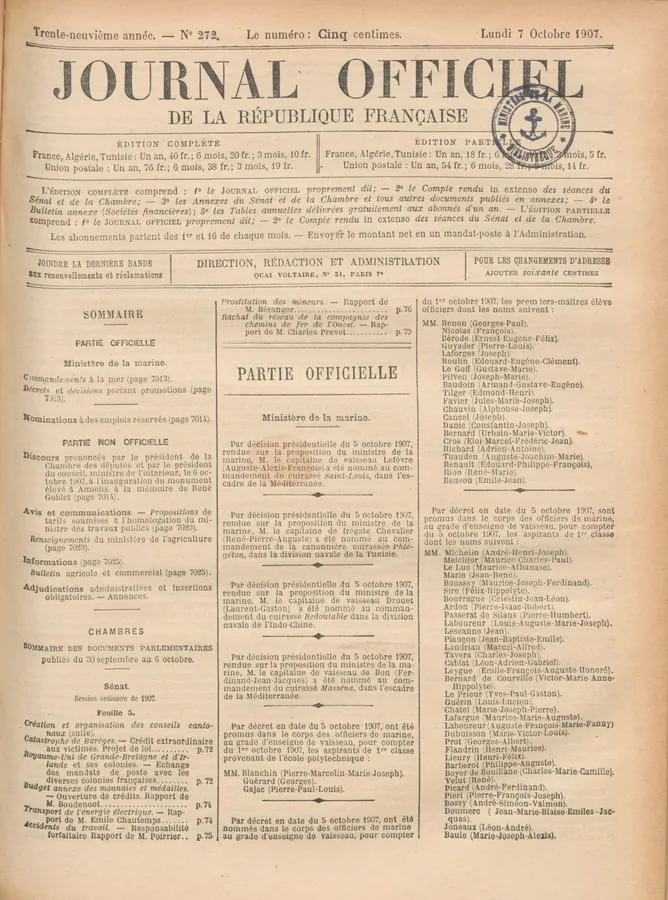
Shrinkflation looks like something a regulator would have prohibited from the start. The ministerial answer of December 6, 2022 says otherwise. It states that, as long as the actual weight or volume is displayed, shrinkflation is not prohibited:
“‘Shrinkflation’ is therefore not prohibited.” — Ministry of Economy (2022)
The reason sits in two older texts. An order of April 11, 2009 repealed all the rules fixing nominal quantities for prepackaged goods, except for alcohol and pasta. A nominal quantity is the weight or volume a prepackaged product is labeled with. Before that order, the rules fixed which sizes could be sold. The 2022 answer ties this liberalization to European directive 2007/45/CE of September 5, 2007.
The ministry’s logic was that the unit price does the protecting. Showing the price per unit of measure lets the consumer compare products, whatever size the pack has. The shopper’s division in the previous sections is exactly that comparison.
The authorities did look at the practice. In September 2022, at the request of minister Olivia Grégoire, the DGCCRF (France’s consumer fraud authority) launched a survey on shrinkflation, checking quantities and the display of the price per kilo or liter. These are French rules; US and UK law are outside this article.
Allowed does not mean unflagged: the April 2024 order added a mandatory notice, with conditions.
What does France’s 2024 shrinkflation labeling rule require?
Since July 1, 2024, French large food stores must display a notice when a product’s quantity falls and its unit price rises. The rule rests on the order of April 16, 2024, amended on June 28, 2024.
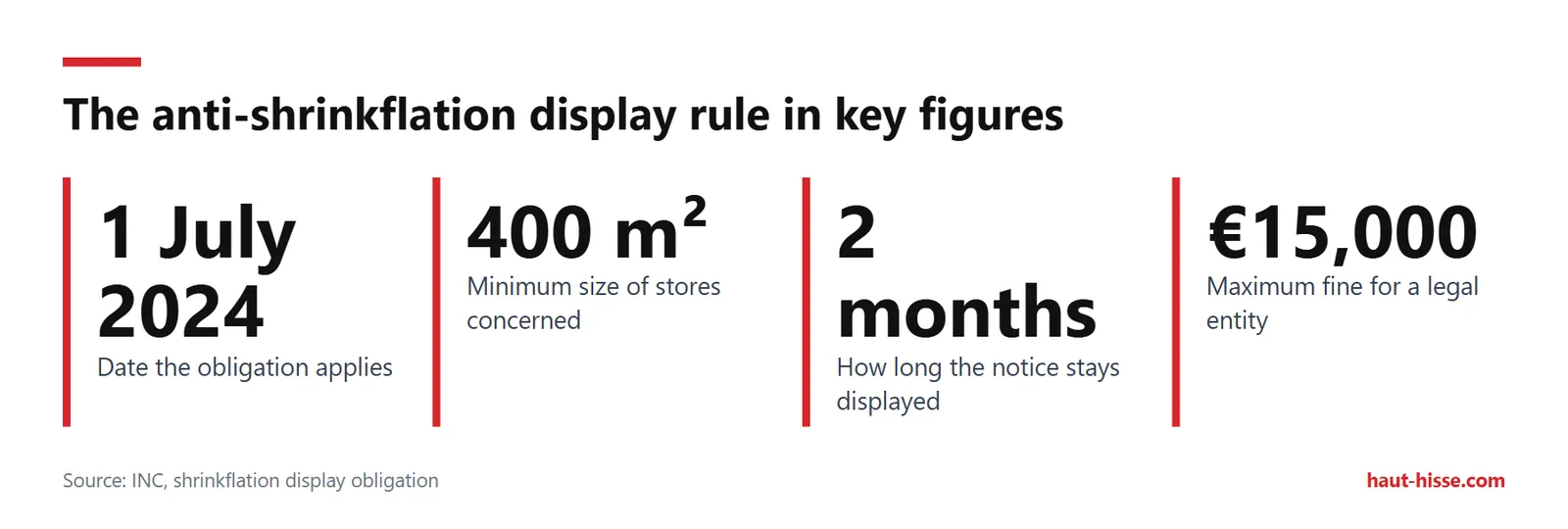
The INC sets out who owes the notice and when. The duty falls on retailers, not manufacturers: physical stores that mainly sell food and cover more than 400 m². Drive pickup and online sales are excluded.
Two conditions must hold together:
- The quantity sold has been reduced.
- The price per unit of measure has gone up.
The rule covers prepackaged goods of constant nominal quantity, food or not. The notice stays up for two months from the day the reduced pack goes on sale. A breach can bring an administrative fine of up to €3,000 for an individual and €15,000 for a legal entity, under article L. 131-5 of the Consumer Code.
The shelf tag then carries two prices, the sale price and the unit price, plus the notice when both conditions apply. Why so many sale prices end in 99, as Milka’s €1.99 does, is covered in why prices end in 99.
A rule on paper is one thing; a UFC-Que Choisir check in the first week showed what shoppers actually saw.
Do stores actually post shrinkflation notices?
Mostly not at first. From July 1 to 6, 2024, UFC-Que Choisir visited 423 super and hypermarkets and saw no notice in 95% of them.
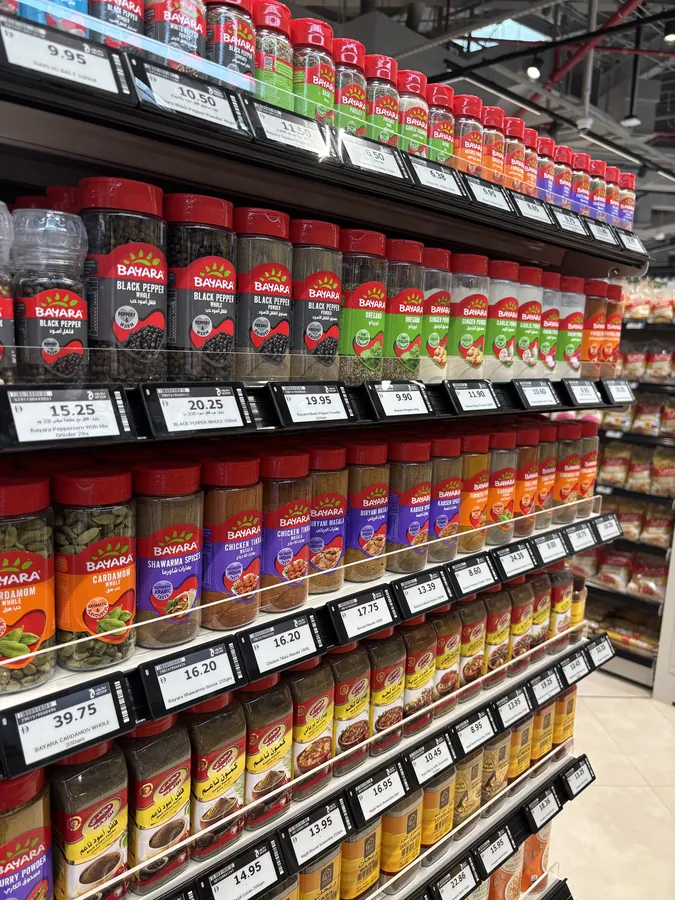
Only three chains appeared to have set up the notices: coopératives U (a French retail cooperative group), E.Leclerc and Carrefour. Some of those notices were wrong. A Lipton tea was flagged at +192%, a figure a shopper would want to check against the unit price on the label. UFC-Que Choisir published the result on July 10, 2024.
The survey covers one week after the rule began, so it is not a measure of long-run compliance. What it shows is the first-week state of a rule that depends on retailers acting on their own shelves.
The consequence today follows from that. UFC-Que Choisir found no notice in 95% of 423 stores in the first week of July 2024, and some notices that did appear were wrong, so the shopper’s own unit-price division still does much of the work. If notices are patchy, the shopper’s own checking matters; why people notice price tags less when paying cashless is a separate question. Why do people pay less attention to prices when they pay by card? The cashless effect on spending is the next question.
Frequently asked questions
What are some embarrassing examples of shrinkflation?
The widest documented gap is Friskies kitten chicken kibble: the bag fell from 2 kg to 1.5 kg, and the price per kilo rose from 26% to 67% depending on the retailer. Milka is the other: a 10% lighter bar, yet the kilo price rose about 64%.
Does shrinkflation ever reverse?
None of the cases above documents a return to the old pack size. What does expire is the French shelf notice: it stays up for two months from the day the reduced pack goes on sale, then it can come down.
Why is shrinkflation bad?
The weight cut and the price move compound, so the real cost exceeds the headline. Chocapic lost about 13% of its weight while its kilo price rose 37%, and Milka’s 10% cut came with about +64%. Without a visible notice, as in 95% of 423 stores in July 2024, the shopper must do the division.
How these articles are prepared: our editorial policy

