



Lottery winners rarely end up broke. The viral claim that 70% go bankrupt has no verifiable source, according to the NEFE. Tracking studies examining what happens to lottery winners show higher life satisfaction, modest drops in work hours, and, for mid-sized windfalls, only delayed bankruptcies rather than ruined lives.
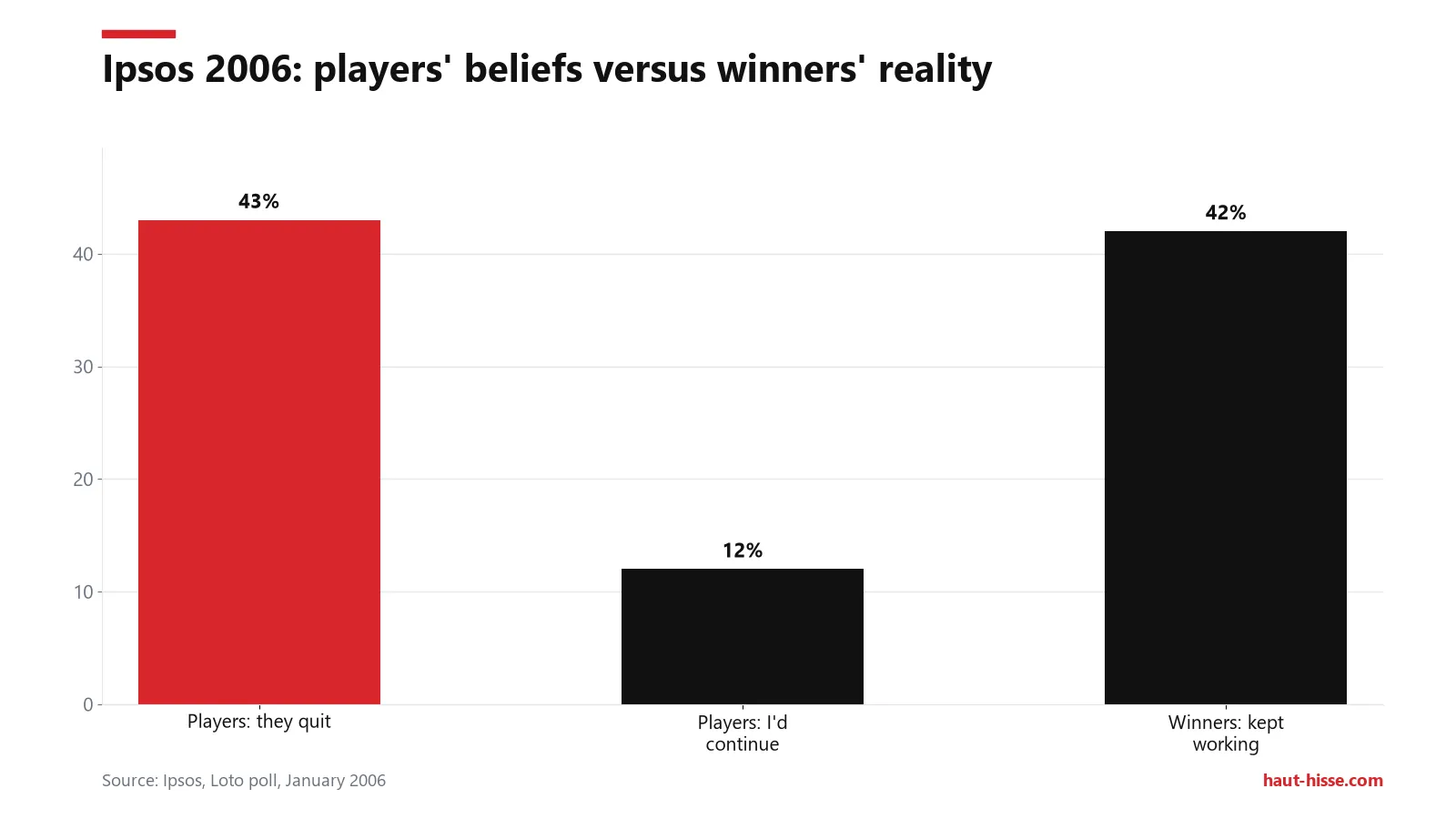
In 2006, 43% of players surveyed by Ipsos believed that winners stop working. Yet 42% of winners of over one million euros who were employed at the time continued working as before. The gap between public perception and actual observation is the rule rather than the exception. The sections below review major studies (Florida, Sweden, Norway), the support program run by the FDJ (La Française des Jeux, France’s national lottery operator), and the limits of what is known.
Key takeaways
- The claim that 70% of lottery winners go bankrupt comes from an unverified remark made during a 2001 panel discussion, according to the NEFE.
- In Florida, nearly 2,000 winners out of almost 35,000 were linked to a bankruptcy filing within five years.
- A large windfall sometimes postpones bankruptcy without preventing it: cash windfalls do not replace paying off debt or building equity.
- In Sweden, large winners rate their lives better for over a decade, though their day-to-day mood improves very little.
- No public data tracks bankruptcy rates among French winners; the FDJ offers advisory support starting at €500,000.
Where does the 70% lottery winner bankruptcy myth come from?
The 70% figure does not rely on any scientific research: the National Endowment for Financial Education (NEFE), a US non-profit foundation often cited as the source, has stated it cannot confirm the claim.

The origin of the 70% myth
The phrase circulates in several forms, most commonly: “70% of lottery winners go bankrupt within a few years.” It is almost always attributed to the NEFE.
According to the NEFE, the figure traces back to a 2001 panel discussion organized by the foundation on major life events. A participant reportedly threw out the estimate offhand without verification, and media outlets picked it up and repeated it.
Why does an unsourced number survive for decades? One explanation is that it reinforces a moral intuition—that easy money gets squandered—and fits neatly into a single headline. This reaction to striking numbers mirrors patterns seen in how people perceive prices and numbers. Tracing a widespread assumption back to its origin is a useful exercise, as shown in the history of the Michelin Guide and its tire origins.
The NEFE statement
In a statement issued on January 12, 2018, the foundation wrote: “This statistic is not backed by research from NEFE, nor can it be confirmed by the organization,” as reported in the NEFE statement. The foundation added that it has no data linking unexpected windfalls to bankruptcy rates.
Three levels need to be separated:
- Proven fact: the NEFE has produced no research on this topic.
- Correlation: the NEFE establishes no statistical link between windfalls and bankruptcy.
- Popular belief: the idea that winners almost always end up ruined.
What happens to Florida lottery winners: financial ruin or delayed bankruptcy?
A study by Hankins, Hoekstra, and Skiba on Florida winners is far from the 70% myth: it shows primarily that mid-sized windfalls postpone bankruptcy for some winners rather than preventing it.
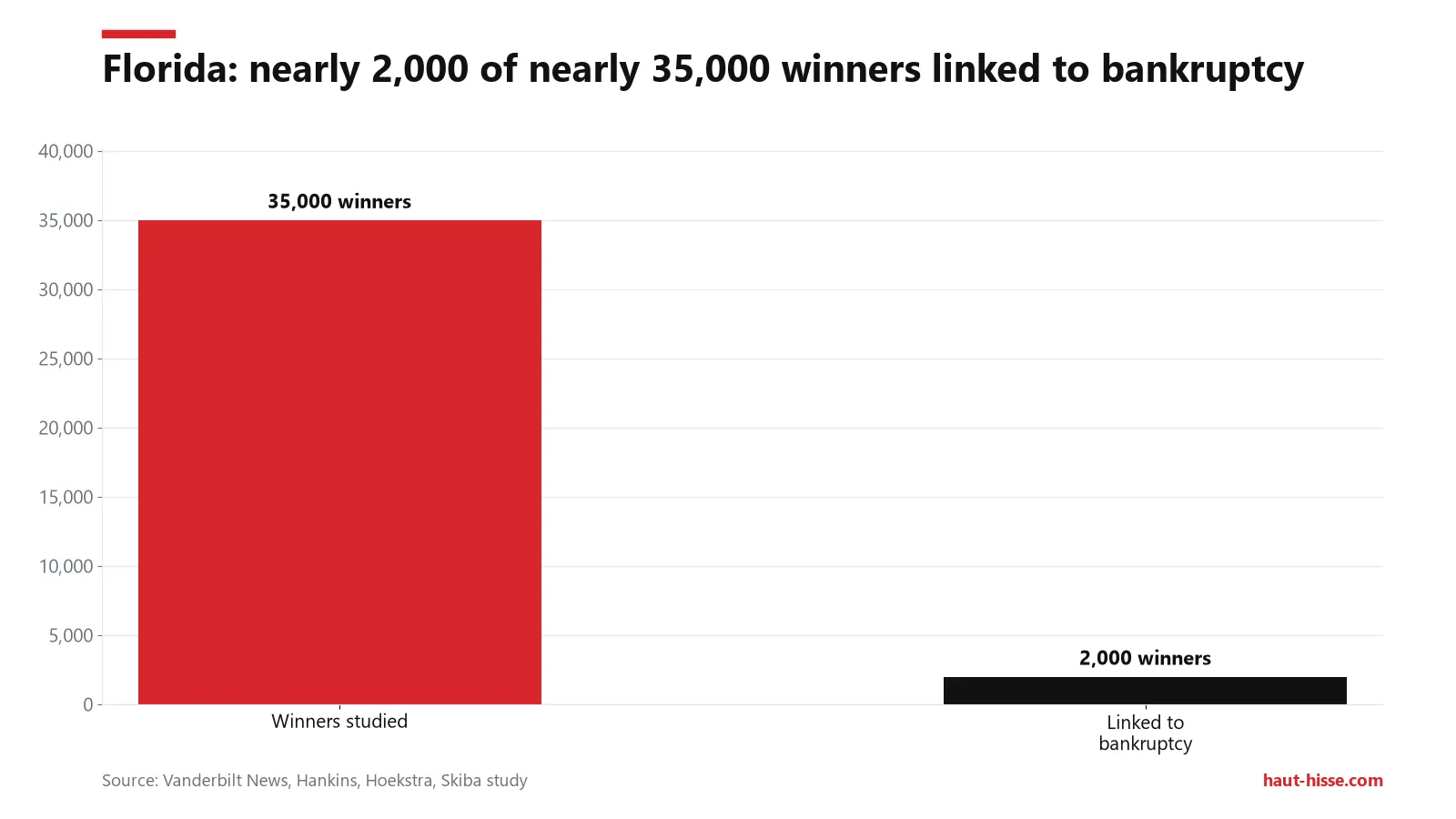
Published in The Review of Economics and Statistics in 2011, the study compares individuals who randomly won $50,000 to $150,000 with small winners. The goal was to track personal bankruptcies. Because the prize amount was determined randomly, the comparison is robust: only the size of the windfall differs between groups.
The dataset breaks down as follows, according to Vanderbilt University:
- Sample: nearly 35,000 winners of the Fantasy 5 game, tracking each person’s first win.
- Timeframe: prizes won between April 1993 and November 2002.
- Result: within five years of winning, nearly 2,000 individuals were linked to a bankruptcy filing.
This represents a small fraction of the total sample—nowhere near 70%.
Postponed bankruptcy versus widespread ruin
Mid-tier winners filed for bankruptcy less often immediately after winning, but faced higher risk later on. According to Vanderbilt, winners of $50,000 to $150,000 filed less frequently than small winners (under $10,000) right after the win. Three to five years later, however, they were 50% more likely to file.
The authors conclude that large cash transfers “only postpone bankruptcy rather than prevent it,” according to the study’s summary. This finding challenges the traditional assumption that bankruptcy stems primarily from sudden negative shocks; here, a sudden influx of cash did not prevent it.
Why do these bankruptcies happen?
The winners who filed had neither paid off their debt nor built equity in assets, according to Vanderbilt. Paige Marta Skiba, a co-author of the study, pointed out that the money provided limited help against underlying debt. She added that some winners appeared to lack the knowledge required to manage large sums of money.
Scale matters here. These prizes were far smaller than multimillion-dollar lottery jackpots. The Florida findings cannot be directly applied to multimillion-euro windfalls.
Does winning the lottery make you happier: life satisfaction versus daily mood
According to a Swedish study by Lindqvist, Östling, and Cesarini, large lottery winners evaluate their lives more positively for over a decade, but their daily happiness and mental health see much smaller changes.
The research, released by the National Bureau of Economic Research (NBER) in 2018 and later published in The Review of Economic Studies in 2020, surveyed a large sample of Swedish lottery players. It separates two concepts:
- Life satisfaction: a person’s overall cognitive evaluation of their life.
- Affect: daily experienced happiness and current mood.
The main finding: large winners experience “sustained increases in overall life satisfaction.” This increase persists for over ten years with no sign of fading. In contrast, the effects on daily emotional well-being and mental health were “significantly smaller.” Financial satisfaction served as the primary driver of the long-term gain in life satisfaction.
The takeaway is nuanced: wealth improves how people evaluate their overall standing, but does not necessarily overhaul day-to-day moods.
Do lottery winners quit their jobs?
Most available data shows a modest reduction in work hours rather than widespread retirement: in Sweden, winning reduces labor earnings moderately, while in France a substantial share of winners keeps working as before.
Findings from Sweden
The Swedish study on labor supply (Cesarini, Lindqvist, Notowidigdo, Östling) analyzed 249,278 lottery players aged 21 to 64. Its primary findings include:
- Effect in the winning year: about 1,150 Swedish kronor (SEK) less in labor earnings per 100,000 SEK won, before taxes and transfers. That represents just over 1% of the amount won.
- Duration: the effect persists for at least ten years and declines slightly over time, largely because winners reach retirement age.
- Spouses: married spouses reduce their earnings less than the winners themselves (0.458 SEK versus 0.981 SEK per 100 SEK won).
The calibrated model developed by the authors, summarized by Northwestern University’s Institute for Policy Research, calculated a lifetime “marginal propensity to earn” of -0.11. In other words, every euro received without working reduces future labor earnings by about 11 cents. Winning a lottery prize “modestly reduces labor earnings.”
Findings from French polling
A January 2006 Ipsos survey conducted for the French Loto examined 100 winners of more than one million euros, comparing public assumptions with actual responses:
| Metric (Ipsos, 2006) | Share |
|---|---|
| Players who believe winners stop working | 43% |
| Players who believe winners continue as before | 12% |
| Employed winners who actually continued working as before | 42% |
The sample size was small and the survey is dated.
The FDJ also features first-person accounts of winners who keep working out of passion or to stay grounded, alongside others who resign. These accounts show a variety of individual paths, without providing an overall percentage.
How do lottery winners spend their money: the Norwegian case
Administrative data from Norway shows that consumption linked to a windfall peaks in the year the prize is won and returns to baseline levels in about five years.
The study, published in the American Economic Journal: Macroeconomics in 2021, examined prizes ranging from roughly $8,300 to $150,000. Two concepts frame the analysis:
- Liquidity: immediately accessible cash.
- Marginal propensity to consume: the proportion of each dollar received that is spent rather than saved.
Winners of smaller, less liquid prizes spent nearly the entire amount within the first year. Those receiving large, highly liquid prizes spent slightly less than half in year one.
To illustrate (not an explicit finding of the study): for a prize at the high end of that range, spending slightly under half leaves just over half untouched in the first year. For a prize at the low end, almost nothing remains.
The comparison with Florida is worth clarifying. Spending a windfall quickly does not mean someone is broke; it describes the pace of spending. The Norwegian study measures consumption, not net worth or bankruptcy rates.
What psychological traps do jackpot winners face?
Existing research points primarily to a lack of practical tools for managing large windfalls, alongside a sharp divide between public fears and winners’ reported reality.
A lack of tools rather than a character flaw
Paige Marta Skiba, co-author of the Florida study, told Vanderbilt University: “Others seemed to simply lack the knowledge to handle large amounts of money wisely,” according to Vanderbilt News. The issue is framed not as personal failure, but as a lack of preparation when handling unfamiliar amounts of wealth.
The gap between fears and reality
The 2006 Ipsos survey highlighted another disconnect:
- General public: 65% thought that winners change their personality for the worse.
- Winners: only 12% reported feeling stressed by financial constraints, 32 percentage points lower than the general public.
Projected public anxieties differ from what winners actually report. This survey relied on self-reported declarations and had a limited sample size.
Media coverage and availability bias
Dramatic stories of ruined lottery winners often make headlines. An anecdote, no matter how memorable, does not represent a statistical average; it does not show how many winners follow the same path.
These stories feed the availability bias, where people judge how common an event is by how easily examples come to mind:
- A striking story: going broke after a multimillion-dollar windfall is dramatic, making it shareable and widely covered.
- Silence around ordinary outcomes: winners who quietly invest and live routine lives do not make the news.
- An exaggerated sense of frequency: encountering these stories repeatedly makes people assume they are typical, making a figure like 70% seem credible.
This dynamic explains why the myth persists, not why it is accurate. Only complete datasets covering all winners, like the Florida study, can establish true proportions.
What support is available for lottery winners in France?
La Française des Jeux (FDJ) provides an advisory program for winners of top-tier prizes, including extended guidance and a group workshop cycle lasting at least five years.
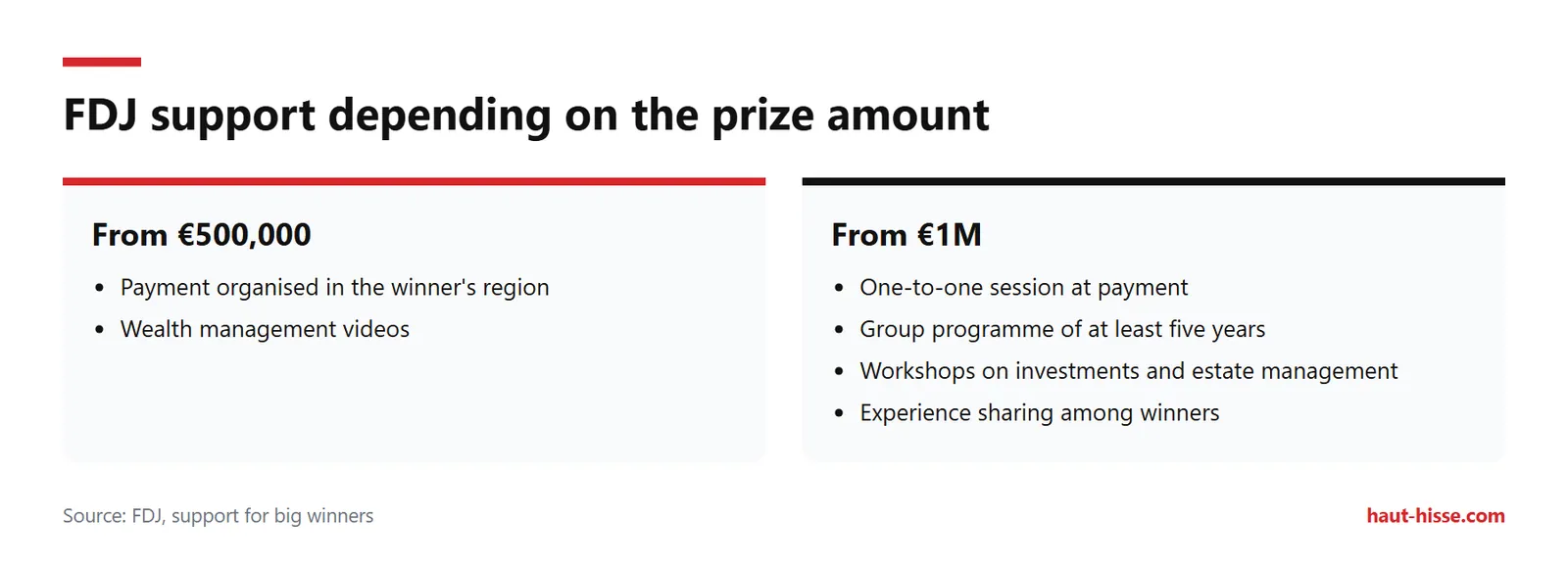
According to the FDJ guidance page, updated May 17, 2023, the process includes several steps:
- From €500,000: the FDJ organizes payment in the winner’s region and provides educational videos on wealth management.
- From €1 million: according to the same page, the winner receives an individual advisory session during prize collection.
- Afterward: winners can join an optional collective program running for at least five years.
The collective track includes workshops on financial investments, estate planning, and adapting to lifestyle changes, along with peer exchanges. The FDJ’s dedicated winner support team consists of 5 people, led by Isabelle Cesari.
Regarding annual numbers, the FDJ noted in an interview with Isabelle Cesari that around 360 major prize winners emerge each year, of whom roughly 180 win €500,000 or more (date not specified). In 2024, 211 prizes of at least one million euros were awarded, totaling €276 million for the French Loto, according to L’Essentiel de l’Éco (November 6, 2025).
No public data evaluates whether this program alters bankruptcy rates among recipients.
What studies leave unanswered: limits and the jackpot effect
Each study examines a specific outcome for a specific prize range: none provides comprehensive data on long-term bankruptcy rates among French jackpot winners.
The table below summarizes the key studies, their findings, and their main limitations.
| Study | Measured outcome | Main limitation |
|---|---|---|
| Florida (2011) | Personal bankruptcies after $50,000 to $150,000 windfalls | Limited to legal bankruptcy filings; prizes far smaller than jackpots |
| Sweden, well-being (2018, 2020) | Life satisfaction, daily affect, mental health | Country with a strong social safety net; cannot be generalized everywhere |
| Sweden, labor (2017) | Labor earnings of winners and spouses | Pre-tax and transfer earnings |
| Norway (2021) | Spending patterns after prizes of ~$8,300 to $150,000 | Measures consumption, not overall wealth |
| France, Ipsos survey (2006) | Continued employment and self-reported feelings among 100 winners | Small sample size, self-reported and dated survey |
In France, no public statistics track financial ruin among winners, and the FDJ program has not been evaluated in public research.
Multimillion-euro jackpots also operate on a different scale than mid-sized prizes. Whether larger sums amplify positive or negative outcomes remains untested by broad empirical data, so extrapolations require caution.
When evaluating viral claims about wealth, three checks help:
- Identify the original study.
- Check the sample size.
- Compare the prize amounts studied with the jackpot in question.
The same verification approach applies to business claims, such as how Costco makes money.
Frequently asked questions
What actually happens to major lottery winners after 5 or 10 years?
Available tracking studies focus primarily on mid-sized windfalls rather than massive jackpots. In Sweden, large winners maintain higher life satisfaction more than ten years later. For French jackpot winners, no public data measures bankruptcy rates at five or ten years.
How many lottery winners become millionaires each year in France?
In 2024, the FDJ awarded 211 prizes of one million euros or more across all its games. The FDJ also reported, without a specific date, that roughly 180 winners receive €500,000 or more annually.
Is the FDJ support program mandatory for winners?
The FDJ describes its support as a service offered to major winners, with an optional group workshop program. Participation is not presented as mandatory.
Sources
- Research statistic on financial windfalls and bankruptcy — National Endowment for Financial Education (2018)
- Hankins, Hoekstra, Skiba, The Ticket to Easy Street? — The Review of Economics and Statistics, MIT Press (2011)
- Lotteries: from big bucks to bankruptcy — Vanderbilt University News (2009)
- Lindqvist, Östling, Cesarini, Long-run effects of lottery wealth on psychological well-being — NBER (2018)
- Cesarini, Lindqvist, Notowidigdo, Östling, Labor supply effects of lottery wealth — J-PAL (2017)
- Working paper IPR 15-18 on labor supply and lottery windfalls — Institute for Policy Research, Northwestern University (2015)
- Study on the consumption of lottery winners in Norway — American Economic Journal: Macroeconomics (2021)
- Support for major winners — FDJ (2023)
- Interview with Isabelle Cesari — FDJ / Konbini
- Loto survey, 30 years — Ipsos (2006)
- They still work — FDJ
- Loto winners: what they really do with their money — L’Essentiel de l’Éco (2025)
Prepared with the help of AI tools, then fact-checked and edited by the Haut-Hisse editorial team.


