


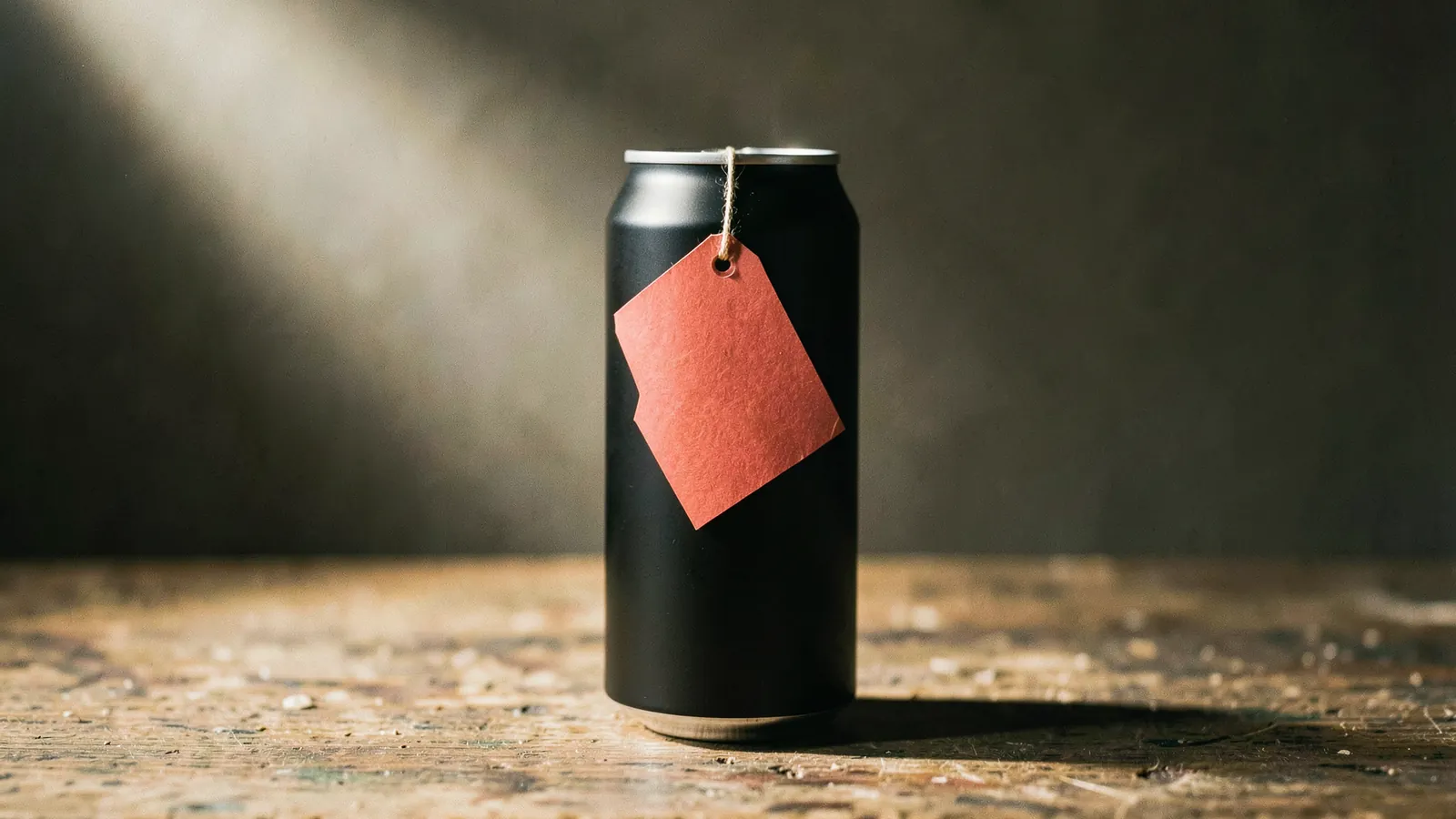
This breakdown shows how Liquid Death sells water in a can. The answer is in the packaging and the story: a beer-style can, punk humor and live festivals turn ordinary water into a social object. The product itself isn’t new. The marketing built into the can is what creates the value.
Key takeaways
- The can borrows the look and ritual of beer, giving a non-alcoholic drink a social signal.
- The humor reverses the usual pitch for bottled water, selling attitude instead of purity.
- Live events and grocery retail came in stages, after the brand had built its story.
- The premium price pays for the packaging more than the liquid, and profitability is not published.
Revenue rose from about $3 million at the 2019 launch to an estimated $130 million in 2022, according to Contagious. That curve is surprising, because the liquid is not rare. This breakdown follows four mechanisms: the can, the humor, live events and price. It relies only on documented indicators: scanned retail sales, social media followers and store counts. It also explains what those numbers cannot prove.
How Liquid Death sells water: the product and the Warped Tour idea
Liquid Death is a canned water brand founded in 2018 by Mike Cessario, a former advertising creative, and the idea came from an observation made on tour. FoodNavigator reports that Cessario spent ten years in advertising and that the company is headquartered in Santa Monica, California. Wikipedia records that he filed the trademark on July 6, 2017, and that direct-to-consumer sales began in January 2019 on the brand’s official website.
The observation dates back to the Warped Tour. NoGood reports that Cessario saw performers filling Monster Energy cans with water. The starting point was a gesture, not a liquid. People were pouring water into a container that said something other than “water.” This reading is my interpretation.
The launch was prepared through content. Before the product went on sale, a teaser video had already passed 3 million views, according to Fortune. Contagious puts it bluntly: “there is no pretense of product innovation here.” The success comes from marketing, not from anything new in the bottle or the water source.
This logic connects to how price is perceived. A small presentation detail changes what the buyer believes they are paying, as our article on prices ending in 99 shows. At Liquid Death, that detail is the entire packaging.
Mechanism 1: the can that copies beer
The aluminum can gives a non-alcoholic drink the look and the gesture of beer, which answers a social need: having something to hold at the bar.
- What you see: an aluminum can with a beer look and a metal aesthetic, where water is usually sold in plastic bottles.
- The lever: borrowing the codes of another category, which makes the packaging a status signal.
- The evidence: Cessario puts it this way in Fortune: “There’s no reason that only beer can have that kind of cool look and feel.” A Material survey, cited by Fortune, finds that 59% of Americans surveyed say they need a non-alcoholic drink to socialize.
The same interview gives the design principle. Cessario says he wanted to build marketing and shareability into the product itself, so that customers would promote it for free. The customer doesn’t just buy water. They buy an object they can show off, photograph and put on a festival table.
Can or plastic bottle: a status choice
Here is my analysis, which remains an interpretation. A plastic bottle talks about hydration, purity and sport. An opaque can with a metal look talks about belonging. It signals a taste, a crowd, a night out. The customer weighs a function (drinking) against a signal (showing who they are). In my view, the price pays for that signal much more than for the contents.
Who buys: Gen Z and the alcohol alternative
The brand claims more than 70% of its customers are Gen Z or millennials. The figure comes from Fortune, which reported the company’s statement in October 2025. The same Material survey, conducted among 1,000 Americans aged 18 to 42, finds that three in four want drinks with health benefits.
NBC News describes the brand’s core market as live-event audiences, with Live Nation events as a key channel. The brand also targets “sober curious” consumers, meaning people who cut back on or question their drinking.
The need I read in this data is simple: take part in the social ritual without alcohol, without feeling left out. The beer-style can answers that, and Cessario was looking for exactly that kind of object to hold at the bar. This is an analysis based on these elements, not proof of motivation for every customer. The survey also covers Americans, so its results don’t transfer directly to French consumers.
The recycling counterpoint
Aluminum also offers an environmental argument. A study by Eunomia, an environmental consulting firm, prepared for the International Aluminium Institute, reported by Recycling Magazine in 2022, puts the share of recycled material in new aluminum can products at about 70%. The figure is 40% for plastic and 34% for glass.
Two caveats apply. The study was commissioned by the aluminum industry. It measures a material, not the total impact of a brand, which also depends on transport, production and volumes.
Mechanism 2: punk humor that flips the codes of water
Liquid Death’s humor turns the usual pitch for bottled water, which sells purity and health, on its head, and makes the can recognizable in a second.
- What you see and hear: a name, a metal aesthetic and an ironic tone that says the opposite of an alpine spring. In February 2022, the first Super Bowl LVI spot used “Breaking the Law” by Judas Priest and ended with “Don’t be scared, it’s just water.”
- The lever: parody. The brand borrows the codes of menace and heavy metal, then defuses them with a reassuring line.
- The evidence: the pre-launch teaser passed 3 million views, and the brand claims 14.5 million followers on TikTok and Instagram, according to Fortune. Both figures measure attention, not purchases.
I don’t attribute any specific intent to the brand. I am simply noting the gap between its tone and the category’s usual pitch.
Choosing the media
Cessario calls boring advertising on traditional media his “biggest waste of money,” FoodNavigator reports. He was talking about dull marketing, not about traditional media in general. Content therefore has to be entertaining enough to share, which explains the idea of building marketing into the product: “We needed to bake all the marketing and shareability into the product itself,” he told Fortune.
The Super Bowl spot and social media
The Super Bowl LVI spot was the brand’s first, Wikipedia states. What I notice in its final line is that it reassures in a parodic tone, as if drinking water were a risky act. It makes fun of the code it borrows and makes it likeable. The irony works as a signature.
On social media, the 14.5 million followers are a claim the brand made in October 2025, as Fortune reported. The figure is the company’s own statement, not an independent measurement. It shows the size of the audience, not conversion into sales.
Mechanism 3: live events and grocery retail
Liquid Death combined a presence at live events with Live Nation and a gradual push into grocery retail. Festivals offer a non-alcoholic option among bars that mostly sell beer.
- What you see: the can in venues and at festivals, then on store shelves.
- The lever: exclusivity on a channel where the brand’s story makes sense.
- The evidence: in May 2021, Wikipedia reports, Live Nation took part in a Series C round (a funding round, detailed in the table below) and agreed to sell the drink exclusively at its events and venues for a period. NBC News describes Live Nation events as a key channel.
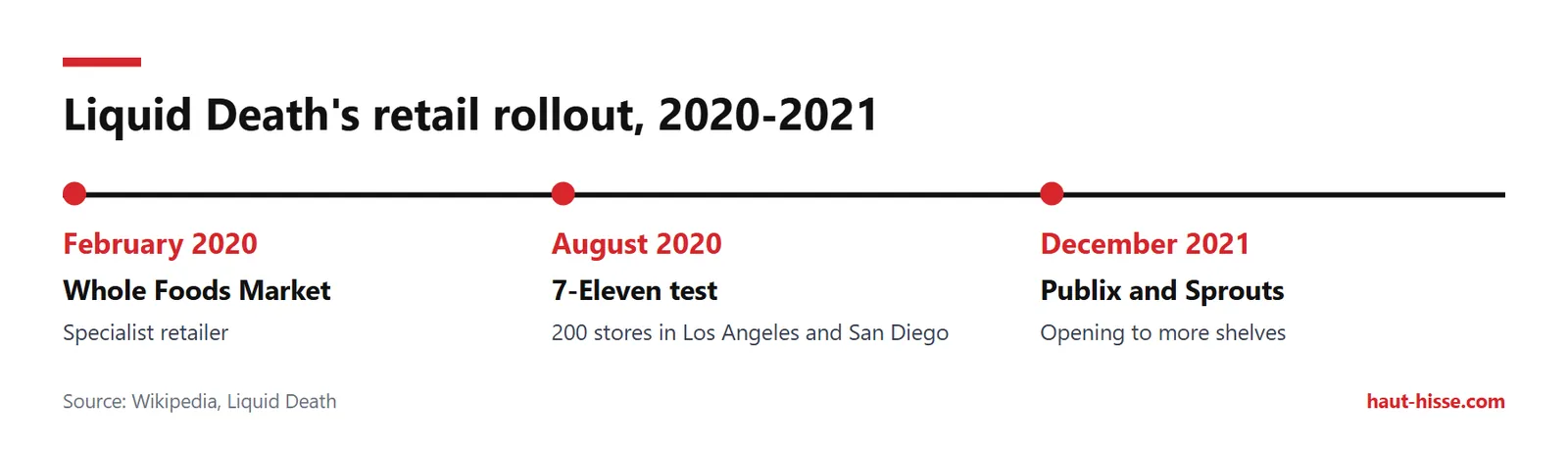
Grocery retail came later, in stages. Wikipedia’s timeline has three steps:
- February 2020: Whole Foods Market.
- August 2020: a test in 200 7-Eleven stores in Los Angeles and San Diego.
- December 2021: Publix and Sprouts.
This order suggests the brand first established itself where its story made sense (concerts, specialty retailers), then opened ordinary shelves. The question of distribution in France is covered in the FAQ below.
Mechanism 4: a premium price, about three times that of still water
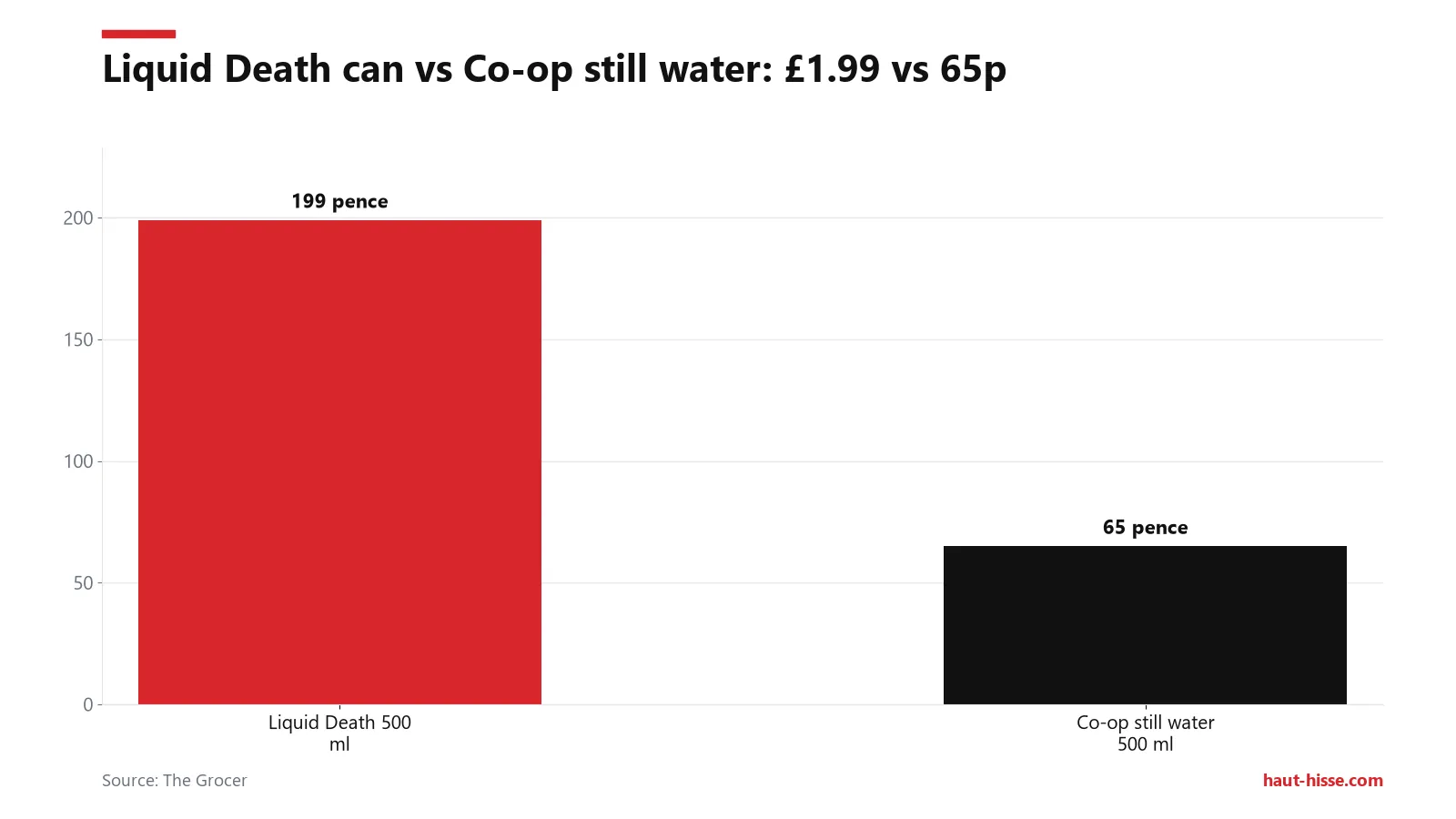
The premium price is the core of the model. In the UK, the can sold for about three times the price of still water in the same format.
- What you see: a can of water priced like a status drink.
- The lever: price as a signal of value, carried by the packaging more than by the contents.
- The evidence: a 500 ml can of Liquid Death water cost £1.99 at Co-op, compared with 65p for Co-op’s own still mineral water in the same format, The Grocer reports. The math is simple: 1.99 ÷ 0.65 gives about 3.06.
This shelf price says nothing about Liquid Death’s margin. Between the store price and the brand’s bottom line sits the retailer, which keeps its share. To understand that layer, our article on how Costco makes money offers a comparison of grocery margin logic.
Revenue or scanned sales: don’t mix them up
The numbers circulate under different labels. “Scanned” sales are those recorded at store checkouts. They measure what customers pay, not what the company receives. Fortune notes that the sales cited are scanned retail sales, and the company’s revenue is not published. The table uses data from Fortune and FoodNavigator.
| Indicator | Value | What the figure measures |
|---|---|---|
| Revenue at launch (2019) | about $3 million | Estimated revenue, cited by Contagious |
| Revenue 2022 | about $130 million | Estimate, not a figure published by the brand |
| Sales 2023 | $263 million | Scanned in-store sales |
| Points of sale 2023 | 113,000 | United States and United Kingdom |
| Sales 2024 | more than $300 million | Scanned in-store sales |
| Growth since 2019 | 380% per year | Compound annual growth rate (CAGR) |
| Share of flavored sparkling water and iced tea | more than 60% | Share of retail sales |
The last figure complicates the image of a “water brand.” FoodNavigator reports that more than 60% of retail sales come from flavored sparkling water and iced tea, not still water. The brand is therefore mostly selling flavored drinks in the same can.
Profitability remains open. No data is published, and I draw no conclusion from it: strong sales growth proves neither a profit nor a loss.
What this case reveals: a mechanism to spot elsewhere
When the packaging does the messaging work, a traditional media budget becomes secondary. The table summarizes the four mechanisms. The “intended effect” column is my reading, not a goal the brand has declared.
| Observed element | Lever | Intended effect |
|---|---|---|
| Aluminum can with a beer look | Borrowing the codes of another category | An object to hold at the bar, non-alcoholic, that people want to show off |
| Name, metal aesthetic, “Don’t be scared, it’s just water” spot | Irony and reversal of water’s codes | Instant recognition and content people want to share |
| Exclusivity with Live Nation at events and venues | Presence on the channel where the story lives | Reaching the core market of live-event audiences |
| Can at £1.99 vs 65p for Co-op still water | Premium price as a value signal | Charging for the social object rather than the liquid |
To recognize this recipe in another brand, look for three signs: an ordinary product, packaging that borrows the codes of another category, and a message the customer wants to pass on.
Funding rounds: what the valuation proves and doesn’t prove
The successive rounds, from $9 million in 2020 to $67 million at a $1.4 billion valuation in March 2024, rest on sales growth and the strength of the brand. The table follows the timeline published on Wikipedia.
| Date | Round | Amount | Valuation |
|---|---|---|---|
| February 2020 | Series A | $9 million | not specified |
| September 2020 | Series B | $23 million | not specified |
| May 2021 | Series C (with Live Nation) | $15 million | not specified |
| January 2022 | Funding round | $75 million | $525 million |
| October 2022 | Funding round | $70 million | $700 million |
| March 2024 | Funding round | $67 million | $1.4 billion |
The October 2022 round needs a caveat. It was led by an existing investor, Science. Dan Primack of Axios said, as Wikipedia reports, that it could be viewed with skepticism, because a round led by insiders sets a price without an outside test.
A further caution: the March 2024 valuation does not describe the brand’s current value, and it is neither revenue nor profit. When you read “a brand worth over a billion,” the date matters as much as the amount.
Ecological limits and criticism: what the analysis doesn’t prove
The aluminum environmental argument rests on an industry-funded study, and the brand has also faced criticism. It is important to separate what the figures prove from what the communication makes of them.
The Eunomia study for the International Aluminium Institute, reported by Recycling Magazine in 2022, gives about 70% recycled content for aluminum, 40% for plastic and 34% for glass. The study compares materials. It does not show that Liquid Death is more environmentally friendly than another brand on a full life-cycle basis.
In 2025, the brand ended its partnership with “The Deep,” a character from the series The Boys, and publicly apologized. NoGood links the break to a scene in which the character burned plastic waste near children. The same article reports that critics argue the beer-style can may normalize alcohol for children.
Finally, three things sit outside this analysis:
- The causal link between a campaign and sales is not established. No one can prove which channel (the Super Bowl, videos, festivals) produced which sales.
- Customer acquisition metrics are not published, including acquisition cost and retention.
- Profitability is not known.
This breakdown explains why the can works as a social object. The analysis cannot quantify what each lever brings in.
Frequently asked questions
Who created Liquid Death?
Mike Cessario, a former advertising creative director, founded Liquid Death. The idea came to him at the Warped Tour, when he saw performers filling Monster Energy cans with water. The company is headquartered in Santa Monica, California.
How much is Liquid Death worth today?
The most recent published valuation dates from March 2024 (see the funding rounds table). No more recent value is documented. A valuation is neither revenue nor profit.
Where can I buy Liquid Death in France?
The documented points of sale are in the United States and the United Kingdom. Nothing confirms distribution in France. Check the brand’s website or ask your retailer before counting on finding it on a local shelf.
Is Liquid Death profitable?
Nobody knows. The brand does not publish its revenue or its profit. The known figures are scanned in-store sales, which measure what customers pay, not what the company keeps.
Sources
- Liquid Death, official website
- Liquid Death’s marketing and brand-building strategy, FoodNavigator (2024)
- Liquid Death marketing, NoGood (2026)
- Liquid Death, Wikipedia (2026)
- Liquid Death names new CFO as $1 billion brand gears up for expansion, Fortune (2025)
- Liquid Death CEO Mike Cessario, interview on water, beer and unicorn status, Fortune (2024)
- Liquid Death CEO Mike Cessario, Gen Z, beer and water, Fortune (2024)
- How Liquid Death became a billion-dollar beverage brand, NBC News (2024)
- Why Liquid Death is our brand of the year, Contagious (2022)
- What is Liquid Death and is it about to take the UK by storm?, The Grocer (2024)
- Study highlights vital role of aluminium cans in circular economy, Recycling Magazine (2022)
Prepared with the help of AI tools, then fact-checked and edited by the Haut-Hisse editorial team.


