

On 29 October 2018, Mr Bean’s official YouTube channel reached 10 million subscribers, according to Chortle. Fewer than 100 channels worldwide had crossed that threshold at the time. It had started with clips from the 14 episodes broadcast on ITV, the British commercial broadcaster, between 1990 and 1995.
How much does Mr Bean earn? No official figure has been published for Rowan Atkinson’s earnings from Mr Bean. The best-known estimate is £11 million for the sale of the character in 2003, reported by HELLO! magazine. It is a press estimate, not a number from published accounts, and it does not show what the actor personally received.
Key takeaways
- No official figure for Mr Bean’s earnings has been published.
- The main estimate, a press figure for the sale of the character, was reported by HELLO! in 2003.
- The original series has only 14 episodes, yet it has been sold in more than 190 countries.
- The two Mr Bean films grossed about $483 million combined, according to Box Office Mojo (Bean, Mr. Bean’s Holiday). Box office is ticket sales, not the actor’s fee.
- Banijay Kids & Family holds the licensing and merchandising rights; Atkinson’s current share is not public.
The press has put a figure on the character’s sale. Two films each grossed more than $230 million worldwide, Bean and Mr. Bean’s Holiday, according to Box Office Mojo, and UK company accounts are worth checking.
A nearly silent character, a very short original series, and sketches shot more than thirty years ago: on paper, the model looks fragile. It isn’t, because these clips still circulate everywhere, from TV channels to YouTube. This analysis reviews press estimates, the catalogue, online audience, box office, licensing, and the filings at Companies House, the UK company register.
Key dates
- 1990-1995: 14 live-action episodes broadcast on ITV, according to Chortle;
- 1997: release of Bean, with a worldwide gross listed by Box Office Mojo;
- 2002: animated series begins, according to Wikipedia;
- 2003: HELLO! publishes a press estimate of the character’s sale;
- 2007: release of Mr. Bean’s Holiday, with a worldwide gross listed by Box Office Mojo;
- 2018: the official YouTube channel passes a major subscriber milestone, according to Chortle;
- 2020: series sold in more than 190 countries, according to Televisual.
1990-1995: only 14 episodes, a very short catalogue
The original live-action series has 14 episodes, broadcast on ITV between 1990 and 1995, according to Chortle. That is the answer to the question people ask most often about the show.
This tiny stock contrasts with how long the income has lasted: more than thirty years after the first broadcasts, the character is still being exploited. The catalogue has not grown, though. An animated series has existed since 2002, according to Wikipedia, but it adds to the offer without changing the original series.
The confusion is common because three things circulate under the same name:
- the 14 original episodes, filmed with Rowan Atkinson;
- the animated sketches, produced from 2002;
- online clips, meaning scenes cut from those two sets.
An “episode” watched on YouTube is therefore often a single scene, not an extra episode. For earnings questions, the distinction matters: each product has its own sales channel.
2003: when the press valued Mr Bean at £11 million
In March 2003, HELLO! magazine credited Mr Bean with a major share of Rowan Atkinson’s fortune.
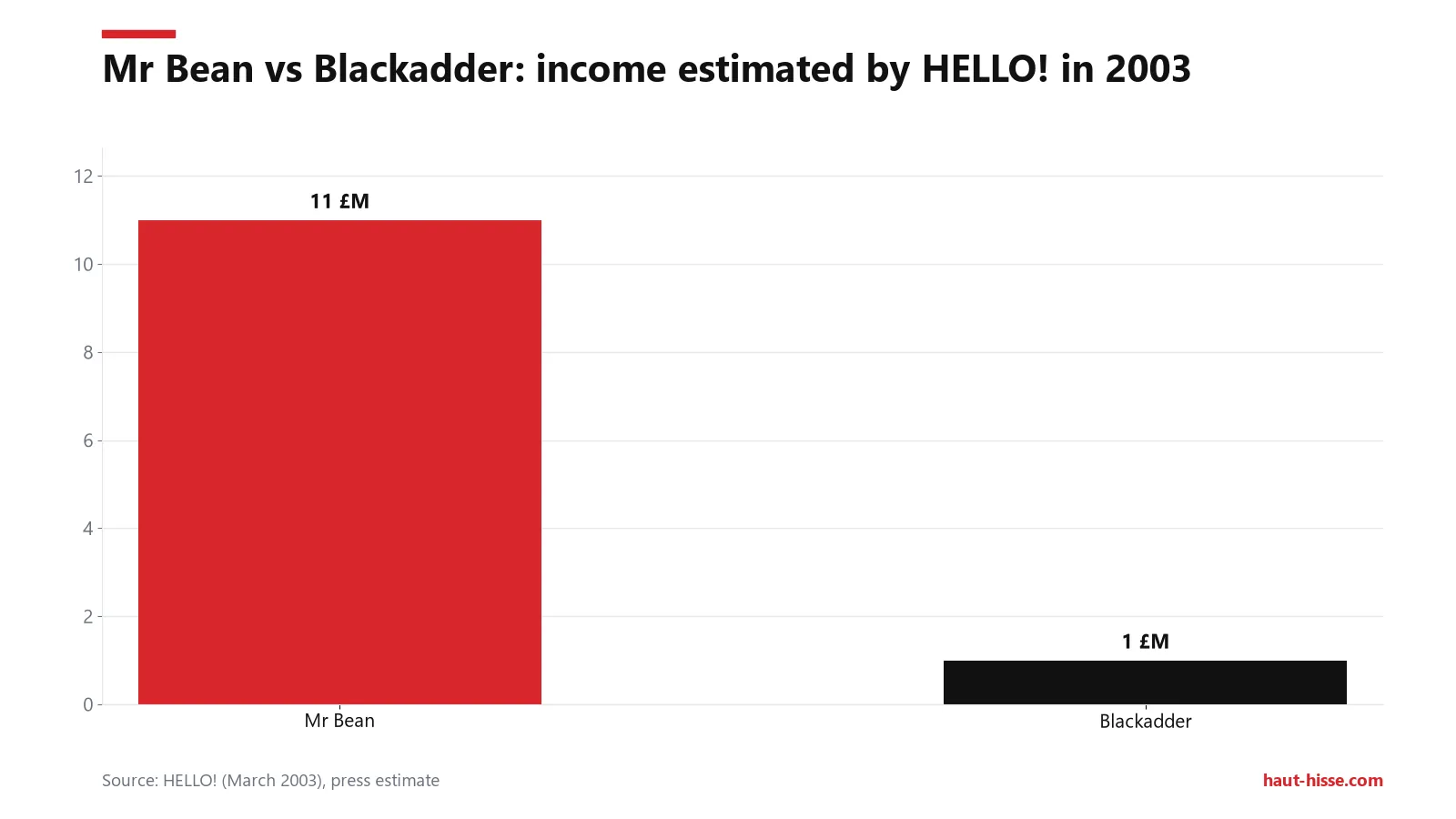
The profile was published on 20 March 2003. The magazine described Atkinson as Britain’s richest television star, with a fortune estimated at about £60 million, according to HELLO!. The same text says the sale of the character in around 94 countries would have brought the actor £11 million. It also offers a comparison: Blackadder, Atkinson’s other major TV success, would have earned about £1 million. The gap is more than ten to one in favour of Mr Bean.
This figure is a press estimate. It does not come from published accounts, and it does not state the period covered or the method of calculation. The actor’s fortune, for its part, remains an estimate, not a verified asset.
Why having almost no dialogue made Mr Bean so easy to export
Because Mr Bean says very little, the series sells without heavy dubbing. Wikipedia writes that this minimal dialogue “has allowed the series to be sold worldwide.”
A standard sitcom has to be translated, adapted and sometimes rewritten for local humour. A pantomime scene needs none of that: the same content serves every market, and adaptation costs stay low.
The reach is documented. In September 2020, the live-action series and seasons 1 to 3 of the animated series had been sold in more than 190 countries, with Latvia the most recent addition, according to Televisual. That matches HELLO!’s 2003 estimate, which already mentioned 94 countries.
One limit remains. Being sold in 190 countries says nothing about the price of each sale. A broadcaster in a small market does not pay what a major network pays, and the share that goes to the actor depends on contracts that are not public.
YouTube: how much does Mr Bean earn on the platform?
No official YouTube earnings have been published for Mr Bean. The audience is known, though, and it is large, which is what makes the stakes clear.
The official channel reached 10 million subscribers on 29 October 2018, according to Chortle, which noted that very few channels had reached that mark. It started with clips from the 14 original episodes, and animated sketches were added later. Its most-viewed video, a hospital scene, was approaching 105 million views at the time.
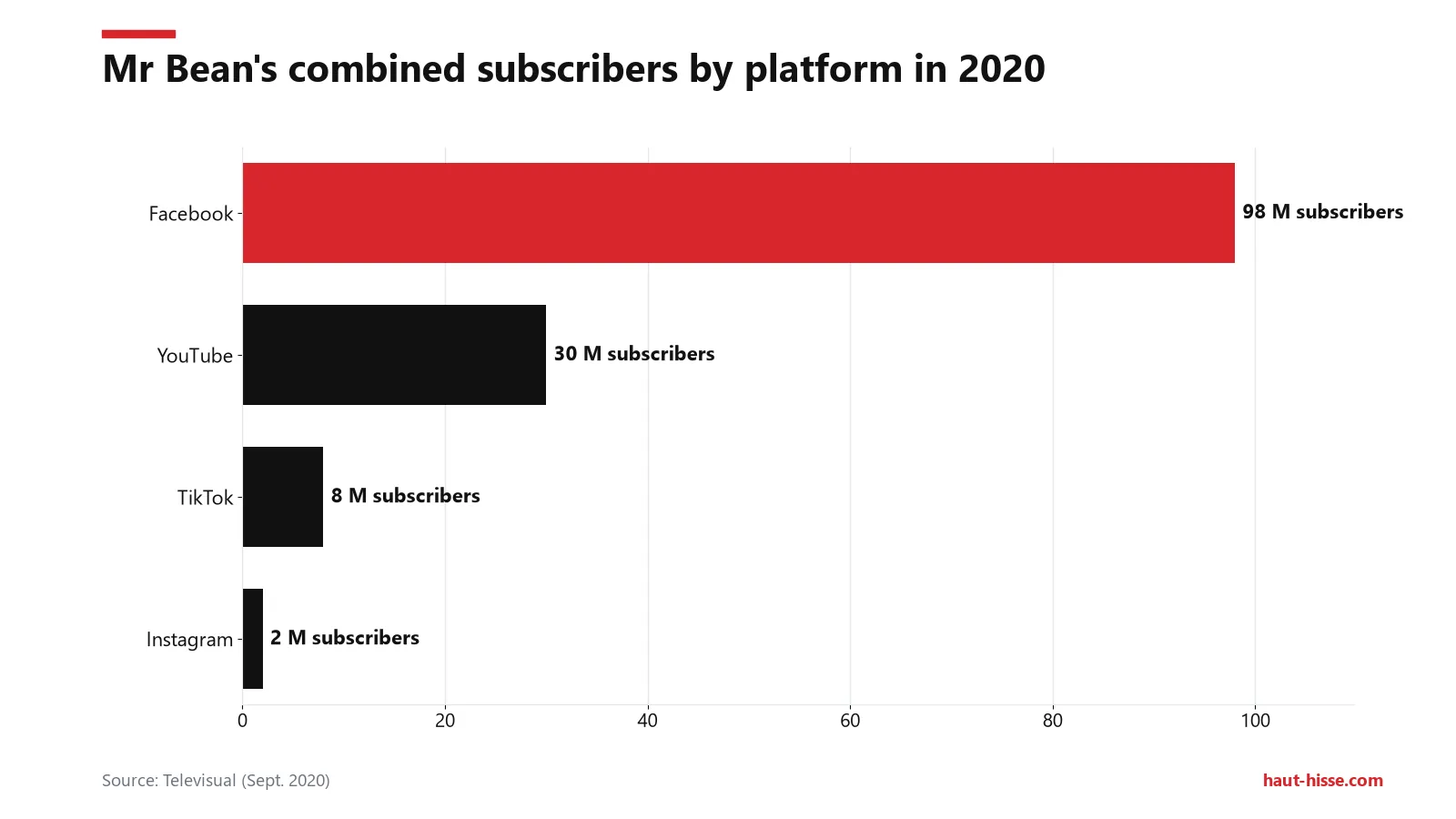
Two years later, Televisual counted about 30 million YouTube subscribers across three channels, for more than 11 billion cumulative views. Across all platforms, subscribers exceeded 137 million: 98 million on Facebook, 2 million on Instagram and 8 million on TikTok. The brand’s two mobile games had 58 million downloads in six years.
These figures measure an audience, not revenue. Advertising income depends on the viewer’s country, the format and the platform’s terms. Above all, the share that goes to Rowan Atkinson, compared with producers and rights holders, is not documented anywhere.
1997 and 2007: how much did the Bean and Mr Bean’s Holiday films earn?
The two films together total about $483 million in worldwide box office, according to Box Office Mojo (Bean, Mr. Bean’s Holiday). These are box office figures, meaning tickets sold, not Atkinson’s earnings.
The table reproduces the Box Office Mojo data.
| Film | Year | Worldwide total | International share |
|---|---|---|---|
| Bean | 1997 | $251,212,670 | 82% |
| Mr. Bean’s Holiday | 2007 | $232,227,857 | 85.7% |
Adding the two totals gives $483,440,527. In both cases, most of the gross comes from abroad: the United States contributes little, which fits the export argument. Holiday was in cinemas from 22 March 2007 to 19 January 2008.
Atkinson’s fee for Holiday is not documented, and no reliable figure is known. Much of the gross goes to cinemas, distributors and producers before it reaches a performer. Multiplying the total by an assumed percentage would only produce an invented number.
Who owns the Mr Bean rights: licensing, plush toys and games
Banijay Kids & Family holds the worldwide licensing and merchandising rights to the Mr Bean brand. That company, not the actor, therefore runs the exploitation of merchandise, according to Banijay.
In May 2024, Banijay announced three licensing agents: Bulldog in the United Kingdom, WP Brands in Australia and New Zealand, and Black White Orange in the Indian subcontinent. The company also announced a Steiff Mr Bean teddy bear, published by Danbury Mint for the United States, Germany and the United Kingdom.
The principle is that a brand lends its image to manufacturers and distributors. This differs from a retailer’s business, as described in the analysis of how Costco makes money. The two mobile games mentioned above follow the same brand logic.
These facts do not say whether Atkinson still receives a share of this licensing income, or how much. The contracts are not public.
What the filings at Companies House show
UK registers confirm that companies linked to the Mr Bean universe exist. Profit and dividend figures should be read in the filed documents: they are a line of verification, not a figure in themselves.
Hindmeck Limited (company no. 01809198) was incorporated on 16 April 1984. It is active, its business activity code is SIC 90030 (“creative arts”), and its latest accounts run to 30 April 2025, according to Companies House. It filed “total exemption full” accounts every year from 2017 to 2026, the latest on 30 January 2026, according to its filing history. The link between this company and Atkinson comes from press articles and does not appear in the accounts themselves.
Tiger Aspect Films Limited (company no. 02950699), incorporated on 20 July 1994, was named MR BEAN LIMITED from 18 August 1994 to 28 August 1996, according to Companies House. Its latest accounts run to 31 December 2023.
In March 2006, Chortle reported that the sale of Tiger Aspect, a company Atkinson co-owned, could earn him up to £4.5 million. The buyout by TWI was then valued at £30 million. That sum does not concern Mr Bean alone: the article does not mention the character.
Rowan Atkinson’s wealth, and why the figures differ
The two press estimates date from 2003, for HELLO!, and 2006, for Chortle.
In March 2006, Chortle put Atkinson’s fortune at £55 million, without mentioning Mr Bean, compared with about £60 million according to HELLO! in 2003. The gap between the two figures is probably explained by unpublished methods: assets counted, exchange rates, and the valuation of company shares. This is a hypothesis, since neither publication details its calculation. For another example of figures that look precise without being so, see the analysis of why prices end in 99.
Is Mr Bean a billionaire? No. The estimated fortunes remain in the tens of millions of pounds.
What the whole picture shows is that a small catalogue with almost no dialogue, sold across the world, can produce lasting income. The actor’s exact share remains unknown. No official earnings are published, estimates date quickly, and nothing details how revenue is split between producers, broadcasters and rights holders.
Frequently asked questions
How many Mr Bean episodes actually exist?
Fourteen, all broadcast on ITV from 1990 to 1995. The animated series, launched in 2002, adds its own sketches. Clips published online are not new episodes.
Does Rowan Atkinson still receive rights from Mr Bean?
No public document says so. Banijay Kids & Family holds the worldwide licensing and merchandising rights, but the contracts with Atkinson are not published. Any figure claimed for his current income would therefore be guesswork.
How much did Rowan Atkinson earn for Mr Bean’s Holiday?
His fee is not documented. The film grossed $232,227,857 worldwide, but that box office figure is shared between cinemas, distributors and producers. It does not measure the actor’s pay.
Is Mr Bean a billionaire?
No. The press estimates, published by HELLO! in 2003 and by Chortle in 2006, cover tens of millions of pounds. Those figures refer to the actor, not the character.
Why is Mr Bean broadcast in more than 190 countries?
The character speaks very little, which avoids dubbing and heavy adaptation. Wikipedia says this minimal dialogue has allowed the series to be sold worldwide. More than 190 countries had bought it by 2020, according to Televisual.
Sources
- Rowan Atkinson: fortune and Mr Bean sales — HELLO! (2003)
- Funny money: Rowan Atkinson’s fortune and the Tiger Aspect sale — Chortle (2006)
- Mr Bean hits 10 million YouTube subscribers — Chortle (2018)
- Mr Bean: audience and sales in 2020 — Televisual (2020)
- Bean (1997) — Box Office Mojo (2026)
- Mr. Bean’s Holiday (2007) — Box Office Mojo (2026)
- Banijay Kids & Family secures licensing agents and plush deal for Mr Bean — Banijay (2024)
- Hindmeck Limited, company profile — Companies House (2026)
- Hindmeck Limited, filing history — Companies House (2026)
- Tiger Aspect Films Limited, company profile — Companies House (2026)
- Mr. Bean (character) — Wikipedia (2026)
Prepared with the help of AI tools, then fact-checked and edited by the Haut-Hisse editorial team.


