

To learn how to be charismatic, research points to observable, trainable behaviors: metaphors, stories, an animated voice, gestures, and facial expressions. Training improves charisma ratings, but the effect is moderate, takes practice, and can veer into self-parody. No method works miracles, and existing clinical trials rely on small sample sizes.
People often cite the 7%, 38%, and 55% ratio to claim that nonverbal cues dominate communication. Yet these figures stem from two 1967 studies by Mehrabian on narrow emotional cues, not an analysis of charisma. This guide separates observed research (speech tactics, voice, gestures, framing a vision) from common myths, detailing measured effects, modest outcomes, and real limits.
Key takeaways
- Researchers define charisma as a leader’s symbolic influence grounded in emotional and ideological appeals, rather than an innate, mysterious trait.
- Antonakis’s training program covers 12 charismatic leadership tactics: 9 verbal and 3 nonverbal (gestures, facial expressions, and an animated voice).
- The 7-38-55 formula comes from two 1967 Mehrabian studies examining feelings and liking, not overall communication.
- A charismatic speech boosted worker output by 17% in a field experiment, though impact varied by social context.
- Trial sample sizes remain small, and awkward application by beginners risks turning into self-parody.
Charisma: definition and what research means by it
Researchers generally define charisma as symbolic influence exerted by a leader, built on emotional and ideological foundations. This definition remains debated, alongside a separate approach that examines everyday charisma.
The most widely cited framing comes from Antonakis, Fenley, and Liechti (2011), reported by People Matters. It states that the charismatic effect relies on signals interpreted by the audience—such as words, voice tone, and gestures—rather than formal authority.
In 2016, Antonakis, Bastardoz, Jacquart, and Shamir argued that charisma remains widely misunderstood. They pointed to vague definitions, conflation with transformational leadership (a style that rallies teams around a shared vision), unreliable questionnaires, and flawed causal models. These models are statistical analyses that jump to conclusions about one factor causing another. The authors proposed a definition rooted in signaling theory, which examines how a sender transmits information to a receiver.
Another line of research takes a different path. Tskhay, Zhu, Zou, and Rule (2017) describe an everyday charisma comprising two interpersonal dimensions: influence and affability (being warm and approachable). They validated a six-item tool, the General Charisma Inventory, presented as observable, measurable, and distinct from leadership constructs.
The word therefore carries two meanings. The first belongs to leadership: speeches, vision, and mobilizing groups. The second concerns everyday interpersonal presence. Most training trials outlined below focus on the first.
Is charisma innate or can it be learned?
Available data suggests charisma involves learned behaviors: structured training improved performance evaluations in 2011. Twin studies on leadership also show a heritable component, though without isolating charisma specifically.
Antonakis, Fenley, and Liechti (2011) directly tested whether individuals can be trained to act more charismatically. Their protocol used two experiments—one in the field and one in a laboratory. Training significantly improved charisma ratings, leader prototypicality, and leadership emergence.
On the genetic side, a 1998 twin study examined 247 adult twin pairs: 183 monozygotic (identical) pairs and 64 same-sex dizygotic (fraternal) pairs. It estimated that roughly 48% of the variance in transactional leadership stems from additive genetic heritability (the sum of individual gene effects). For transformational leadership, roughly 59% of the variance appeared linked to non-additive heritability (gene interactions).
That study does not resolve the charisma debate. Its measures relied on self-reports and evaluated general leadership rather than charisma alone.
The nature-versus-nurture dichotomy is therefore an oversimplification. Research points instead to trainable behaviors layered on top of baseline dispositions. Can charisma be learned? The most cautious answer is: partly, with moderate average effects and no guaranteed outcomes.
Some mainstream articles, such as coverage by WEKA, portray charisma alternately as an innate gift and a skill, citing Wiseman and Riggio without dates or formal citations.
How to be charismatic: tactics identified by research
The Antonakis program centers on 12 charismatic leadership tactics: 9 verbal and 3 nonverbal. Unlike vague advice about “presence,” these behaviors can be described, practiced, and evaluated.
The table below summarizes the tactics detailed by the British Psychological Society’s Research Digest. The right-hand column outlines observable examples in a speech.
| Tactic | Type | What you observe |
|---|---|---|
| Metaphors | Verbal | An image linking the idea to a familiar situation |
| Stories and anecdotes | Verbal | A short narrative illustrating the message |
| Moral conviction | Verbal | Framing the issue around core values |
| Collective sentiments | Verbal | Expressing what the group feels |
| High expectations | Verbal | Setting an ambitious goal for the group |
| Confidence | Verbal | The speaker communicating confidence |
| Contrasts | Verbal (rhetorical device) | Pairing two opposite terms in one sentence |
| Lists | Verbal (rhetorical device) | A concise enumeration of points |
| Rhetorical questions | Verbal (rhetorical device) | Asking a question without expecting an answer |
| Gestures | Nonverbal | Hand and body movements that accompany the message |
| Facial expressions | Nonverbal | Expressions matching the content of the message |
| Animated voice | Nonverbal | A dynamic tone rather than a monotone delivery |
Verbal tactics
Nine of the twelve tactics rely on language: metaphors, stories and anecdotes, moral conviction, collective sentiments, high expectations, confidence, and three rhetorical devices (contrasts, lists, and rhetorical questions).
These tactics map onto two broader concepts. Communicating a vision relies on setting high expectations, expressing confidence, and stating moral convictions. Emotional resonance relies on articulating collective feelings, supported by facial expressions and voice inflection. These links represent practical interpretations rather than formal categories in the original curriculum.
Voice and body language: the three nonverbal tactics
The three nonverbal tactics are body gestures, facial expressions, and an animated voice. According to People Matters, these are harder to master than verbal tactics and depend heavily on cultural context.
When it comes to vocal delivery, science offers no single recipe. A systematic review by Michalsky and Niebuhr (2019) tested ten common myths about charismatic speech, including the interaction between verbal and nonverbal cues, prosody (rhythm and intonation), breathing patterns, and fundamental frequency (average pitch). The findings were mixed: some claims held up, others were refuted, and several remained inconclusive. Rigid targets for pitch or breathing exercises lack empirical backing.
The 7-38-55 myth: do voice and gestures drive everything?
No. The 7%, 38%, and 55% rule does not prove that body language and tone override words in every situation. It comes from two 1967 Mehrabian studies conducted under highly specific laboratory conditions.
One of these papers, “Decoding of inconsistent communications,” was authored by Mehrabian and Wiener (Journal of Personality and Social Psychology, 6(1), 109–114). In Silent Messages (2nd edition, 1981), Mehrabian explicitly stated that his formulas apply only to communications about feelings and attitudes (liking versus disliking). He added that the exact numerical values in his equation are approximate, according to a blog article citing these excerpts.
The same source notes that the findings applied to conflicting messages where spoken words contradicted nonverbal signals. Listeners did not know the speaker, the setup was artificial, and the sample size was very small. These details come from a secondary source and are not verified in the original paper.
The rule has been broadly misapplied as a universal law. Charisma research demonstrates otherwise: 9 of the 12 core tactics are verbal, meaning content matters. Work on your delivery and body language, but prioritize crafting the message: an apt metaphor or a relevant story remains central to observed charisma.
How researchers measure leadership charisma
Charisma research relies on third-party assessments and behavioral metrics rather than self-evaluations alone. Even so, researchers acknowledge that survey questionnaires in the field have historically suffered from low reliability.
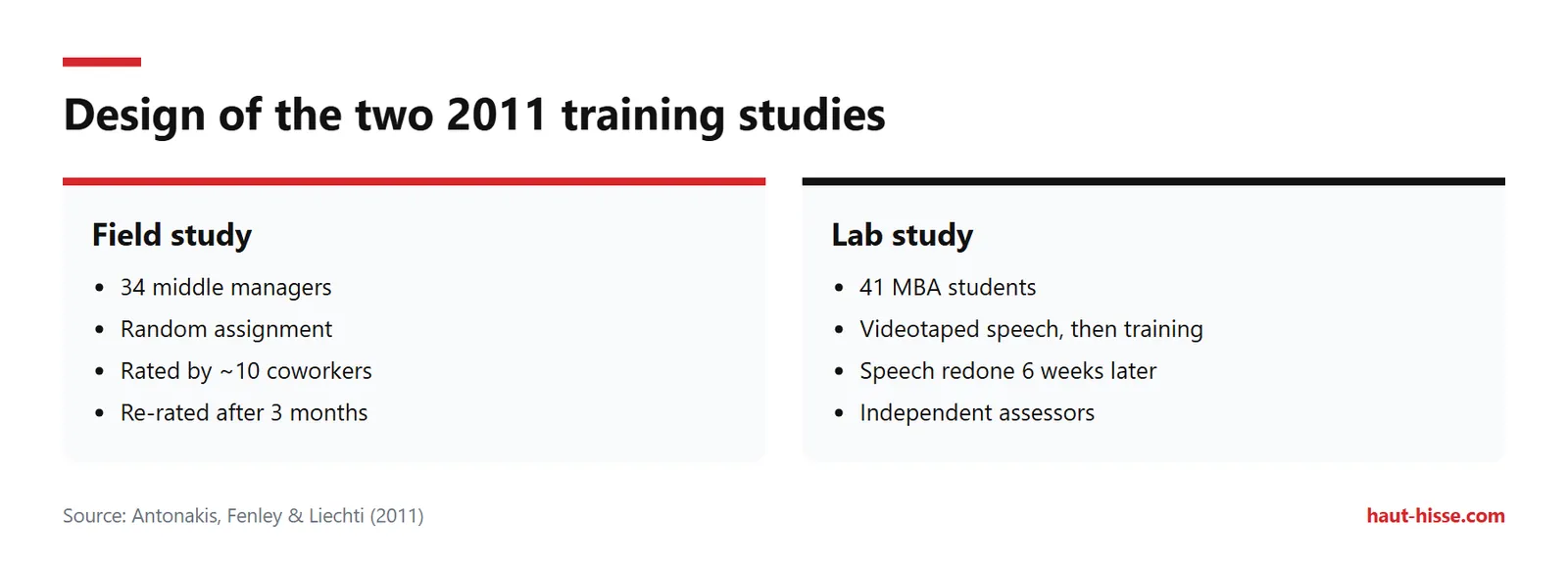
In the 2011 field experiment, 34 middle managers were evaluated by themselves and by roughly ten coworkers each. Participants were randomly assigned to a training group or a control group. Training took place one month after the baseline measurement, and follow-up ratings were collected three months later.
The accompanying laboratory experiment involved 41 MBA students. Each student delivered a filmed speech, completed the training, and delivered the speech again six weeks later. Independent raters assessed the performances.
The 2016 review urges caution when reviewing older studies due to weak questionnaires and poorly specified causal models. For everyday presence, the General Charisma Inventory by Tskhay and colleagues uses six items to evaluate influence and affability.
Another approach measures hard behavioral outcomes. In a 2021 experiment detailed on John Antonakis’s University of Lausanne page, researchers evaluated charisma through the speed and quality of work completed. This eliminates reliance on subjective participant impressions.
Does charisma training produce measurable results?
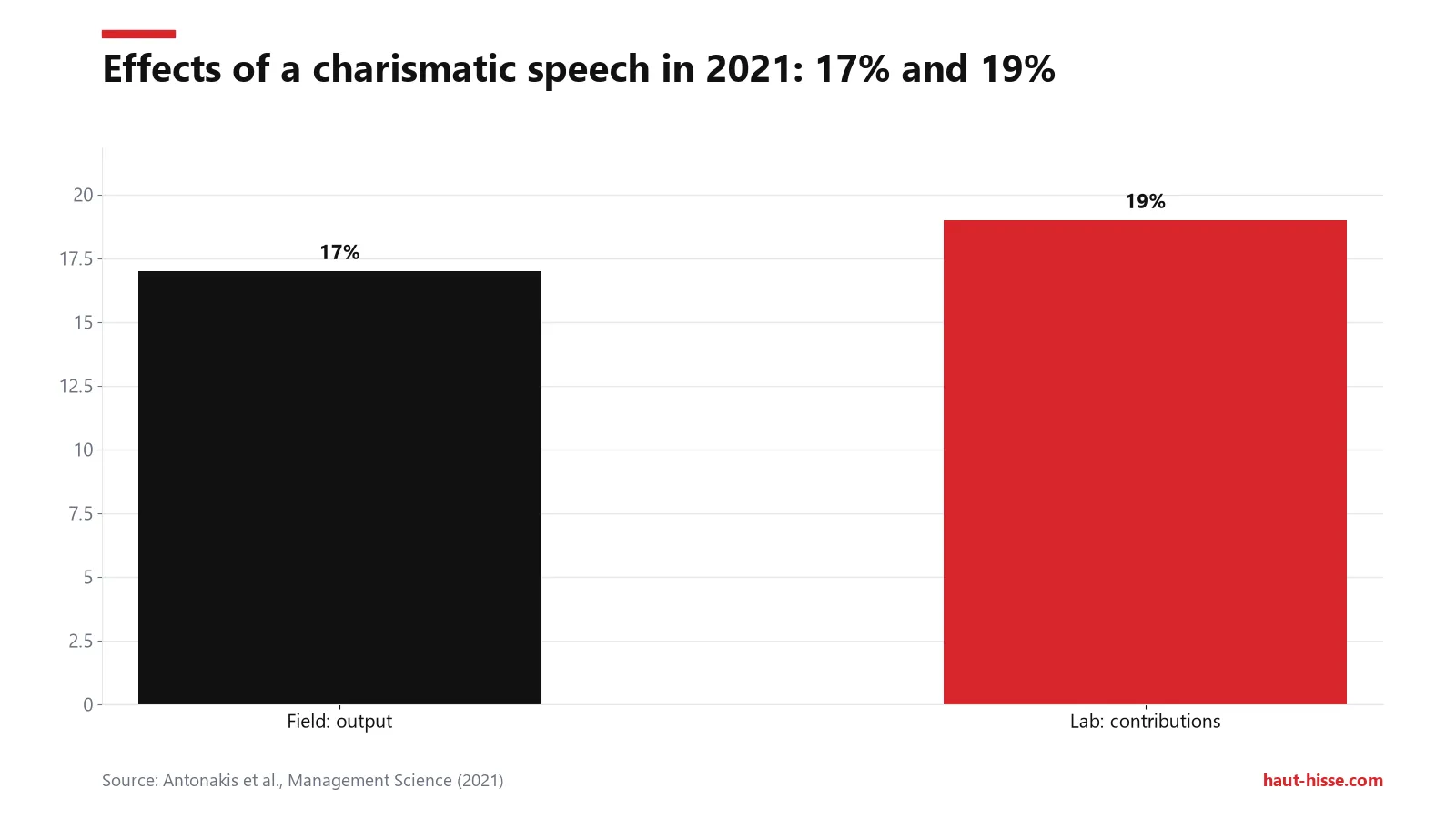
Yes, but effects are moderate and limited to the observed timeframes. The 2011 training lifted charisma evaluations, while a charismatic speech led to a 17% increase in output in a 2021 field trial.
The table below summarizes the four trials examined here. The 2021 figures come from the study published in Management Science.
| Study | Sample | Follow-up period | Result |
|---|---|---|---|
| 2011, field | 34 middle managers | 3 months | Gains in charisma ratings, leader prototypicality, and leadership emergence |
| 2011, laboratory | 41 MBA students | 6 weeks | Speeches incorporating more tactics received higher ratings (trust, competence, influence, affect, prototypicality) |
| 2021, field | Mail sorting workers | Not specified | Output roughly 17% higher following a charismatic speech compared to a standard speech |
| 2021, laboratory | Public goods game participants | Not specified | Contributions up to 19% higher, depending on the social context |
The terms from the 2011 study have distinct meanings. Leader prototypicality reflects how closely a person fits the group’s mental image of an ideal leader. Leadership emergence describes the group’s tendency to recognize that person as their leader. Secondary reports describe the training effect as moderate, while the study’s abstract provides no exact numerical effect size.
The 2021 trial offers a practical example. According to John Antonakis’s profile, it compared three scenarios: fixed pay with a standard speech, fixed pay with a standard speech plus a piece-rate bonus above a production threshold, and fixed pay with a charismatic speech. The researchers tracked both output quality and quantity. According to the Management Science study, output rose by approximately 17% with the charismatic speech compared to the standard speech—an effect comparable to substantial financial bonuses.
In laboratory public goods games—where participants choose how much to contribute to a shared group pot—speeches with more charismatic markers increased contributions by up to 19%. However, speech effectiveness shifted depending on the broader social context.
Duration remains an open question. Tracking in these studies ended at six weeks and three months. No trials demonstrate longer-lasting effects.
Limitations, self-parody, and self-confidence
Charisma advice faces clear constraints: small trial samples, inconsistent outcomes across settings, and a genuine risk of self-parody. Self-confidence has not been proven as either a direct cause or a simple byproduct of charisma.
The authors of the 2011 research caution that mastering these tactics requires significant time; there are no shortcuts, and clumsy implementation by beginners can easily lead to self-parody. They characterized this pitfall as a “pantomime hand gesture and excruciating metaphor,” as reported by the BPS Research Digest. Both 2011 trials involved only a few dozen individuals, meaning results may not generalize across all professional settings.
Charisma does not guarantee broader effectiveness either. In two 2022 experiments, trained actors appeared in videos following a 2×2 design: charismatic versus neutral delivery, featuring female and male leaders. Charismatic delivery had no measurable effect on misinformation detection, persuasion, or prosocial behavior. In fact, participants recalled fewer messages from the charismatic leader than from the neutral leader. The 2021 findings in Management Science echo this conditional impact: the effectiveness of a speech depends heavily on the surrounding social context.
Self-confidence presents similar ambiguities. A career guide on Rekrute, based on a 2008 post, claims that “to win over others, you must first master yourself,” offering neither exercises nor evidence. The training trials reviewed here do not measure the impact of self-confidence on charisma ratings. Those interested in mindset can consult material on positive thinking by Napoleon Hill, though without expecting scientific validation.
Another popular concept is congruence. Discussed in La Libre (2017) based on a book by Catherine Berliet, congruence is presented as advice rather than a proven metric: aligning who you are, what you do, and what you say.
How to be charismatic in meetings and interviews
In meetings and interviews, focus on a few structured tactics at a time and practice them over several weeks. This protocol adapts the isolated tactics studied by researchers, though it has not been tested as a stand-alone interview method.
- Pick one core message and illustrate it with an image (a metaphor) or a short anecdote.
- State the shared goal alongside an ambitious yet achievable expectation. This combines collective sentiments, high expectations, and confidence.
- Use a contrast, a three-part list, or a rhetorical question to emphasize important points.
- For nonverbal delivery, focus on practicing just one behavior at a time (gestures, expressions, or vocal variety). These are harder to internalize and sensitive to context.
- Film your delivery or gather candid feedback, then redeliver the remarks several weeks later, mirroring the 2011 experimental setup.
In job interviews, stick to the verbal tactics and keep physical gestures subtle to prevent overacting. None of the studies cited show an impact on hiring outcomes; this routine trains speaking habits without promising job offers.
In meetings, assess your social setting. The 2021 experiments demonstrate that speech reception varies by group dynamic. A personal story that resonates with long-time team members may fall flat in front of unfamiliar stakeholders.
Frequently asked questions
What traits make a person charismatic?
Research focuses on observable behaviors rather than fixed personality traits. Tskhay and colleagues identified two dimensions of everyday charisma: influence and affability. In spoken communication, proven tactics include moral conviction, high expectations, and expressions of confidence.
How can you improve your voice and body language to be more charismatic?
Focus on practicing a single nonverbal tactic at a time, record your delivery, and review your progress several weeks later. Gestures, facial expressions, and vocal variety are harder to learn than verbal tactics. A review by Michalsky and Niebuhr shows mixed evidence regarding common vocal training claims.
How can you be charismatic if you are shy?
The relationship between shyness and charisma is not documented in the training trials cited, so caution is warranted. Because charismatic tactics consist of specific, concrete behaviors, you can practice them one at a time—such as opening with a concise metaphor or brief anecdote—before worrying about gestures or vocal pitch.
Does charisma differ between men and women?
No definitive evidence shows that charisma functions differently across genders. In a 2022 experiment evaluating male and female leaders in charismatic and neutral conditions, charisma changed neither persuasion nor prosocial behavior for either group. The tactics documented in training trials apply identically across genders.
Sources
- Antonakis, Fenley, and Liechti, charisma training experiments — Academy of Management Learning & Education (2011)
- Charisma involves teachable behaviours — British Psychological Society, Research Digest (2011)
- Can charisma be taught to leaders — People Matters
- Antonakis, Bastardoz, Jacquart, and Shamir, charisma literature review — Annual Review of Organizational Psychology and Organizational Behavior (2016)
- Tskhay, Zhu, Zou, and Rule, everyday charisma — Journal of Personality and Social Psychology (2017)
- Antonakis et al., charismatic speech and worker productivity — Management Science (2021)
- John Antonakis’s research profile on charisma — University of Lausanne
- Mehrabian and Wiener, Decoding of inconsistent communications — Journal of Personality and Social Psychology (1967)
- Ignore the big 55-38-7 myth of nonverbal communication — Cutting Edge PR
- Michalsky and Niebuhr, ten myths about charismatic speech — AUC Philologica (2019)
- Experiments on leader charisma and its effects — The Leadership Quarterly (2022)
- Nature vs nurture: are leaders born or made? — Twin Research and Human Genetics (1998)
- Charismatic people: how to persuade as a manager — WEKA
- How to develop charisma — Rekrute (2008)
- How do you develop charisma? — La Libre (2017)
Prepared with the help of AI tools, then fact-checked and edited by the Haut-Hisse editorial team.


