


In 1900, Michelin printed 35,000 copies of a 400-page guide, given away to motorists who bought tires when France had fewer than 3,000 cars. The origin of the Michelin Guide was a commercial tactic: founders Édouard and André Michelin offered travel tips to encourage driving, wear out tires, and boost replacements before introducing dining reviews in 1926.
Key takeaways
- The first 1900 guide was a free 400-page promotional booklet given to tire buyers.
- Michelin dates the switch to paid sales to 1920, while Wikipedia and Andy Hayler point to 1922.
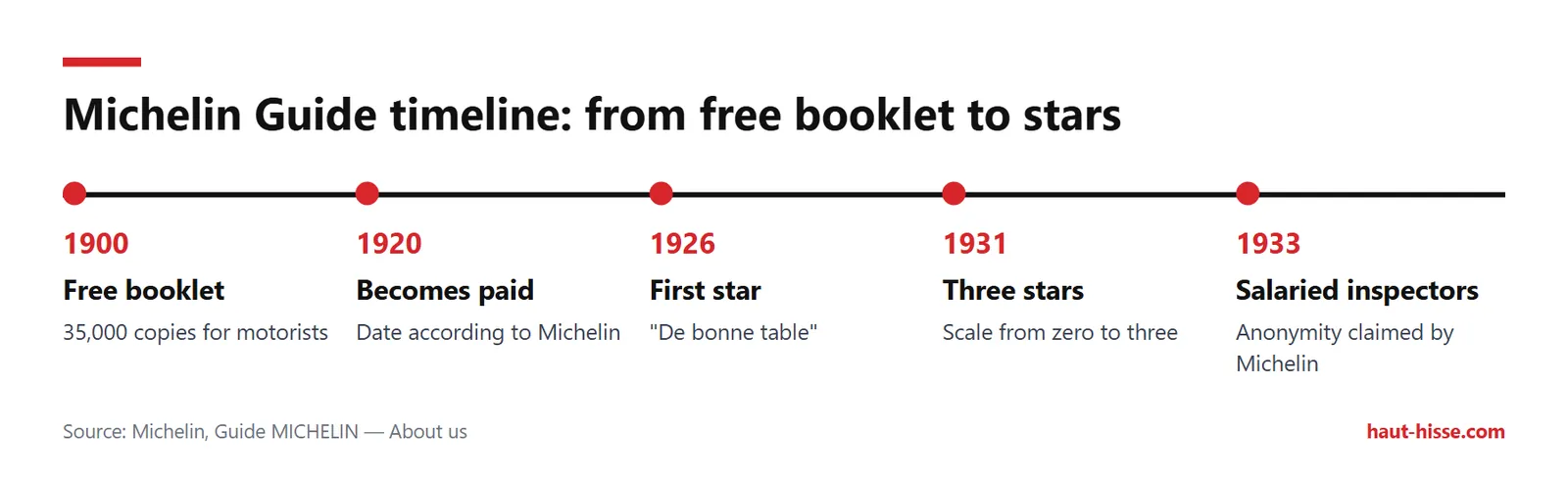
- The first star appeared in 1926, with second and third stars introduced in 1931 according to Michelin.
- Anonymous inspectors, employed directly by Michelin, were introduced in 1933.
- In 2011, the guide business lost over €15 million a year, according to the Financial Times as reported by Tyrepress.
1900: 35,000 free guides for fewer than 3,000 cars
The first Michelin Guide appeared in 1900: a free promotional booklet of around 400 pages, published by tire manufacturer Michelin and handed out to drivers.
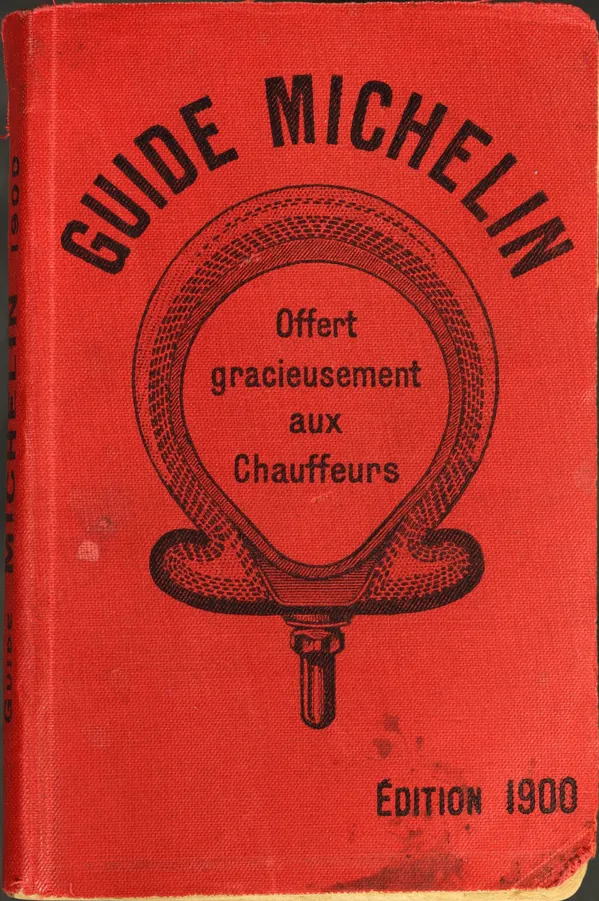
The print run reached 35,000 copies, distributed to motorists purchasing tires, according to Michelin. The guide was originally a gift tied to a purchase, not an editorial product sold on its own.
The historical context explains this move. According to Wikipedia, citing Michelin, France had fewer than 3,000 cars on its roads at the time. Food critic Andy Hayler gives a similar estimate. Other sources suggest around 3,500 cars, though this difference does not change the broader picture.
A print run of 35,000 copies for a fleet of just a few thousand vehicles shows the guide targeted far more drivers than those already on the road.
What was inside the 1900 edition
The first edition combined mechanical advice with travel listings. According to Michelin’s feature on the guide’s history, it included:
- repair garages and doctors;
- road maps and city plans;
- practical advice, such as changing a tire or refueling.
The stated aim was to “provide all information that may be useful to a driver traveling in France,” according to the same source. Restaurants were not the focus of the booklet; they appeared later when the guide shifted its purpose.
1900: the tire-and-mileage strategy
A tire manufacturer publishes a travel guide because drivers on the road wear out tires. According to Wikipedia, the Michelin brothers wanted to increase tire demand.
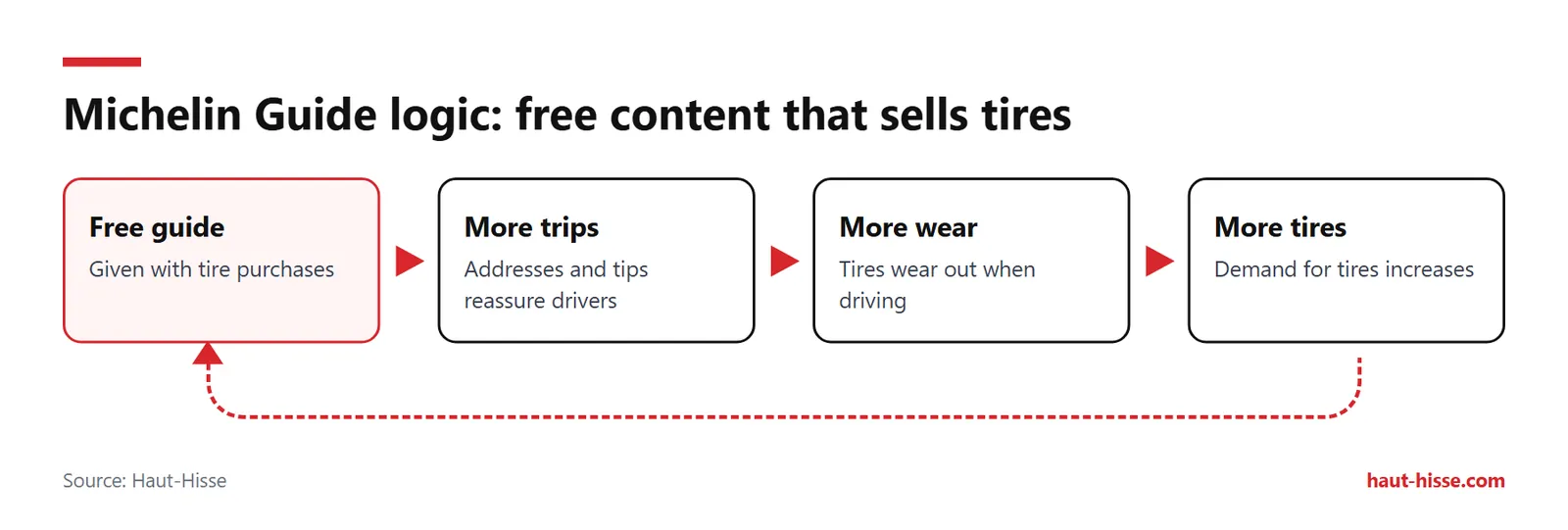
The mechanism follows a direct chain: more road trips cause more wear, leading to more tire sales. The guide gave motorists reasons to travel and practical tips to avoid fearing breakdowns. A free product drove usage, and usage drove demand for the paid product.
In 1900, Michelin did not rate anything; it provided practical information. Ratings came later with restaurant listings, followed by stars.
This approach mirrors what is now called content marketing: helpful free content distributed alongside a product to create consumer demand. Other brands also use content to drive sales, as seen in Liquid Death’s brand strategy, though the product and era differ.
The cited documents do not quantify the return on investment for this strategy; there are no figures showing how many tires the guide helped sell.
1920: charging for the guide and ending free distribution
According to Michelin, the guide began charging in 1920. The following year, advertisements were removed, and hotels and restaurants entered the publication under a dedicated ranking system.
The official chronology follows two steps: an end to free copies in 1920, followed in 1921 by dropping advertisements and adding rated hotels and restaurants. The 7-franc price involves differing dates, detailed in the table below (1921 according to Michelin, 1922 according to Wikipedia and Andy Hayler).
An anecdote surrounds this transition. According to Wikipedia, André Michelin allegedly saw copies of the guide being used to prop up a workbench in a garage. He reportedly concluded that people only respect what they pay for. This story lacks primary documentation. It also does not mean the guide became paid immediately, as free editions continued until 1920.
Charging for content changed how the guide was perceived. It shifted from a promotional brochure to a reference work—something difficult to achieve with a free giveaway included with tires. No sales or circulation numbers are documented after 1900, so the effect on its reputation remains qualitative.
1926: the first star for fine dining
The first star, awarded for “good cooking” (“de bonne table”), appeared in 1926. Second and third stars were added in 1931 according to Michelin, establishing a zero-to-three-star scale.
1926: recognizing selected tables
According to Michelin, the first star for “good cooking” was introduced in 1926. Six years after switching to a paid format, the guide moved beyond simply listing restaurants to singling out specific establishments.
1931: the one-to-three-star rating scale
Michelin introduced the second and third stars in 1931. That same year, according to Wikipedia, the cover changed from blue to red: the red cover dates from 1931, not from the original 1900 release.
1936 and postwar: published criteria and an Allied reprint
In 1936, Michelin published its grading criteria. A single star denoted “a very good restaurant in its category,” according to Wikipedia.
Publication was suspended during World War II. In 1944, the 1939 French guide was reprinted at the request of Allied forces for military use, and publication resumed on May 16, 1945, according to the same source.
A clear, straightforward star rating gave the guide recognizable authority, as a single symbol conveyed an entire assessment.
1933: anonymous, salaried inspectors
Michelin inspectors, employed directly by Michelin, were introduced in 1933. According to Michelin, anonymity and independence from visited establishments are the guide’s defining principles.
The official website describes them as the “main architects of the MICHELIN Guide since 1933.” They work for Michelin, not for restaurants.
Anonymity and independence remain claims made by Michelin and should be understood as such.
Funding introduces a nuance. Tourism boards pay to bring the guide to their regions, as detailed in the business section below. According to Wikipedia, Michelin maintains that restaurant selections are made exclusively by its inspectors.
1920, 1921, or 1922: timeline discrepancies across sources
Several key dates differ depending on the source: the switch to paid sales (1920, 1921, or 1922) and the three-star scale (1931 or 1933). The table compares these accounts and outlines what can be stated with confidence.
| Event | Michelin account | Wikipedia or Andy Hayler account | What can be stated cautiously |
|---|---|---|---|
| Switch to paid sales | 1920; 7 francs in 1921 on the “long history” page | 1922, at 7 francs (Wikipedia, Hayler) | The guide became paid in the early 1920s; the exact date depends on the source |
| One-to-three-star scale | 1931 | 1933 according to Hayler | 1931 according to Michelin; 1933 according to Hayler |
| Inspectors | 1933 | No discrepancy noted | 1933 according to Michelin |
The simplest approach when reading these dates is to cite the specific source (“according to Michelin”) rather than settling on one version.
2011: a guide running at a financial loss
In 2011, according to the Financial Times as reported by Tyrepress, the guide division was losing over €15 million per year, representing less than 1% of Michelin’s total revenue. The same report noted that Accenture, hired by Michelin in 2010, projected annual losses of €19 million by 2015 if operations remained unchanged.
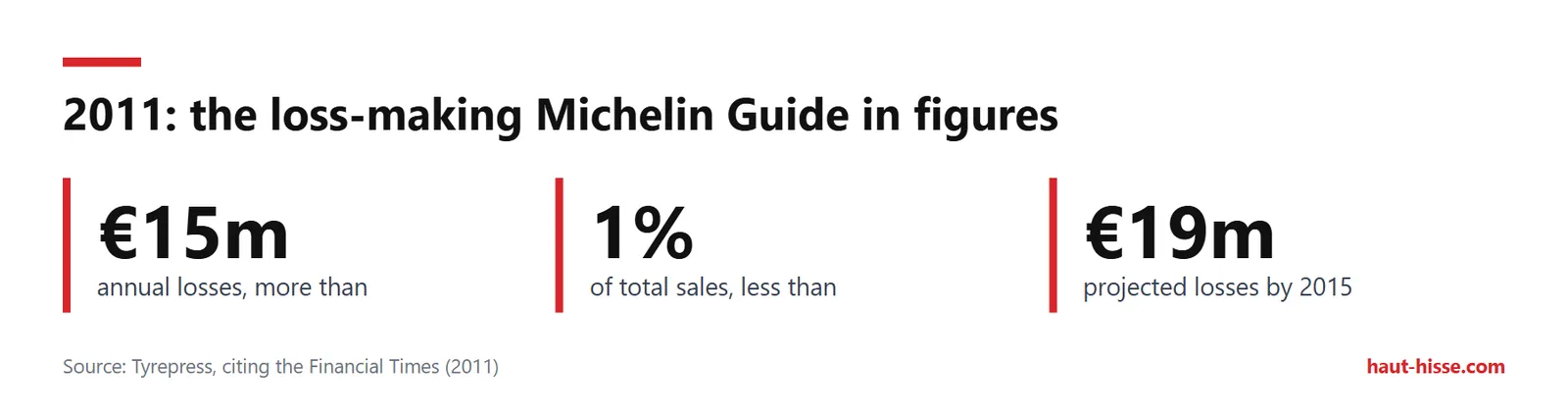
These figures date to 2010–2011 and do not reflect current operations.
A guide operating at a loss can still benefit a parent company, much like loss-making divisions that support broader sales elsewhere. Costco offers another example of this dynamic in a different sector. For Michelin, none of the cited sources measure this indirect financial benefit.
Part of the funding comes from regional entities. Tourism boards pay to attract the guide: South Korea paid 3.2 billion won, and Thailand paid 144 million baht over five years. The brand maintains that its inspectors decide selections independently.
These documented payments come from tourism boards, not from restaurants.
The current business model
The cited sources identify two revenue streams: sales of the guide, which has been sold for a fee since the early 1920s, and tourism board partnerships. None provide recent data on the breakdown between these sources or on the guide’s current profitability.
What the Michelin Guide reveals about content marketing
The guide’s history illustrates how useful content can support core product sales before turning into a valuable brand asset. Documented facts also point out its limits.
The model developed in three phases:
- A free booklet tied to tire purchases in 1900.
- A paid book featuring graded listings between 1920 and 1922, depending on the source.
- Stars and inspectors between 1926 and 1933.
The guide’s authority relies on the stated independence of its inspectors. A ranking published by a tire maker only carries weight if readers believe it cannot be bought.
Clear limitations remain:
- the exact effect on tire sales is unquantified;
- the workbench anecdote lacks primary source documentation;
- several historical dates vary across sources;
- the only disclosed financial figures date to 2011 and show a loss.
Content decisions often create indirect consequences that creators do not anticipate, a dynamic that second-order thinking helps assess. Shifting from a free gift to a paid product altered the guide’s role far beyond its cover price.
This case demonstrates a specific mechanism rather than a universal formula.
Frequently asked questions
Why is the Michelin Guide cover red?
The cover has been red since 1931. According to Wikipedia, Michelin switched the color from blue to red that year. The cited documents do not explain why that choice was made.
Do restaurants pay to receive a Michelin star?
Documented payments come from tourism boards, not restaurants. Wikipedia mentions South Korea and Thailand. According to Michelin, its inspectors make all selection decisions independently.
What do one, two, and three Michelin stars mean?
The scale runs from zero to three stars, established in 1931 according to Michelin. In 1936, Michelin published its criteria: one star denotes “a very good restaurant in its category,” according to Wikipedia.
Who pays Michelin inspectors?
Michelin employs them directly. According to the guide’s official website, they are Michelin employees, introduced in 1933, whose anonymity and independence from visited establishments are stated principles of the brand.
Sources
- Guide MICHELIN — About Us — Michelin
- The MICHELIN Guide, a long history — Michelin (2020)
- Michelin Guide — Wikipedia
- Michelin history — Andy Hayler (2012)
- Guides costing Michelin 15 million euros a year — Tyrepress (2011)
Prepared with the help of AI tools, then fact-checked and edited by the Haut-Hisse editorial team.


