



In 1975, 24-year-old Kodak engineer Steven Sasson built a digital camera prototype using a CCD sensor. The device produced 100×100 pixel black-and-white images, taking 23 seconds to record one onto a cassette tape, according to BGR.
Key takeaways
- Kodak actually invented the digital camera in 1975, but shelved the prototype to protect its highly profitable film business.
- High profit margins on film made management hesitant to adopt digital tech that would cannibalize those earnings.
- Massive pension liabilities, declining sales, and an overstretched cash flow pushed the company into Chapter 11 bankruptcy on January 19, 2012.
- Today, Kodak operates as a much smaller commercial printing and advanced materials company, employing about 3,500 people.
If you look into why Kodak went bankrupt, the answer comes down to a repeated trade-off: protecting highly profitable film while digital technology, invented internally, replaced it. Debt, depleted cash reserves, and plunging sales did the rest as Kodak filed for bankruptcy on January 19, 2012.
With about 3,500 employees and $1.069 billion in revenue according to its 2025 annual report, this is the current size of a company that once developed one of the first digital cameras. The common narrative that “Kodak missed the digital wave” does not hold up against public documents.
1975: The first digital camera ends up on the shelf
The first digital camera was created inside Kodak by engineer Steven Sasson, but management did not see it as a product worth launching.
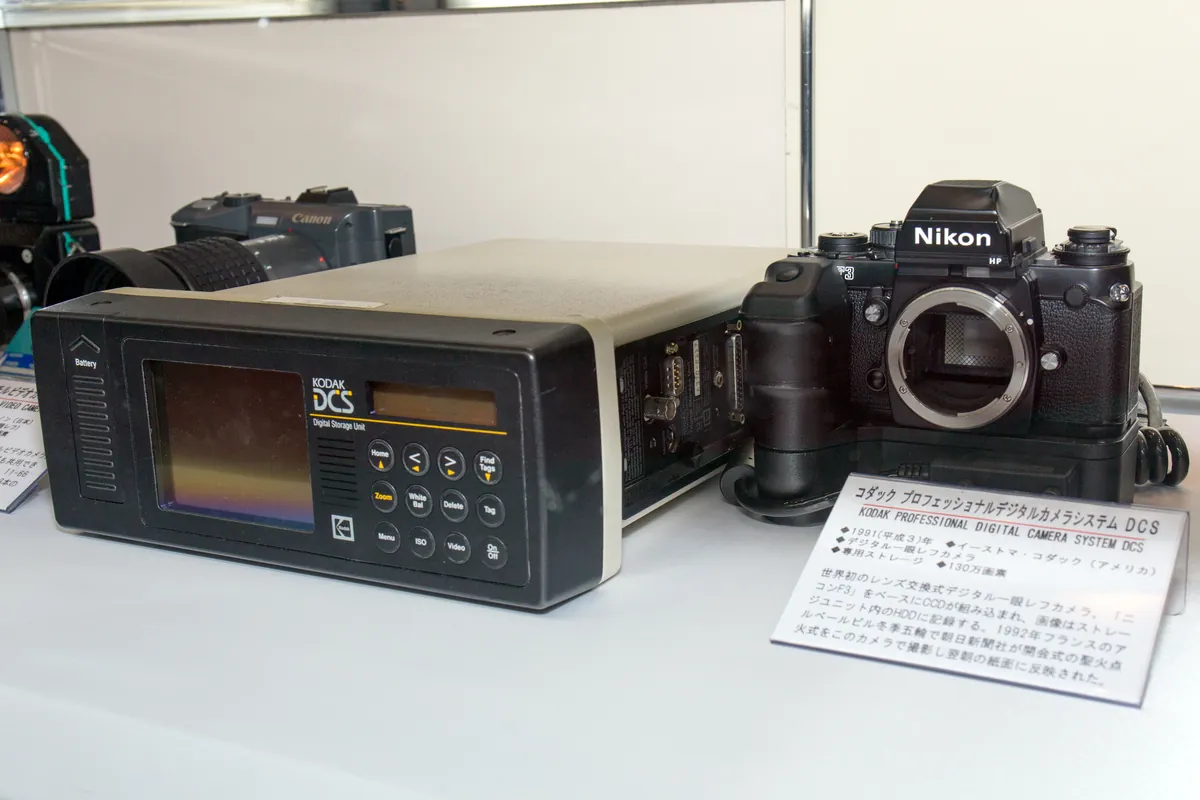
The 1975 prototype relied on a CCD sensor—a component that turns light into an electrical signal—and stored its images on a cassette.
Who invented the first digital camera? A Kodak engineer. The reaction from upper management is well known: according to BGR, executives believed the public would prefer paper prints over mediocre digital images. Sasson himself predicted that digital would compete with film within 15 to 20 years.
The tension was set right from that date. The invention came from within, and it threatened the very business that sustained the company.
Why didn’t Kodak commercialize digital technology sooner?
According to BGR, Kodak reportedly dropped plans to commercialize its 1989 digital SLR out of fear of ruining its film sales; the source uses the word “apparently.” Cannibalization refers to a new product taking customers away from an existing product made by the same company.
The fear of cannibalizing film
In 1989, Steven Sasson and Robert Hills built a 1.2-megapixel digital SLR with compression and a memory card. Kodak chose not to sell it, apparently out of fear of ruining its film sales, reports BGR.
The group did not lack technology. According to this source, the concern centered on revenue from its core business.
High film margins
According to the Rochester Business Journal, Kodak’s gross margin (the share of revenue left after production costs) stood at 46% five years before January 2004. The same article calls film a “cash cow,” a business to milk in mature markets.
With margins that high, every digital camera that prevented a film purchase reduced very profitable revenue. The opportunity cost was steep for management.
Digital was not absent
Kodak did sell digital products. In 1991, it launched the Professional Digital Camera System (DCS), a 1.3-megapixel body built from a modified analog Nikon F3, still according to BGR.
At the time of its bankruptcy filing, Kodak itself stated that it had partly blocked its own digital technology out of fear of harming its film business, according to the Associated Press.
Did Kodak really miss the digital shift? It was not a lack of technology or products: according to the cited sources, fear for film sales weighed heaviest. A comparable mechanism appears in other business models where a highly profitable activity dictates corporate choices: how Costco makes money offers another example.
2003: The digital plan and the dividend trap
In September 2003, Kodak announced a major shift toward digital, but it had to fund this transition while managing the decline of film and paying out shareholder dividends.
The plan called for $3 billion in investments and acquisitions to reach $16 billion in revenue by 2006, along with a reduced dividend, according to the Rochester Business Journal. The context pressured the company, and in January 2004 the chief financial officer made a bet visible in the figures:
| Element (source: Rochester Business Journal) | Figure |
|---|---|
| Planned investments and acquisitions | $3 billion |
| Target revenue in 2006 | $16 billion |
| Dividends paid | $528 million in 2002, $330 million in 2003 (−38%) |
| Global consumer film volumes in 2003 | down about 8% |
| Planned job cuts | 12,000 to 15,000, up to 23% of the workforce |
| Anticipated margins for 2006 | Digital (high end of the 20% range) and declining film, converging toward 31% |
The dividend cut meant about $198 million less for shareholders (editorial calculation based on figures from the Rochester Business Journal). The plan assumed that digital would become nearly as profitable as the business it was replacing.
Albéric Tellier offers a more nuanced view of the conventional narrative. In Annales des Mines (Gérer et comprendre, September 2024), he writes that disruption theory (the idea that initially inferior technology eventually supplants established players) does not fully explain Kodak’s decline. Based on data published between September 2003 and January 2008, he highlights that shareholders rejected the initial digital strategy.
Revenue slump 2009-2011: What annual reports show
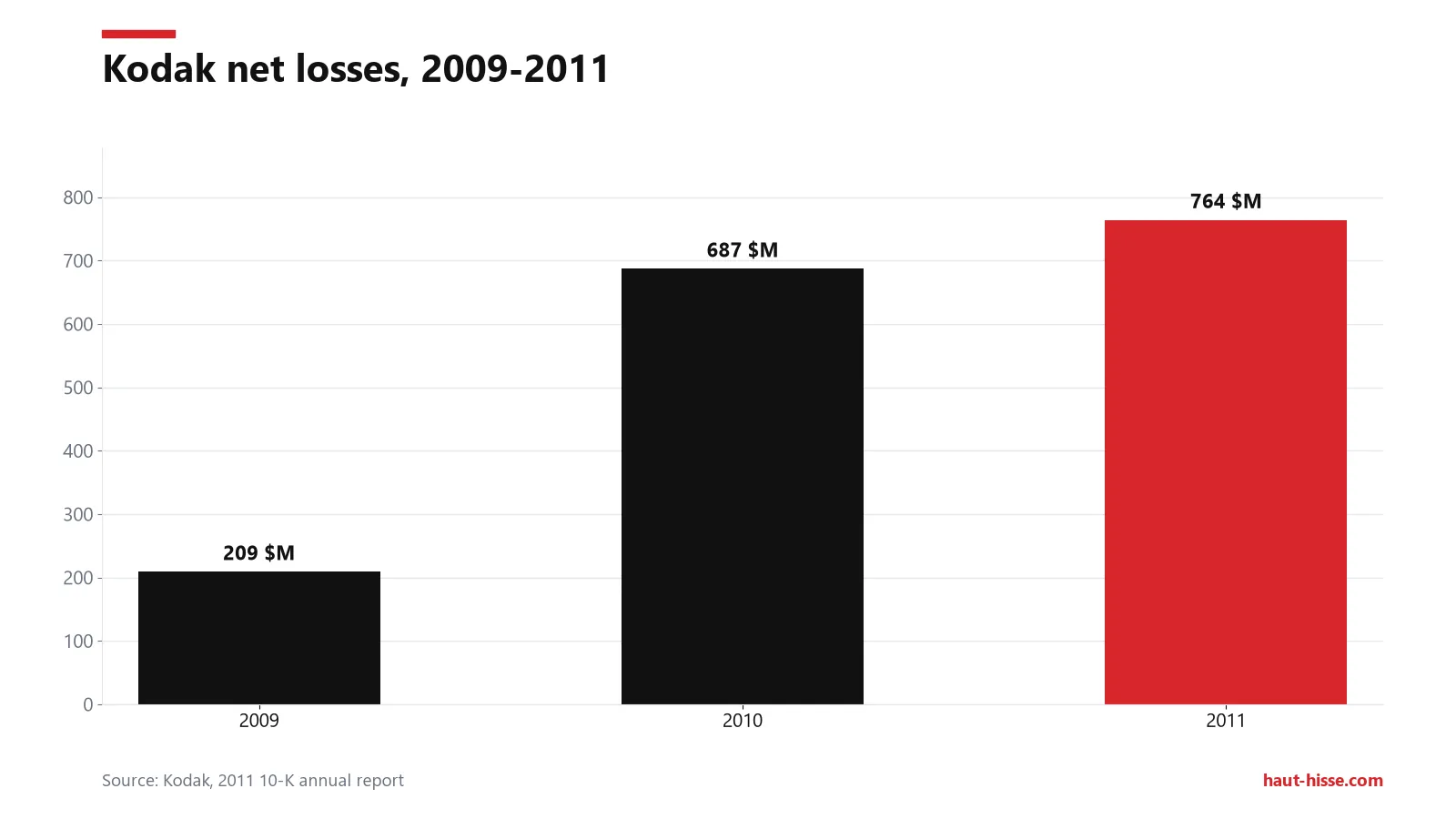
Between 2009 and 2011, according to the 2011 annual report, Kodak’s revenue dropped from $7,609 million to $6,022 million, and losses widened each year.
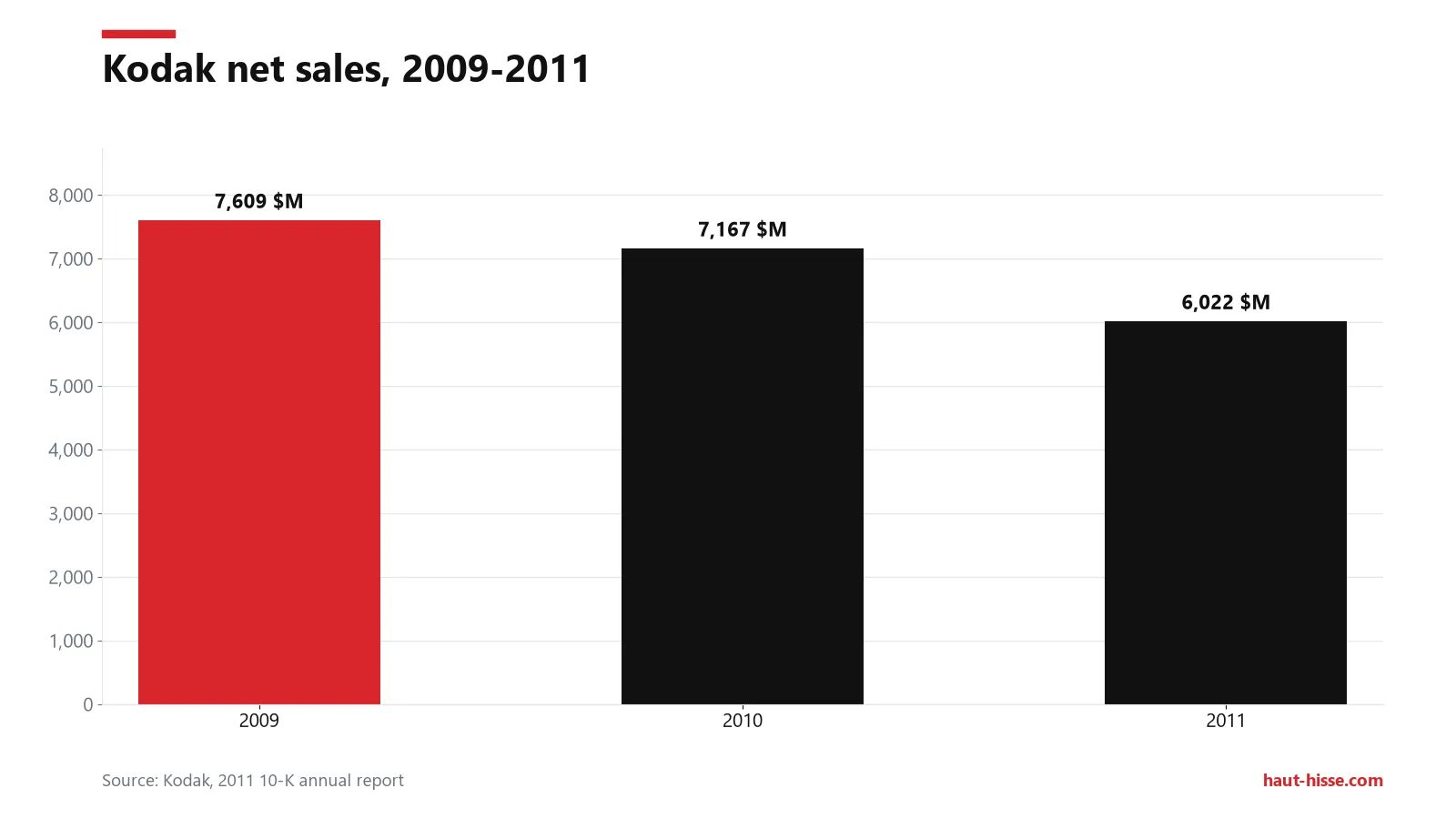
The table below shows figures for continuing operations published in the 2011 annual report filed with the SEC, the US financial markets regulator.
| Year | Net revenue | Net loss |
|---|---|---|
| 2009 | $7,609 million | $209 million |
| 2010 | $7,167 million | $687 million |
| 2011 | $6,022 million | $764 million |
Over these three fiscal years, sales dropped by $1,587 million—more than a fifth of its 2009 revenue—and cumulative losses reached $1,660 million (editorial calculation based on the 2011 annual report). The deterioration accelerated: the 2011 loss was more than three times that of 2009.
The first nine months of 2011 confirmed the downward slope. Sales tumbled 18% to $4.3 billion for a loss of $647 million, according to the Associated Press.
Segment weights show where revenue shifted, according to the 2011 annual report:
| Segment | Share of revenue in 2011 | Share in 2010 |
|---|---|---|
| Digital Capture and Devices (cameras, etc.) | 15% | 28% |
| Prepress Solutions | 26% | 22% |
| Traditional Photofinishing | 12% | 10% |
| Entertainment Imaging (cinema film) | 9% | 10% |
Roughly speaking, the digital camera segment fell from just over $2 billion to just over $900 million (calculated from rounded percentages in the 2011 annual report).
What share of revenue did film represent? These data points do not give a global figure for film alone. The segment breakdown only shows that neither consumer digital nor film sustained the group in 2011.
Debt, cash, and patents: The 2011 race against time
By 2011, Kodak was running low on cash and counting on the sale of its digital patents, a process that faltered prior to filing for bankruptcy.
In June 2011, the company sought to sell 1,100 patents following the Nortel patent auction. That opportunity deteriorated after Google acquired Motorola Mobility in August 2011, reports Génération NT. In November 2011, Kodak warned it would not be able to operate normally in 2012 without sufficient cash reserves, according to the same article.
The burden of pensions added to the pressure. The UK pension fund, the Kodak Pension Plan (KPP), claimed about $2.8 billion during the proceedings. According to the 2012 annual report, this plan was underfunded by about $1.5 billion under US GAAP accounting standards as of December 31, 2012. An underfunded plan has obligations to retirees that exceed its covering assets.
How much did the digital patent sale raise? On February 1, 2013, the group sold and licensed its digital imaging patent portfolio for about $530 million net, according to that same 2012 annual report. Twelve licensees, including Apple and Samsung, contributed to the payment. The exact number of patents sold in 2013 is not specified; the 1,100 patents mentioned earlier concerned the June 2011 attempt. The value of these patents did exist, but it arrived after the bankruptcy filing.
Why Kodak went bankrupt: The decisions leading to Chapter 11
Kodak and its US subsidiaries filed for Chapter 11 protection on January 19, 2012, in the US Bankruptcy Court for the Southern District of New York. Chapter 11 is the US procedure allowing a company to restructure while continuing business operations.
Kodak entered the process with up to $950 million in debtor-in-possession (DIP) financing—credit granted to a company in proceedings so it can keep running, according to the 2011 annual report. That same document stated that the bankruptcy filing cast substantial doubt on the group’s ability to continue as a going concern. At the end of 2011, Kodak employed the equivalent of 17,100 full-time staff, including about 8,350 in the United States.
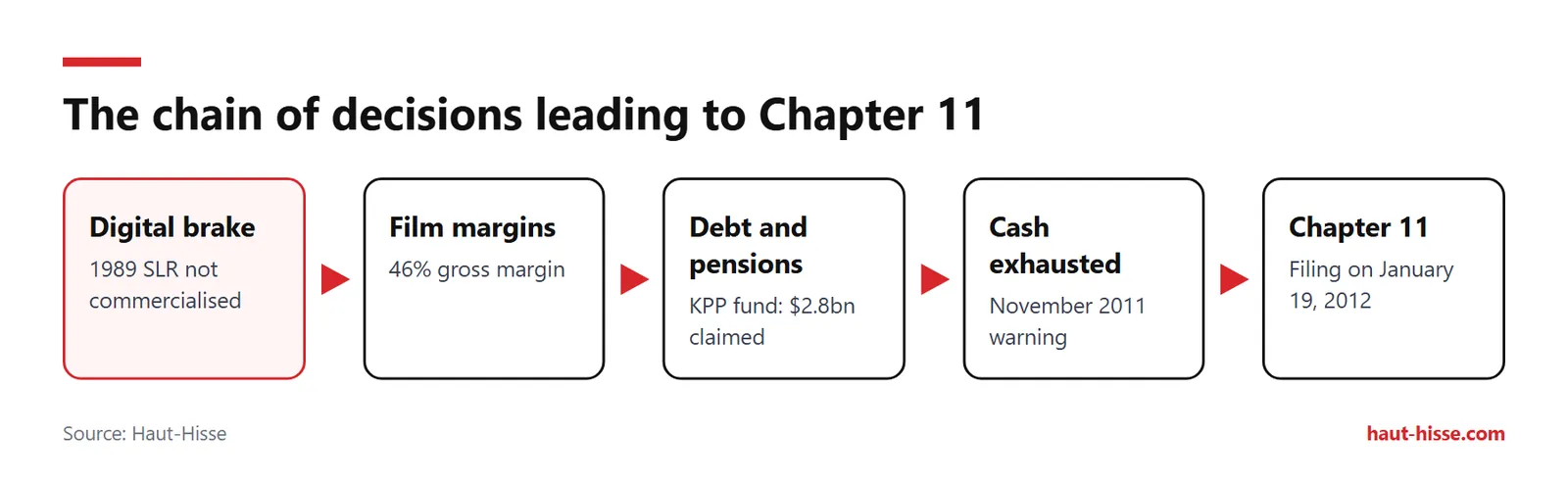
Public documents connect four links, without assigning motives that no one documented:
- The brake on digital: according to BGR, the 1989 SLR was “apparently” not commercialized out of fear for film sales, a concern reported rather than a documented decision.
- Film margins: as long as they remained high, steering customers away from film was costly.
- Debt and pensions: an underfunded pension fund and a multi-billion-dollar claim weighed on the balance sheet.
- Cash in 2011: the patent sale bogged down, reserves ran dry, and the group announced it in November.
None of these links alone was enough. Their sequence led to January 19, 2012.
Emerging from bankruptcy in 2013: What happened next?
Kodak exited Chapter 11 on September 3, 2013, leaner and refocused, while parts of its operations were transferred to the UK pension fund.
On August 23, 2012, Kodak announced the launch of sales processes for its Personalized Imaging and Document Imaging businesses, according to the 2012 annual report. These activities were later taken over by the UK pension fund, which became Kodak Alaris. The sale took place under the terms of the fund’s claim settlements. The exact sale price is not confirmed by an open primary source.
The remaining perimeter was narrower. Entertainment Imaging & Commercial Films accounted for 10% of revenue in 2012, compared to 13% in 2011, according to that same report. This comparison uses the 2010-K 2012 perimeter and is not comparable to the 9% for Entertainment Imaging alone cited earlier for 2011. The February 2013 sale of digital patents brought in about $530 million net, with contributions from 12 licensees including Apple and Samsung, according to the same 2012 annual report.
Bankruptcy did not make Kodak disappear. It forced the company to sell off large parts of the business to settle pension debts.
Kodak today: Does it still exist?
Kodak still exists, but as a much smaller commercial printing and advanced materials manufacturer that once again flagged going-concern doubts in 2025.
The group describes itself as a global manufacturer focused on commercial printing and advanced materials and chemicals. Its 2025 annual report reports about 3,500 employees across 27 countries, revenue of $1.069 billion (up $26 million or 2% from 2024), and Prepress Solutions making up 52% of revenue. By comparison, Kodak employed the equivalent of 17,100 people at the end of 2011.
On August 12, 2025, Kodak reported “substantial doubt” about its ability to continue as a going concern, with debt maturing within 12 months. Its cash position stood at $155 million as of June 30, 2025, according to WXXI News (AP).
Did Kodak really miss the digital shift? Strategic error vs. structural constraints
Kodak did not ignore digital: it invented and sold it, but subordinated it to defending a highly profitable film business.
The table categorizes the main decisions by nature. The supporting facts are those detailed above (BGR, Rochester Business Journal, Annales des Mines, 2012 annual report).
| Decision or situation | Nature | Supporting fact |
|---|---|---|
| Unlaunched 1975 and 1989 prototypes | Strategic error | According to BGR, the 1989 SLR was “apparently” not commercialized out of fear for film sales |
| Film margins | Structural constraint | High gross margin, film labeled a “cash cow” |
| Dividend and shareholders | Structural constraint | Dividend cut in 2003; shareholders opposed the initial digital strategy, according to Tellier |
| Pensions and debt | Structural constraint | Underfunded UK pension fund, $2.8 billion claim |
What constitutes an error is clearest: the refusal to commercialize in 1989, which BGR reports was motivated by the fear—”apparently”—of hurting film sales. What constitutes a constraint weighed just as heavily: film margins the group could not abandon overnight, shareholders unenthusiastic about the initial digital strategy, and an underfunded pension fund.
One hypothesis, presented as such: even with an earlier launch, the decline would have been hard to avoid, since digital was directly replacing the most profitable activity. This analysis cannot be proven, but it explains why the 1989 error does not explain everything on its own. A comparison with Kodak’s competitors would require a separate investigation.
The lesson boils down to one mechanism: highly profitable revenue can stall the decision to pivot away from it, even when management knows the technology that will replace it. Another case of a flagship product being shut down can be found in the history of Concorde and why it stopped flying.
Frequently asked questions
When did Kodak file for bankruptcy?
The Chapter 11 case, opened in New York on January 19, 2012, lasted just under twenty months: the group exited on September 3, 2013.
What happened to Kodak after bankruptcy?
Kodak continued operations, refocused on commercial printing and advanced materials. Its Personalized Imaging and Document Imaging businesses were transferred to the UK pension fund, which became Kodak Alaris. In 2025, the group once again reported doubts regarding its going concern.
Who invented the first digital camera?
Steven Sasson, a Kodak engineer, built a digital camera prototype using a CCD sensor in 1975. It produced 100×100 pixel black-and-white images. Kodak did not launch it as a product.
Sources
- Eastman Kodak 2011 Form 10-K Annual Report — SEC (2012)
- Eastman Kodak 2012 Form 10-K Annual Report — SEC (2013)
- Eastman Kodak 2025 Form 10-K Annual Report — SEC (2026)
- Eastman Kodak: faillite, chapitre 11 et restructuration — Génération NT (2012)
- Kodak and the invention of the digital camera — BGR
- Kodak’s new strategy sharpens focus on cash flow — Rochester Business Journal (2004)
- Résumé du numéro de septembre 2024 — Annales des Mines, Gérer et comprendre (2024)
- Kodak cautions there’s substantial doubt about its ability to stay in business — WXXI News (2025)
- Former trailblazer Kodak files for Chapter 11 — The Daily Record, AP (2012)
Prepared with the help of AI tools, then fact-checked and edited by the Haut-Hisse editorial team.


