


Tendencies to spend more with a bank card than in cash stem from the cashless effect. Researchers show paying by card dulls the pain of paying and decouples consumption from payment. However, a comprehensive 2024 meta-analysis found this effect is small on average and weakening over time, rather than an unavoidable personal fate.
In 2024, cards surpassed cash in the number of in-store payments in France for the first time, according to the Banque de France, France’s central bank. Meanwhile, the European Central Bank (ECB) reports that cash still accounts for 52% of point-of-sale transactions across the euro area. How this payment choice affects your budget is a practical concern. Below are the underlying mechanisms, the research behind them, their limitations, and steps to offset the effect.
Key takeaways
- A 2024 meta-analysis (71 articles, 392 effect sizes) links cashless payments to higher spending, though the overall effect is small.
- Under Prelec and Loewenstein’s mental accounting model, cards weaken the connection between the pleasure of buying and the pain of paying, whereas cash tightens it.
- A 2021 replication failed to reproduce the credit card effect, and the broader meta-analysis shows the phenomenon weakening over time.
- In a study by Raghubir and Srivastava (2008), two factors narrowed the spending gap: making the parting with money more salient and breaking down expenses item by item rather than estimating them as a lump sum.
Why do we spend more with a bank card than cash?
Researchers point to two related mechanisms: cards decouple the purchase from payment, and they make paying less emotionally painful than handing over physical currency.
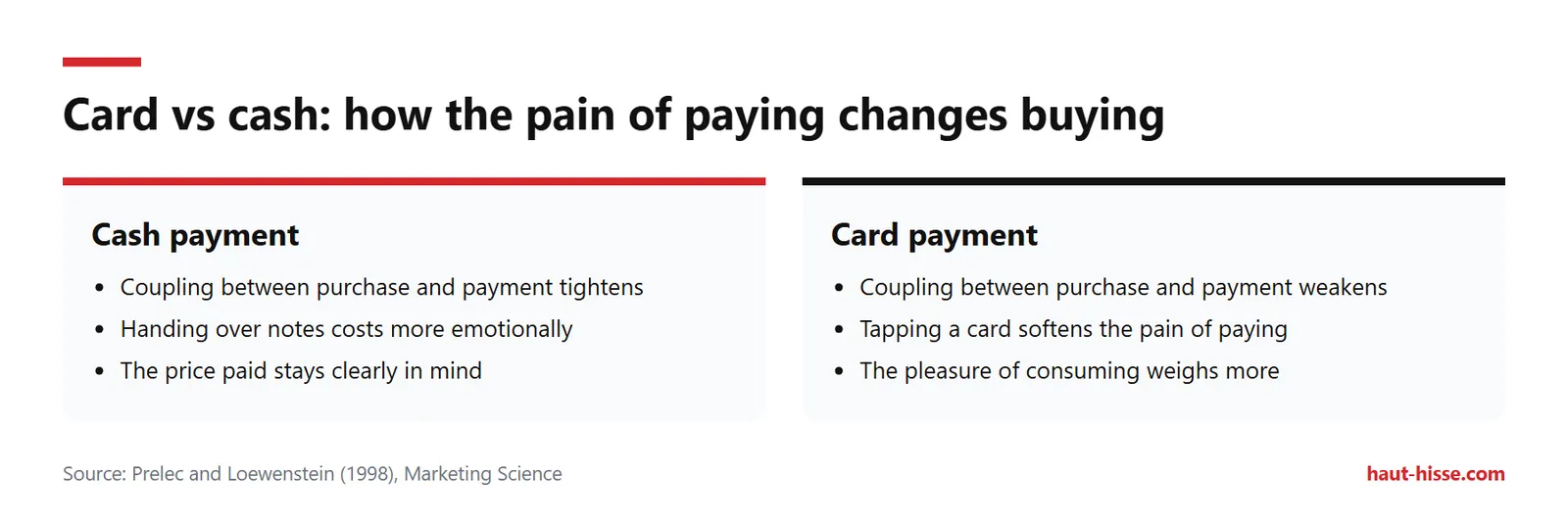
The cashless effect refers to increased spending when transactions are made without physical cash. This is the finding of a meta-analysis by Schomburgk, Belli, and Hoffmann, published in 2024 in the Journal of Retailing. A meta-analysis pools data from existing studies to calculate an average effect; this 2024 paper compiled 71 articles. Because it represents a statistical average, it does not dictate what any individual actually spends with a card.
The pain of paying: definition and role
The pain of paying is the emotional discomfort felt when parting with money. The meta-analysis authors identify this as the primary driver: handing over cash carries a higher emotional cost than tapping a card.
A study by Thomas, Desai, and Seenivasan (2011) supports this view. Across three experiments, the payment method’s effect operated through this pain, showing up strongest among people who are particularly sensitive to it.
Brain imaging research points to a neural basis. In Knutson et al. (2007), the insula—a brain region linked to anticipating pain—activated in response to excessive prices. This activation preceded and predicted the decision not to buy. This finding is correlational, measured across 26 participants in the correlational analyses, rather than direct proof that paying by card dampens insula activation.
Decoupling purchase and payment
Decoupling refers to weakening the mental link between what you consume and what you pay. In their double-entry mental accounting model, Prelec and Loewenstein (1998) posit that consumption pleasure and payment pain interact. Credit cards weaken this coupling, whereas cash strengthens it.
The authors also highlight a trade-off. Forgetting the payment increases immediate enjoyment, but it reduces decision efficiency. Knowing what you are paying helps you make sounder choices.
Price perception influences spending in other ways as well. Prices ending in .99 are one classic example. For additional case studies, see how Costco makes money and how Liquid Death sells water.
What do key experiments on card payments show?
Foundational experiments, from Feinberg (1986) to Thomas et al. (2011), test distinct mechanisms: purchase-payment coupling, debit delays, the pain of paying, physical separation from money, and psychological conditioning.
The table below outlines these studies by mechanism.
| Mechanism | Study | Design | Finding |
|---|---|---|---|
| Coupling (purchase/payment decoupling) | Prelec and Loewenstein (1998) | Survey-based model and conjoint analysis | Credit cards weaken the link between payment and consumption, while cash tightens it; the model fit roughly 60% of subjects better than standard discounting, compared to 29% |
| Time delay (debit immediacy) and rehearsal | Soman (2001) | Two experiments | Past spending reduces purchase intentions more when participants write down the amount and funds leave immediately |
| Reduced pain of paying | Thomas, Desai, and Seenivasan (2011) | Three experiments and six months of shopping data from 1,000 households | Shopping baskets paid by credit or debit card contained more impulsive and unhealthy food items; the effect operated through the pain of paying |
| Parting with money | Raghubir and Srivastava (2008) | Four studies | Higher spending with credit cards and stored-value scrip than with equivalent cash; making the parting more salient reduced the gap, and itemizing expenses dampened the effect |
| Conditioning to card-related stimuli | Feinberg (1986) | Four experiments and one study | Spending probability, decision speed, or spending amounts increased |
| Not specified in abstract | Prelec and Simester (2001, Marketing Letters) | Sealed-bid auctions | Willingness to pay increased when paying by card rather than cash |
The “Finding” column reflects averages across groups with differing conditions: auction bidders behave differently than households doing routine grocery shopping.
Feinberg interpreted his findings as conditioning: cards act as spending-facilitating cues. Soman isolated two factors: rehearsal (writing down the amount) and the immediacy of the debit.
Raghubir and Srivastava added an instructive insight: participants spent more using stored-value scrip than with the exact same amount in physical cash. This indicates the phenomenon is not exclusive to cards.
What does the 2024 meta-analysis reveal about the cashless effect?
Published in the Journal of Retailing by Schomburgk, Belli, and Hoffmann, the paper aggregates 392 effect sizes across 71 articles, concluding there is a small but statistically significant effect.
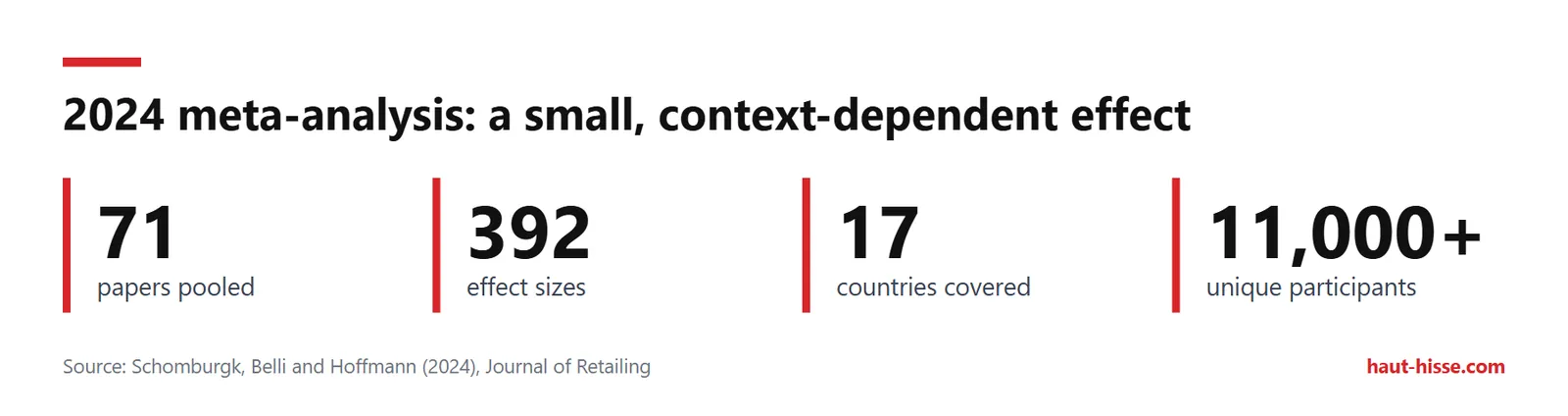
The scope is broad: 71 studies conducted across 17 countries, covering more than 11,000 unique participants. The core finding is straightforward: cashless payments are associated with higher spending, though the overall effect is characterized as small.
The authors note that the specific features of the payment medium do not alter the effect. Instead, context and purchase type drive the variation. The meta-analysis shows the effect is:
- Stronger for conspicuous consumption and status-driven purchases, such as jewelry
- Stronger during periods of economic growth
- Weaker for prosocial spending
- Absent for tipping and charitable donations
The historical trend is equally significant. According to the same meta-analysis, the effect has weakened over more than 40 years of research. As reported by Inside Retail, the authors suggest it may eventually disappear altogether.
Mainstream coverage often leaves out these nuances. Several French media reports cited both the meta-analysis and a Forbes survey claiming that 58% of consumers report spending more when using cards. Le Journal de l’économie, for instance, cited Forbes alone for that figure without providing an effect size. That 58% figure is purely self-reported: it captures consumer beliefs, not verified spending.
Do contactless and mobile payments trigger more impulse purchases?
The evidence is mixed and limited: mobile payments increase purchase intentions in some experiments but not others, and contactless payments have not been proven to cause higher spending.
Mobile payments
A 2024 study published in PsyCh Journal observed higher purchase intention with mobile payments compared to cash. The research involved 160 valid participants in Study 1 and 59 participants in an eye-tracking setup for Study 2. Pain of paying explained this difference only for high-cost items. For low-cost items, greater focus on product benefits drove the result.
A counterpoint appears in a replication by Liu and Dewitte. In their online studies, mobile payments did not increase spending. In the lab, mobile payments differed from cash on basket size, but not on willingness to pay. While reduced pain of paying and increased convenience were observed, these did not translate into higher total spend.
Contactless payments
Contactless card payments require tapping the terminal without entering a PIN. Looking at US survey data from 2009 to 2013, contactless adoption showed no statistically significant effect on cash usage once individual heterogeneity was controlled. Those who adopted contactless cards were already frequent card users.
That study measured cash usage frequency, not total money spent. As a result, it establishes nothing definitive about impulse buying. While one might hypothesize that the quick gesture shortens deliberation time, none of the studies reviewed demonstrates this. There is also no verified empirical data measuring the effect of contactless payments on impulse spend amounts in France.
Do people really spend more with a bank card? Limitations and replications
Yes, on average, but the effect is small, context-dependent, and declining over time. A 2021 replication failed to reproduce the credit card effect entirely.
Liu and Dewitte conducted four studies, comprising three online experiments and one laboratory trial (n = 692). They found no credit card effect on either willingness to pay or total basket value. This suggests the original effect may have been overstated or has diminished. Their accompanying meta-analysis of the literature confirmed an overall effect, but revealed it decreases over time and varies by geographic location.
Several other limitations apply:
- Many experiments take place in laboratory settings, and sample sizes vary widely—from 26 participants in Knutson et al.’s correlational analyses to 692 participants in Liu and Dewitte’s replication. Prelec and Simester’s published abstract does not disclose auction bid values.
- A small effect size describes a population average; it does not indicate what happens to any single consumer. Thomas et al. showed the effect is stronger among people who are especially sensitive to payment pain.
- Counterexamples exist: there is no observed effect on tips and donations, and the effect is weaker for prosocial purchases.
It is also necessary to separate three tiers of evidence: experimental findings (auctions, lab tasks), correlational checkout data, and popular belief. The 58% figure from the Forbes survey, cited in mainstream media, falls entirely into the third tier. Alarmist headlines are unsupported: the 2024 meta-analysis describes a small, variable effect that the 2021 replication could not consistently confirm.
What is the status of cash usage in France and the euro area?
Cash usage is declining but remains substantial: in 2024, card payments surpassed cash transactions in French shops for the first time, while cash remains widely used at points of sale across the euro area.
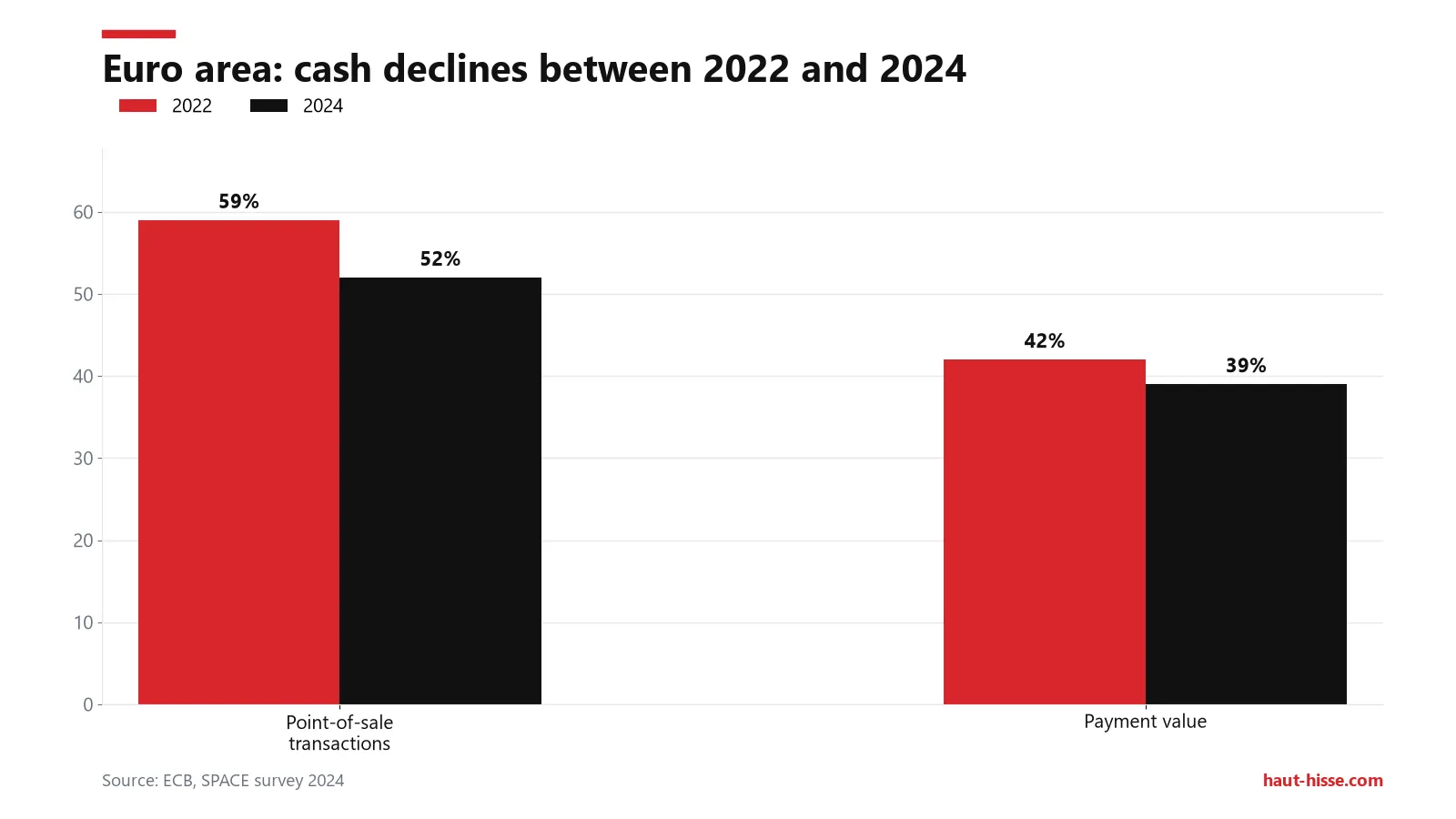
In the euro area, the ECB’s SPACE survey, published on December 19, 2024, reported the following figures, including consumer preferences:
| Metric | 2024 | 2022 |
|---|---|---|
| Share of cash in point-of-sale transactions | 52% | 59% |
| Share of cash in payment value | 39% | 42% |
| Share of cards in payment value | 45% | Not specified |
| Share of mobile apps in payment value | 7% | 4% |
| Consumers preferring cards or other non-cash methods in shops | 55% | Not specified |
| Consumers preferring cash | 22% | Not specified |
| Consumers with no preference | 23% | Not specified |
| Consumers who consider having the option to pay in cash important | 62% | 60% |
Preferences remain divided: a majority prefers non-cash payment methods, yet having the option to pay in cash is still considered important by a large majority of respondents.
In France, Bulletin No. 256 from the Banque de France, France’s central bank, published on February 25, 2025, indicated that card transactions overtook cash payments in retail stores for the first time in 2024. Point-of-sale transactions made up under 73% of total payment volume, down from 84% five years earlier, while online payments accounted for 25%. Still, a large majority of French citizens continues to value physical currency.
Australia illustrates how far this trend can go. According to Inside Retail, cash now accounts for only around 16% of in-person transactions, down from roughly 70% in 2007. The meta-analysis authors note that the cashless effect could eventually fade away.
These figures describe payment methods, not total expenditure. They do not prove a causal impact on household budgets.
How can you reduce the impact of card payments on your spending?
Research suggests four practical adjustments: making payment more salient, itemizing expenses rather than estimating lumps, reintroducing debit immediacy and rehearsal, and using cash for self-control. The empirical backing varies across these tactics.
These ideas are derived from experimental mechanisms and do not account for individual circumstances. Their effectiveness represents an average and varies from person to person. Here are the four steps, along with their level of evidence:
- Make parting with money more salient. In Raghubir and Srivastava’s study, the spending gap between payment methods narrowed when the transaction context heightened awareness of parting with funds. Level of evidence: laboratory experiments.
- Estimate expenses item by item. In the same study, itemizing purchases softened the spending effect compared to making an aggregate estimate. Level of evidence: spending-estimation experiments.
- Recreate rehearsal and immediacy. Soman (2001) found that physically writing down an amount and seeing funds leave an account immediately made past spending more effective at curbing future purchase intent. Level of evidence: two experiments.
- Use cash as a self-control tool. The lead author of the 2024 meta-analysis, Schomburgk, recommends: “we recommend consumers carry cash instead of cards whenever they can, as it acts as a self-control method.” Level of evidence: author recommendation from a meta-analysis, not a direct test of the intervention.
Prelec and Loewenstein noted a trade-off between consumption enjoyment (when payment is forgotten) and decision efficiency. Becoming more conscious of each transaction comes at the cost of day-to-day purchasing ease.
Because the effect is small and declining, the utility of these steps depends on your profile and situation. They are most relevant for individuals sensitive to payment pain or when purchasing status items, where the cashless effect is most pronounced.
Frequently asked questions
Do credit cards cause more spending than debit cards?
The studies cited here do not directly compare the two. Raghubir and Srivastava observed higher spending with credit cards, while Thomas et al. noted more impulsive basket contents when paying with either credit or debit cards. Neither study established a direct head-to-head comparison.
Is paying in cash necessary for managing a budget?
Paying in cash is not mandatory. The lead author of the 2024 meta-analysis recommends cash as a practical self-control method where possible. Because the average effect is small and varies among individuals, its value depends on your personal sensitivity to the pain of paying.
Why doesn’t parting with money feel real on a card?
Under Prelec and Loewenstein’s model, cards weaken the connection between purchase and payment, whereas cash reinforces it, making transactions feel less emotionally uncomfortable. Knutson et al. linked insula activation to anticipating payment pain, though their research does not directly test the specific impact of cards.
Sources
- Cashless effect meta-analysis (Schomburgk, Belli, Hoffmann) — Journal of Retailing, via RePEc/IDEAS (2024)
- We spend more with cashless payments — ScienceBlog (2024)
- How to make cashless pay off for you — Inside Retail Australia (2024)
- Credit card effect replication (Liu and Dewitte) — Journal of Retailing and Consumer Services, via RePEc/IDEAS (2021)
- Prelec and Loewenstein, The red and the black — Marketing Science, via RePEc/IDEAS (1998)
- Feinberg, Credit cards as spending facilitating stimuli — Journal of Consumer Research, SWOV record (1986)
- Soman, Effects of payment mechanism on spending behavior — Journal of Consumer Research, via RePEc/IDEAS (2001)
- Raghubir and Srivastava, Monopoly money — Journal of Experimental Psychology: Applied, via PubMed (2008)
- Thomas, Desai, and Seenivasan — Journal of Consumer Research, via RePEc/IDEAS (2011)
- Knutson et al., Neural predictors of purchases — Neuron, via PubMed (2007)
- Mobile payment and purchase intention — PsyCh Journal, via PMC (2024)
- Contactless payment and cash usage — Swiss Journal of Economics and Statistics, University of St. Gallen (2020)
- SPACE survey on payment attitudes in the euro area — European Central Bank (2024)
- The French continue to appreciate cash — Banque de France, Bulletin No. 256 (2025)
- Paying for groceries by bank card — Journal de l’économie (2025)
Prepared with the help of AI tools, then fact-checked and edited by the Haut-Hisse editorial team.


