



A luxury product’s price is the sum of real costs (materials, workshops, boutiques), high margins and, in some cases, scarcity that works as a social signal. To understand why luxury is so expensive, separate these three layers so you don’t mistake a partial cost for the full cost.
At Hermès, the gross margin is about 71% of revenue in 2025, according to a calculation by our editorial team based on the results release.
In June 2024, the Milan court placed Manufactures Dior SRL under judicial administration after subcontractors were billing a bag from €53, while that bag sold for €2,600. This figure fuels a lot of outrage, but it measures only one link in the chain. The following sections separate what is cost from what the results of Hermès, Kering and LVMH show about margins, then what comes from scarcity and social signaling. They end with a five-question grid.
Key takeaways
- The price of a luxury product breaks down into production cost, distribution and marketing costs, then margin and brand value.
- Hermès posted a current operating margin of 41.0% in 2025, compared with 11.1% for Kering. Luxury houses are not all alike.
- According to Bain, prices of iconic bags on a like-for-like basis rose 50% to 70% between 2019 and 2025.
- The Dior case figure measures a subcontracting cost, not the full cost of a bag sold for €2,600.
- Scarcity can support prices, but the Veblen effect varies with buying motives.
Why luxury is so expensive: three layers in one price
The price of a luxury product breaks into three layers: what it costs to make and distribute, what the house keeps as margin, and the brand value customers agree to pay for. Mixing up these layers is the most common error in price comparisons.
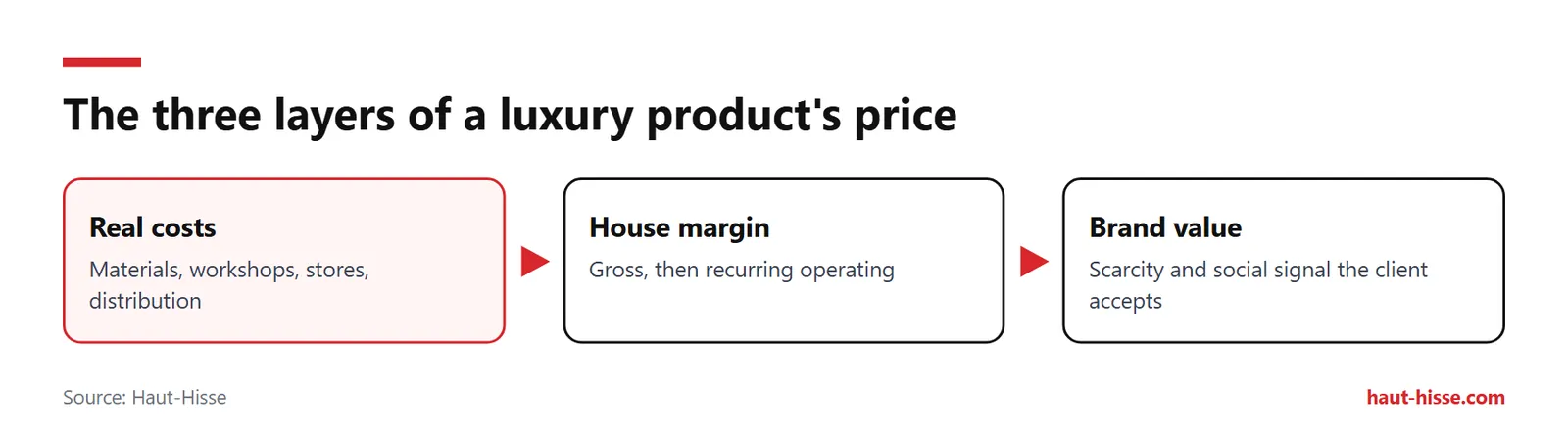
Three accounting terms help separate them. Cost of sales is what the house pays to produce. Revenue minus cost of sales gives the gross margin. The current operating margin is what remains after distribution, marketing and overhead, expressed as a share of revenue.
A low manufacturing cost tells you nothing about the operating margin. In 2025, Hermès reached a gross margin of €11,379M on €16,002M of revenue, or about 71%. The release does not give this percentage; it is a calculation by our editorial team. For every €100 in sales, about €71 therefore remains after cost of sales, on average across the group and not on a specific product.
The 2025 figures come from the Hermès and Kering releases, from LVMH results as reported by The Fashion Law, and from the Bain study with Altagamma. The central distinction comes down to one sentence: on one side is what is cost (materials, know-how, boutiques); on the other is what comes from brand power (scarcity, signaling, price increases).
What does it really cost to make a luxury product?
The real manufacturing cost is almost always unknown to the public. Houses do not publish it, and the figures that circulate are estimates, often partial. No manufacturing cost for a specific bag, the Birkin included, is public. We can only explain the mechanics that make such a price possible.
Materials and craftsmanship: what the price really pays for
According to its 2025 results release, Hermès has built its production around several benchmarks:
- more than half of its products are made in in-house, exclusive workshops;
- the 24th leather goods workshop was opened in September 2025, in L’Isle-d’Espagnac;
- other sites will open in Loupes (2026), Charleville-Mézières (2027) and Colombelles (2028);
- the group employed 26,494 people at the end of 2025, including 16,349 in France, compared with 25,185 a year earlier.
These integrated production choices weigh on costs: buildings, training, salaries. The release does not put a figure on what this represents per bag.
On quality, material choices and handcraft explain part of the price. Their exact share is not quantified, and nothing allows us to claim that every luxury product is of better quality than an ordinary one.
The Dior case: €53 for a €2,600 bag, a subcontracting cost
In June 2024, a Milan court placed Manufactures Dior SRL under judicial administration. According to Fortune, subcontractors were billing a bag from €53, for a retail price of €2,600. The investigation covers four suppliers employing 32 people. It targets the subcontractors, not Dior directly.
The court found the practice widespread, not limited to a few batches. Yet this figure remains a subcontracting cost. It excludes materials, design, distribution and marketing, so it does not represent the full cost of the product. Reading it as “the real cost of a luxury bag” would be a methodological error.
Isolated estimates: the €20 perfume trap
For perfume, Le Tribunal du Net claims that a bottle rarely costs more than €20 to make, for a price of €150 to €300, with advertising at 20-30% of revenue.
This estimate is not attributed to any study or named source, and it cannot be verified. It is useful only as a disputed order of magnitude, not as a reference figure. It also does not specify what it includes (bottle, juice, packaging, labor), which rules out any reliable comparison.
Gross and operating margins: what Hermès, LVMH and Kering show
Not all large groups earned as much in 2025. Hermès posted a 41.0% current operating margin, while Kering fell to 11.1%. On gross margin, only Hermès (about 71%) and Kering (about 72.6%) publish the figures needed to calculate it (editorial team calculations).
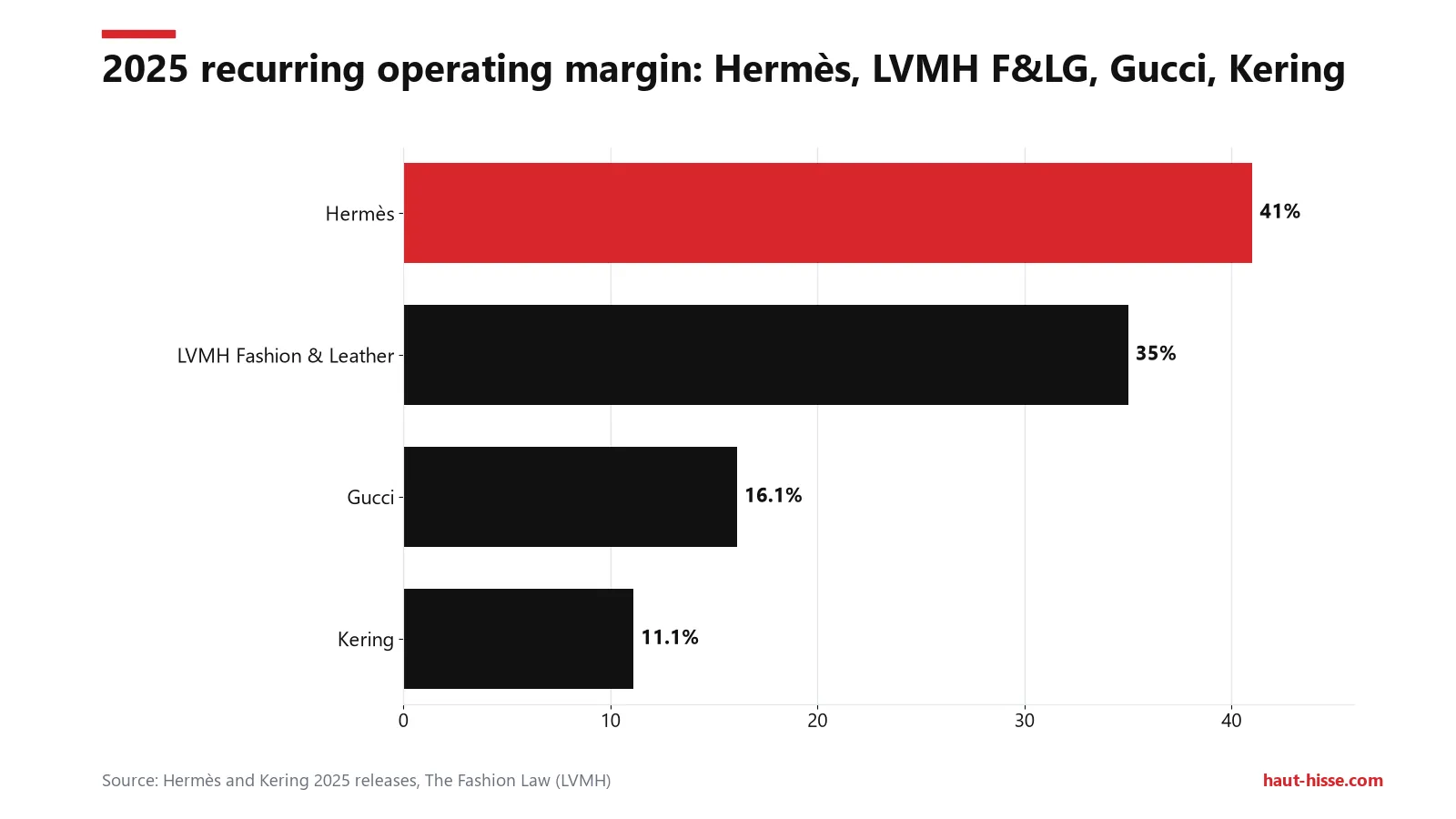
The table below gathers the 2025 figures from the Hermès and Kering releases, along with LVMH’s figures as reported by The Fashion Law. Percentages in parentheses are editorial team calculations.
| Group | 2025 revenue | Gross margin | Current operating margin |
|---|---|---|---|
| Hermès | €16,002M | €11,379M (about 71%) | 41.0% |
| Kering | €14,675M | €10,660M (about 72.6%) | 11.1% (14.5% in 2024) |
| LVMH | €80.8bn | not reported | €17.8bn current operating profit (about 22%) |
| LVMH, Fashion and Leather Goods division | €37.8bn | not reported | €13.2bn operating profit (about 35%) |
| Gucci (Kering) | €5,992M | not reported | 16.1% (down 4.9 points) |
The two indicators complement each other. Gross margin mainly measures price relative to production cost, while operating margin shows what the house keeps after paying for boutiques, communication and overhead. The same gross margin can therefore produce very different operating margins. Hermès and Kering both exceed 70% gross, but their operating margins are nearly 30 points apart.
To see the contrast, compare with a low-margin model. Mass retail lives on volume and thin margins, as explained in the analysis of Costco’s business model. Luxury does the opposite: fewer units sold, and much more margin per unit.
Reporting periods and accounting definitions differ from one group to another. LVMH’s Fashion and Leather Goods division cannot be compared directly with an entire group.
Distribution and marketing: where the margin points go between gross and operating
The gap between gross margin and operating margin corresponds to distribution, marketing and overhead costs. Groups do not publish, in their results, the share of each of these items as a percentage of price.
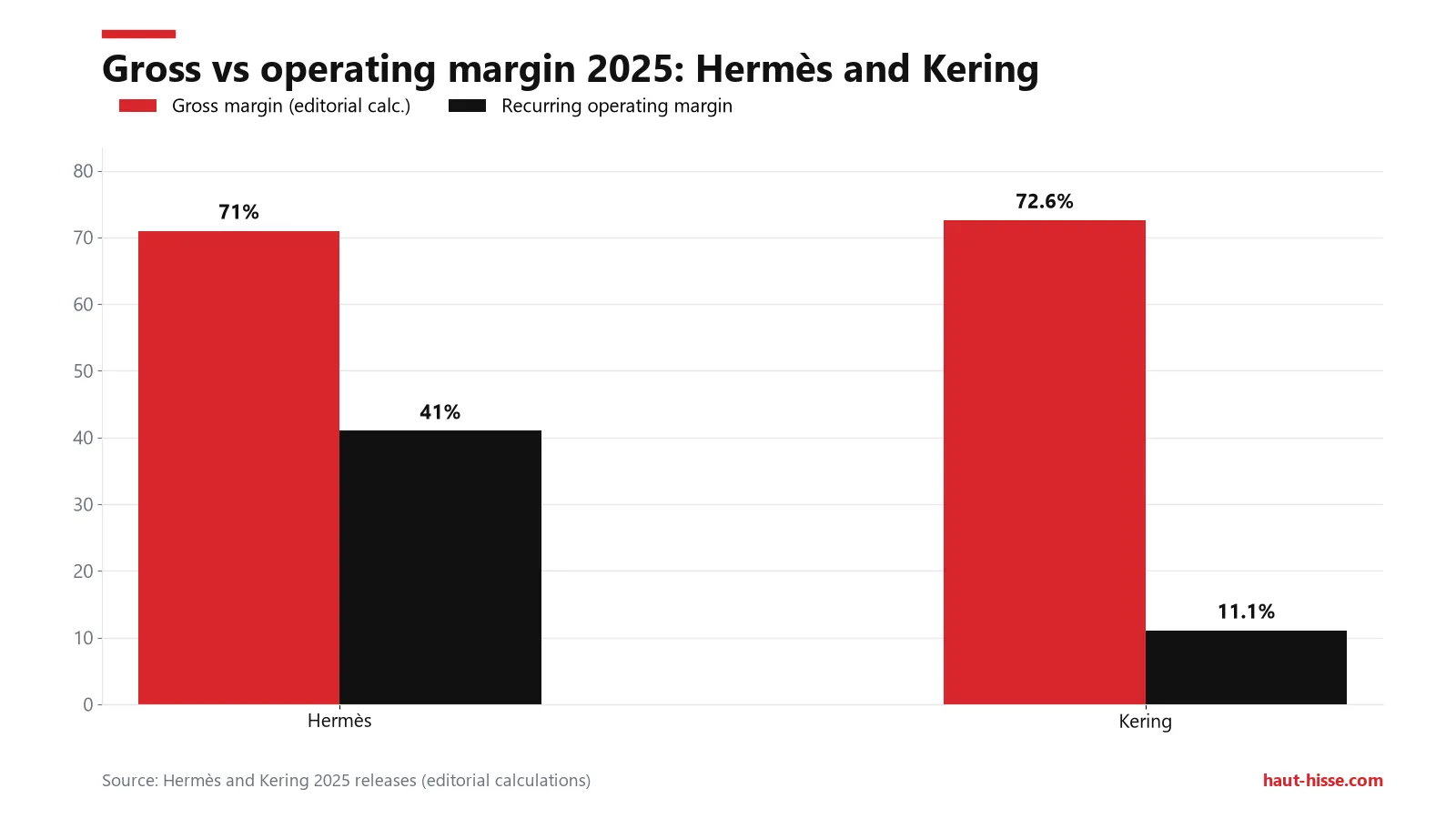
A simple calculation nonetheless gives an order of magnitude:
| Group | Gross margin 2025 | Current operating margin 2025 | Gap |
|---|---|---|---|
| Hermès | about 71% | 41.0% | about 30 points |
| Kering | about 72.6% | 11.1% | more than 60 points |
At Hermès, these 30 points cover boutiques, communication and general expenses. This is our calculation from the release, not a published line item. At Kering, reported revenue fell sharply. A consistent reading is that largely fixed costs (rent, staff, communication) weigh more when sales decline. The releases do not detail this mechanism, so it remains a hypothesis.
Currency also plays a role. Sales are booked in foreign currencies while costs are in euros, which pushes prices up when currencies weaken, explains CB News.
A pie chart that splits the price into precise shares between materials, boutiques and marketing rests on no published figure. Be wary of infographics that offer one.
Why do luxury brands keep raising prices?
Price increases can be explained by customs duties, currency movements and brand power. The Bain study conducted with Altagamma (November 2025) does not quantify the share of each of these factors.
The documented increases are summarized below:
| Source | Scope | Increase | Period |
|---|---|---|---|
| Bain | Iconic bags, like-for-like | 50% to 70% | 2019-2025 |
| CB News (press analysis) | Certain Chanel, Prada and Dior bags in France | more than 50% | 2023 |
| Reuters | Hermès in the US: full offset of new tariffs from May 1, on top of regular adjustments of about 6-7% | announced | April 2025 |
CB News argues that luxury prices follow scarcity and exclusivity more than production costs. This is a press analysis, not a primary source.
Not all customers go along. Federica Levato, partner at Bain, told Reuters that price increases perceived as disconnected from creativity leave customers, including wealthy ones, feeling betrayed:
“Because they’re also starting to get really upset and to feel betrayed in this sector.” — Federica Levato, Bain, via Reuters (2025, our translation)
Several market signals point the same way:
- sales at reduced prices weighed more on the sector’s revenue in 2025 than in 2015 (Bain);
- “hero” bag launches were markedly fewer in 2023-2025 than in 2016-2019 (Bain);
- the sector’s inventory-to-sales ratio exceeds its 2019 level by 3 to 4 points.
This data shows a sector where prices rose fast and inventories and promotions followed. It does not establish the motive of any particular house.
Does deliberate scarcity raise prices? The Veblen effect explained
The Veblen effect describes a price increase that raises demand, because a high price signals status. A study by Fassnacht and Dahm (2021) confirms that the effect exists, but its strength depends on buying motives.
The mechanism combines three elements: a high price, limited access and a social signal. A “Veblen good” is a good whose demand rises with its price. A “signal” is a visible cue that tells others about its owner’s status. When all three reinforce each other, price stops being a deterrent and becomes part of the appeal.
The two researchers ran eight experiments published in the Luxury Research Journal. The effect varies depending on whether buying motives are intrinsic (enjoyment of the product) or extrinsic (others’ perception), and between “hard” and “soft” luxury.
Scarcity also has a ceiling. The same authors note that luxury growth relies heavily on volume, which can erode a brand’s scarcity and desirability. Veblen goods, by contrast, can grow while preserving exclusivity.
Bain’s market data point toward a more concentrated customer base. Customers spending more than €20,000 a year accounted for a little over 46% of luxury spending in 2025, versus 30% in 2019. The active customer base fell to about 330 million people, from about 400 million in 2022.
These figures are consistent with a smaller, wealthier luxury market. They do not prove that scarcity was engineered.
Not all prices play on status. Prices ending in 99 rely on the opposite mechanism, a feeling of getting a good deal, as explained in the analysis of 99-ending prices. As for the scarcity of a specific model such as the Birkin, no sourced figure explains it.
How to tell whether a luxury price reflects cost or brand
A luxury price reflects cost when it tracks materials, labor time and distribution. It reflects the brand when it mostly tracks scarcity, status and repeated increases. A five-question grid helps you judge without inventing anything. The table below lists the signals to look for and where to check them.
| Question | Cost-related signal | Brand-related signal | Where to check |
|---|---|---|---|
| How is the product made? | In-house workshops, staffing that tracks volume | Little-documented outsourced production | Annual report, results release |
| What margin does the house keep? | Operating margin close to peers’ | Gross and operating margins both very high | Annual report |
| How has the price changed? | Increases close to those of materials and currency | Repeated increases, above materials inflation | Price history, house announcements |
| Is the product really scarce? | Volumes limited by workshop capacity | Shortages advertised while stock and promotions exist | Sales, outlets, sector studies |
| Would the product be worth this price without the logo? | Price close to a comparable unbranded product of similar quality | Large gap with that same product without the logo | In-store or online comparison |
To apply the grid, four steps are enough:
- Compare the price with that of a similar-quality product without a logo.
- Read the house’s gross and operating margins in its annual report.
- Look at the history of price increases over several years.
- Check for promotions and high inventory levels across the sector.
A few benchmarks help calibrate the reading. At Hermès, gross and operating margins are both very high. Across the sector, reduced-price sales have gained ground since 2015, according to Bain. Finally, the Dior case is a reminder that a partial cost, such as subcontracting, does not reveal the full cost.
A brand can also carry the price of an ordinary product on its own. The analysis of Liquid Death shows how brand value applies to canned water.
This grid explains a mechanism. It does not tell you whether to buy. A luxury bag remains a consumer good, and its resale value is neither guaranteed nor comparable to an investment’s return.
Frequently asked questions
Why is luxury in crisis despite price increases?
According to Bain, the personal luxury market declined slightly in 2025, and the active customer base has shrunk markedly since 2022. Price increases may have pushed some customers away, but Bain does not establish a single cause.
Why do prices vary between markets?
Currency movements and customs duties can explain part of the variation. Sales are booked in foreign currencies while costs are in euros, which pushes prices up when a currency weakens, CB News notes. Hermès also announced in April 2025 that it would offset new US tariffs with price increases in the United States from May 1.
Is luxury really better quality?
Material quality and craftsmanship explain part of the price, but their share is not quantified. Nothing allows us to claim that every luxury product is better than an unbranded one.
What is a luxury brand’s margin on a bag?
No house publishes its margin per bag. Only group averages exist, covering all products. The gross margin tables for Hermès and Kering above give those calculations.
Sources
- Hermès International 2025 full year results — Hermès International, regulated release (2026)
- Kering 2025 results — Kering, regulated release (2026)
- LVMH reports revenue and profit declines in 2025 amid shifting demand — The Fashion Law (2026)
- Finding a new longevity for luxury — Bain & Company (2025)
- Luxury sector to revive in 2026 but price hikes leave shoppers betrayed, Bain says — MarketScreener, Reuters (2025)
- Hermès sales up 7% in first quarter — Reuters via Yahoo Finance (2025)
- LVMH Italian Dior maker investigation — Fortune (2024)
- Fassnacht and Dahm, study on the Veblen effect — Luxury Research Journal, Inderscience (2021)
- The real price of luxury — CB News (2025)
- Why luxury perfume is so expensive: the real manufacturing cost — Le Tribunal du Net
Prepared with the help of AI tools, then fact-checked and edited by the Haut-Hisse editorial team.


