



Published
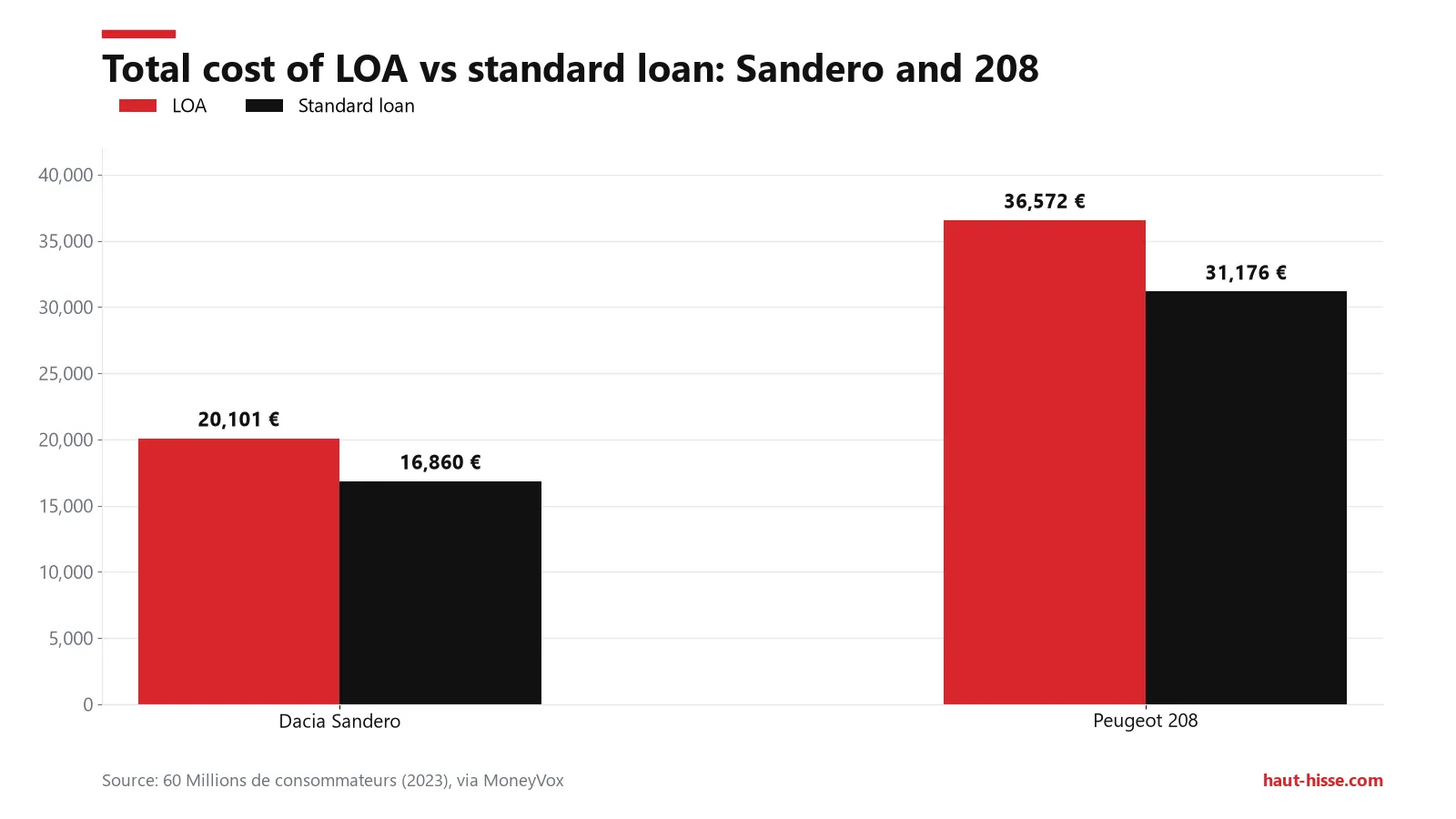
Comparing a lease vs finance car means comparing total costs, not monthly payments. A LOA (location avec option d’achat, a lease with a purchase option) is a rental the lessee can buy at the end. A 2023 comparison by 60 Millions de consommateurs, France’s consumer magazine, found it costs 17 to 19% more than a standard car loan.
In this comparison, the higher first rent is not recovered, and returning the car can add fees. A low monthly payment catches the eye, but it says nothing about the sum paid upfront, the amount charged at return, or the car’s value at the end of the contract. All three affect the final price. The sections below measure the gap with a table and a worksheet to fill in from your own contract.
Key takeaways
- In the 60 Millions de consommateurs comparison, the Dacia Sandero costs €20,101 on a LOA versus €16,860 on a loan (+19%).
- If you don’t buy the car, the higher first rent is not refunded, unlike the security deposit.
- According to UFC-Que Choisir, France’s consumer association, about a quarter of renters faced disputed return charges, averaging €1,200.
- Between April 2023 and June 2024, the DGCCRF, France’s consumer protection authority, found irregularities at 50% of the 101 lenders it inspected.
- Ordinance no. 2025-880 extends consumer credit protections to LOA contracts from November 20, 2026.
Why do two-thirds of new cars sold to private buyers use leasing?
In 2024, 66% of new cars registered by private buyers were financed through leasing (LOA or LLD), according to UFC-Que Choisir. Here, “leasing” covers both the LOA and the LLD (long-term rental, with no purchase planned). The setup has become a default way to buy, even though its full cost is barely visible in the advertised monthly payment.
In April 2026, the same association published a survey of 1,285 consumers, with nearly 1,000 testimonies. About a quarter of renters reported disputed return charges, averaging €1,200. Of those who paid, 65% consider the charges unjustified. These charges arrive at the end of the contract, when the attractive monthly payment is already a thing of the past.
MoneyVox, a French personal finance site, cites 67% for the same year, 2024. Both figures point to the same order of magnitude: two out of three new cars bought by private buyers.
On the financing side, the Association française des sociétés financières (ASF), France’s finance companies association, cited by UFC-Que Choisir, reports car financing of €10.8 billion for 2024 (+3%). LOA financing rose 7.4%, personal loans fell 28.5%, and the LOA accounted for 9 out of 10 new-car financings.
According to the same source, new registrations reached 1.72 million, down 3.2%. Financing therefore grew in a shrinking market, and the LOA gained ground on the personal loan.
The advertised monthly payment does not always include insurance, tires or sometimes maintenance. According to MoneyVox, these items “can add several tens of euros more each month.” Multiplied by the number of months in the contract, they add to a payment that is already presented as all-inclusive.
One working hypothesis: a low monthly payment shifts attention from the total price to the monthly amount. A small, repeated charge feels smaller than a single lump sum, a mechanism similar to the one we discuss in our piece on bank cards versus cash. This reading does not attribute intent to any brand or lender. It describes a presentation effect.
The sections that follow track the contract in order: what the law says, what happens to the upfront payment, how to calculate the total, then return, the purchase option, early exit and remedies.
The creator Ecki (News Auto) asks whether LLD and LOA are “the car scam of the century.” The video expresses a creator’s opinion, not a figure-based source. It sets the tone of the public debate.
Lease vs finance car: what is the legal difference?
Legally, the LOA is a lease with a purchase option that the lessee is not required to exercise. A classic loan, by contrast, finances the purchase directly. According to Service-Public.fr, France’s official government information site, the option price is fixed from the start. It equals the vehicle value stated in the contract minus the amounts already paid, and the security deposit is deducted if you buy. On the purchase itself, the official page is clear: you are not required to buy.
An LLD (long-term rental, with no purchase planned) is a rental with no buyout. Service-Public’s page on the LOA spells out the differences between the two.
The legal framework changed in 2010. According to the French Ministry of Economy’s reply, published in the Journal officiel (France’s official gazette) on May 28, 2024, the Lagarde Act of July 1, 2010 ended the standard contracts imposed by the 1978 Scrivener Act. Lenders can therefore draft their contracts with more freedom. They must still avoid unfair terms (Articles L. 212-1 and following of France’s Consumer Code), meaning clauses that create a significant imbalance to the consumer’s detriment.
The table below compares the three formulas on four points. “Per contract” means the rule varies from one lender to another.
| Point | LOA | LLD | Classic loan |
|---|---|---|---|
| Vehicle ownership | The lessor stays the owner until the option is exercised | The lessor stays the owner; no purchase planned | The borrower buys the vehicle from the start |
| Fate of the upfront payment | The higher first rent is lost without a purchase; the security deposit is returned, minus deductions | Per contract | Any down payment reduces the amount borrowed |
| Obligation to buy at the end | No, the option is optional | No purchase planned | Not applicable, the purchase is already made |
| Penalty for damage | Charges billed beyond normal wear, per contract; deposit kept in whole or part | Per contract | No return bill; the vehicle’s condition affects its resale value |
These rules are French. Belgium, Quebec and Morocco have their own regimes and regulators, so check the protections described here locally.
The 14-day right of withdrawal on a LOA
The right of withdrawal on a LOA is 14 calendar days. It is exercised by registered letter with acknowledgment of receipt, without giving a reason or paying a penalty, according to Service-Public. “Calendar” means weekends and public holidays count. The registered letter proves when you sent it, which matters if the lender disputes the deadline.
The DGCCRF has found clauses that restrict this right by requiring a mandatory form. Such a requirement limits a right that the law presents as having no formal conditions beyond the registered letter.
What happens to the higher first rent and the upfront payment?
According to Service-Public.fr, the higher first rent is not refunded if the lessee does not buy the vehicle, unlike the security deposit. The part of the upfront payment that corresponds to the higher first rent is therefore a permanent cost if the car is returned.
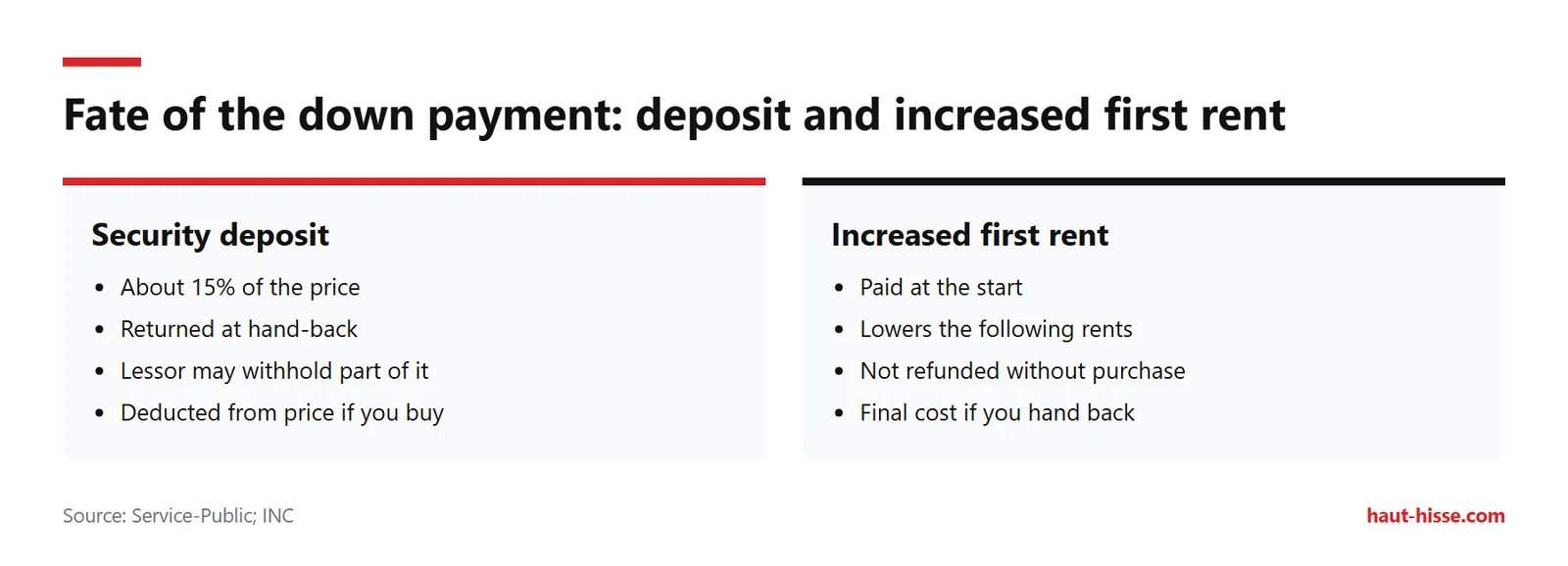
According to the Institut national de la consommation (INC), France’s national consumer institute, a lessee’s upfront payment has two parts: the security deposit, about 15% of the price, and the higher first rent. Both are paid at the start, but they do not end up in the same place.
Three scenarios sum up what happens to these amounts:
- Return with no dispute: the security deposit goes back to the lessee, and the higher first rent stays with the lessor.
- Return with charges: the lessor may keep all or part of the deposit for excess mileage, damage or lateness, and the higher first rent is lost.
- Exercising the option: the security deposit is deducted from the buyout price. The higher first rent has already reduced the monthly payments, and the car becomes yours, so the upfront payment is not lost in the same way.
The mechanism is simple. The higher first rent lowers the following payments, but it creates no ownership right if the car is returned. It moves money from the monthly payments to the start.
One reading: a monthly payment lowered by a high first rent works like a bait price, the eye-catching number that draws attention away from everything else. The mechanism resembles that of prices that end in 99, where one precise figure grabs attention. In both cases, the total price takes a back seat.
A broker, Elite-auto, lists the non-refundable upfront payment among four pitfalls of the LOA. It suggests keeping it for the residual value, meaning the estimated value of the car at the end of the contract, if you plan to buy. This is a seller’s view, taken from a commercial page. It illustrates the argument without proving it.
The contract states the two amounts that matter: the higher first rent and the security deposit. They feed the calculation worksheet in the next section.
How do you calculate the real cost of a LOA or a car loan?
The real cost of a LOA adds up the rent payments, the upfront payment, the buyout price if you exercise the option, and any return charges. Compare that with the total cost of a loan repaid in full by its end date. In the 60 Millions de consommateurs comparison, the measured gap ranges from 17 to 19%.

The formula, step by step
- LOA without purchase: upfront payment (higher first rent + the part of the security deposit not returned) + total rent + return charges + options outside the rent (insurance, tires, maintenance).
- LOA with purchase: upfront payment + total rent + option price. Use the price stated in the contract, after deducting the security deposit.
- Loan: total monthly payments + fees − resale value, if any.
- Comparison: put the totals side by side for the same vehicle and the same holding period.
What the comparison measures
According to the 60 Millions de consommateurs comparison, a Dacia Sandero priced at €14,900 cash costs €20,101 on a LOA versus €16,860 on a classic loan, a gap of €3,241 (+19%). A Peugeot 208 priced at €26,114 costs €36,572 on a LOA versus €31,176 on a loan, a gap of €5,396 (+17%). The comparison does not specify the term or the down payment, and these figures date from 2023. They serve as a benchmark, not current prices.
The table below brings together these gaps, the average return charges from UFC-Que Choisir, the excess-mileage rate from the INC and the roughly 15% deposit, linked by the formula above. The cost excluding insurance comes from MoneyVox.
| Item | Amount or rule | Who pays | Source |
|---|---|---|---|
| LOA vs loan gap, Dacia Sandero (€14,900 cash) | €20,101 vs €16,860: +€3,241 (+19%) | Renter | 60 Millions de consommateurs (2023) |
| LOA vs loan gap, Peugeot 208 (€26,114) | €36,572 vs €31,176: +€5,396 (+17%) | Renter | 60 Millions de consommateurs (2023) |
| Upfront payment | Deposit of about 15% of the price + higher first rent, lost without a purchase | Renter (the lessor keeps the first rent) | INC; Service-Public |
| Excess mileage | €0.11 per km as an example; €550 for 5,000 km | Renter | INC, illustrative calculation |
| Disputed return charges | €1,200 on average, for about a quarter of renters | Renter | UFC-Que Choisir |
| Rent excluding insurance, tires and maintenance | Several tens of euros more per month | Renter | MoneyVox |
What the comparison leaves out
Return charges are added on top of the gap, if they are not already included. A purely arithmetic calculation shows the effect. For a renter who pays the average €1,200 reported by UFC-Que Choisir, the Sandero’s gap would rise from €3,241 to €4,441, or 26% of €16,860. The 208’s gap would rise from €5,396 to €6,596, or 21% of €31,176.
This calculation adds up two measures of different kinds and does not describe an average renter. The €1,200 applies to about a quarter of renters. As for the deposit, 15% of €14,900 is €2,235, based on the roughly 15% rate cited by the INC. That sum goes back to the renter minus deductions, whereas the higher first rent does not.
The limits are clear. The comparison covers only two models and cannot be used to draw an average for the whole market. It does not account for resale after exercising the option. A renter who buys and then sells the car may narrow the gap, but that cannot be quantified here.
A worksheet to fill in with your contract
No 48-month simulation is possible without your figures. Pull these from your contract and the credit offer:
- Higher first rent: … €; security deposit: … €
- Rent: … € × … months
- Insurance, tires and maintenance outside the rent: … € per month × … months
- Expected mileage and the rate per extra km
- Buyout price of the option: … €
- For a loan: monthly payment × term, plus fees, minus any resale value
Excess mileage and wear: how are returns billed?
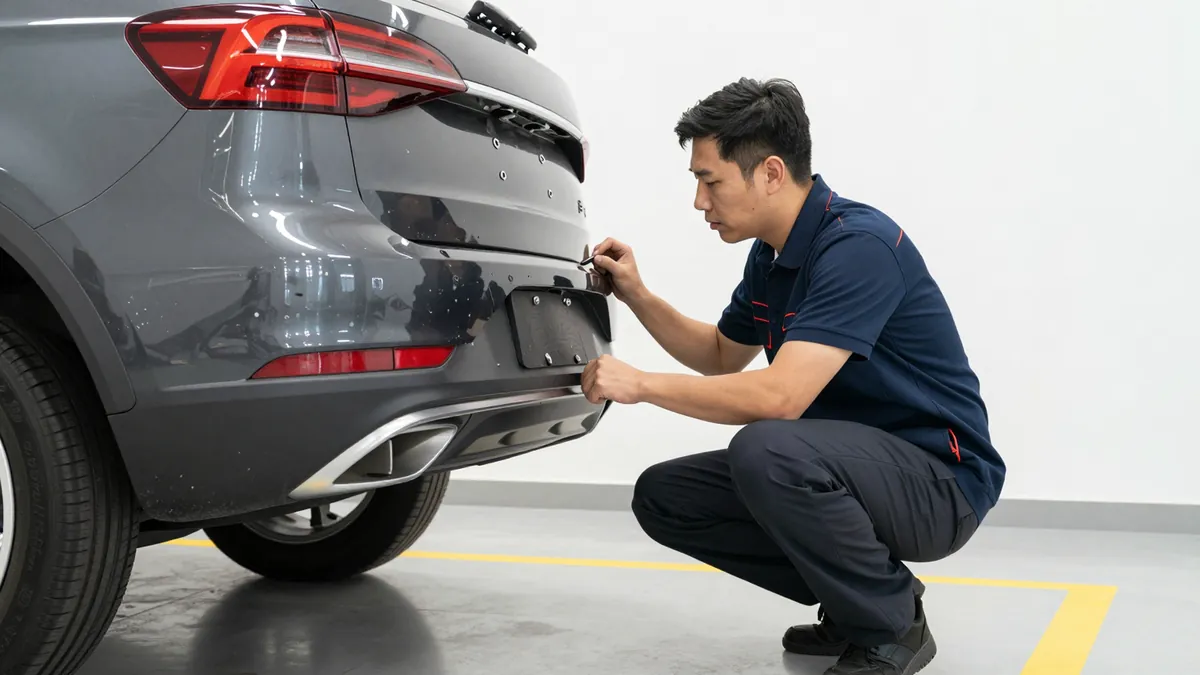
At return, the lessor can bill excess mileage, damage beyond normal wear and lateness, and keep all or part of the deposit. The lessee can dispute the charges and ask to attend the inspection, according to Service-Public.fr.
Here is the scale of the dispute, according to UFC-Que Choisir’s April survey:
- about a quarter of renters faced disputed return charges;
- these charges average €1,200;
- 65% of those who paid consider them unjustified.
These figures reflect what respondents reported, not a count of every contract.
Excess mileage charges
The mileage allowance is the maximum mileage set in the contract. Beyond that, the excess is billed. The INC gives the example of €0.11 per extra kilometer: 5,000 extra km cost €550, and each block of 1,000 km adds €110. This is an illustrative calculation.
The exact rate depends on the contract. Check it before signing, along with your expected annual mileage, since the two together determine the final bill.
Repair charges and inspection disputes
The contract defines what counts as normal wear. Beyond that, the lessor bills for repairs. Among the unfair clauses found in its inspections, the DGCCRF cites excessive return charges that amount to repair fees.
Disputes often arise during the inspection. The lessor or its expert puts a value on the damage, and the lessee disputes it. The right to attend the inspection exists so you don’t discover the bill after the fact.
How to challenge charges you think are unjustified
When you receive a bill you think is unjustified, the steps go in escalating order:
- ask for the inspection and attend it;
- dispute the bill in writing;
- refer the case to the mediator.
The mediator of the Association française des sociétés financières (ASF) recommends being present at the return, according to its 2023 report. Being present and referring to the contract limits disagreements over the vehicle’s condition. No savings figure can be promised, since it depends on the contract and the car’s condition.
Exercising the purchase option: at what price, and is it worth it?
The option price is set in the contract from the start, and buying is never mandatory. Early buyout is generally possible, sometimes after a minimum period, for example 12 months, according to the INC.
This price does not change during the contract. To find out what buying would cost at a given point, the INC recommends requesting the financial schedule, the document that shows the buyout value at each rent. It serves as a benchmark if a trade-in offer arrives or if your situation changes midway.
Because the amount is contractual, it is negotiated before signing, not at maturity. That negotiation cannot be promised: it depends on the lender and the offer.
At maturity, the decision compares three amounts:
- the buyout value stated in the contract;
- the market price of an equivalent used vehicle;
- the return charges you would avoid by buying.
Rent already paid is lost either way, so it does not factor into the choice between exercising the option and returning the car. Only the comparison between what the option costs and what the vehicle is worth matters.
If you plan to resell the car after exercising the option, the calculation compares the option price with the used-car price. No general figure says whether the deal pays off. Whether to exercise the option or return the car depends on the comparison between buyout value and market value, with no fixed rule. A buyout value below market gives an advantage to buying. A higher value makes the option less attractive, excluding return charges.
Early termination and penalties: can you return a LOA car before the end?
Early termination is sometimes possible, but it usually triggers penalties set in the contract. For unpaid rent, the penalty can reach 8% of the unpaid rent, according to Service-Public.fr.
The same page covers two other cases. The lessor terminates the contract if the vehicle is destroyed in an accident. If the lessee dies, the balance falls to the heirs, unless insurance covers it.
When rent is unpaid, two outcomes are possible, according to Service-Public.fr. If the lessor accepts a deferral, the lessee keeps the car with a penalty of 4% of the deferred rent. If it refuses, the penalty can reach 8% of the unpaid rent. For €1,000 of rent involved, that is €40 in the first case and up to €80 in the second. If the contract is terminated, the car must be returned, the rent due paid, and the agreed penalty paid.
Some lenders’ practices have been raised in Parliament. In parliamentary question no. 11717, published in the Journal officiel on October 3, 2023, Deputy Yannick Monnet criticized LOA contracts terminated after three unpaid rents, with full repayment demanded and payment resumption sometimes refused.
Case law protects the lessee on one specific point. In a ruling of April 10, 2013 (first civil chamber, no. 12-18169), France’s Court of Cassation found that clauses requiring immediate return of the vehicle after termination are unfair. They deprive the lessee of the right to introduce a buyer (Article D. 312-18).
UFC-Que Choisir also flags contracts that keep charging rent while the vehicle is off the road after a breakdown. It notes difficulties exiting early after job loss, separation, illness or death, and it calls for termination without charge after such events. This is not a general rule. The termination clause and its penalty schedule should be checked before signing.
Unfair terms, remedies and the November reform
According to SignalConso, the reporting platform of the DGCCRF, the authority found irregularities at 50% of the 101 LOA providers it inspected between April 2023 and June 2024. Ordinance no. 2025-880 extends consumer credit protections to LOA contracts from November 20.
These inspections covered banks, credit companies and intermediaries. They led to 22 warnings and 15 orders to comply. The irregularities concerned:
- billing in case of total loss of the vehicle;
- restriction of the right of withdrawal through a mandatory form;
- excessive return charges amounting to repair fees;
- incomplete information on total cost, term and rent;
- seller pay tied to the type of credit granted.
France’s Commission des clauses abusives (abusive terms commission) had already flagged the problem. In its recommendation no. 21-01 of May 10, 2021, it lists 18 unfair clauses common to all consumer credit and 14 specific to LOA contracts, according to the ministerial reply cited above.
For disputes, the ASF mediator received 3,900 referrals in 2023, up 18.5% from 2022. Among mediation topics, the LOA ranks second, notably for vehicle returns and repair charges. LOA-related referrals fell 30%, a decline attributed to better return guides.
Remedies therefore come in three levels: a written dispute with the lessor, a referral to the ASF mediator, and reporting practices on SignalConso, the DGCCRF’s platform.
Ordinance no. 2025-880 of September 3, 2025, on consumer credit applies from November 20, 2026, less than two weeks away. The INC says it extends credit protections to LOA contracts. The details of these obligations are in the text of the ordinance.
Frequently asked questions
Is a LOA car worth it?
It depends on the total cost, not the monthly payment. A LOA offers a lower rent and an optional purchase. On the other side, the 60 Millions de consommateurs comparison measures a 17 to 19% premium on two models. The answer comes from the worksheet in the section on calculating the real cost.
Can you negotiate the buyout price at the end of a LOA?
The buyout price is written into the contract from the start, so it is negotiated before signing, not at maturity. Ask for the financial schedule, which shows the buyout value at each rent. No discount is guaranteed: it depends on the lender and the offer.
Why do people call the LOA a scam compared with a classic loan?
Legally, a LOA is a valid contract, but it is criticized. DGCCRF inspections found irregularities at half of the providers checked, and UFC-Que Choisir documents disputed return charges. “Scam” is a judgment from content creators, not a legal classification.
What are the most common pitfalls of a car LOA?
A broker, Elite-auto, lists four pitfalls: an underestimated total cost, exceeding the mileage allowance, repair charges at return, and the non-refundable upfront payment. This is a seller’s view. Official inspections partly match it, particularly on return charges.
How these articles are prepared: our editorial policy

