


Published
How much does Spotify pay per stream? Figuring it out starts on April 1, 2024. That is when any track that has not reached at least 1,000 streams over the previous 12 months stops entering the recording royalty pool calculation, according to Music Business Worldwide.
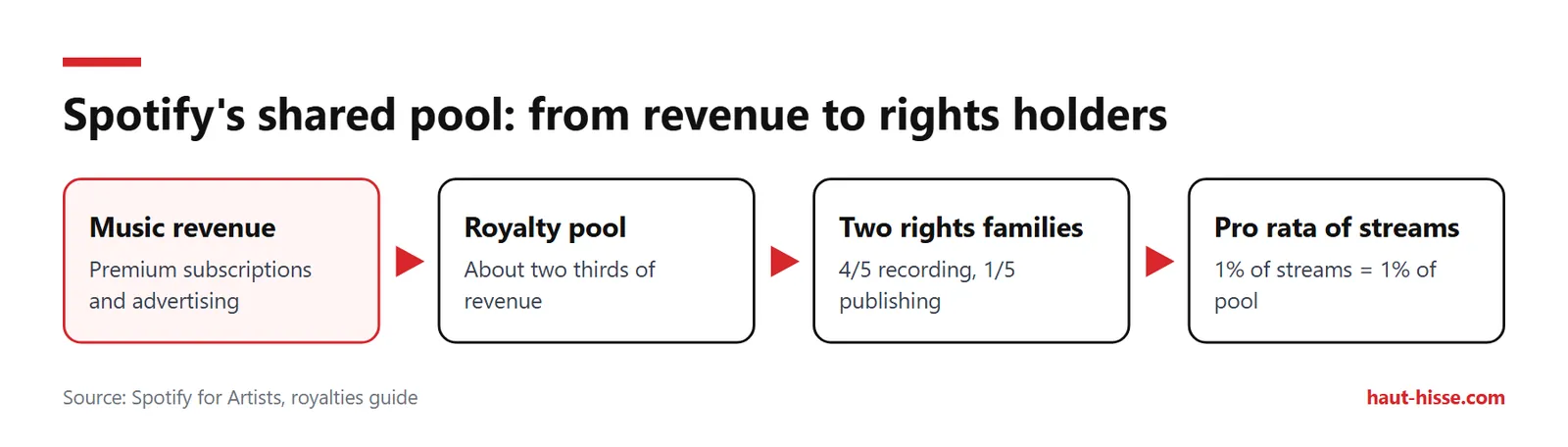
The payout for a Spotify stream varies because the platform puts roughly two-thirds of its music revenue, according to its official royalty guide, into a shared pool that is distributed in proportion to listening share. The label or distributor gets paid first, and then the artist receives their cut based on their contract.
Spotify pays out billions every year, and yet an artist can watch a million streams tick by for a modest payout. That gap comes down to the payout mechanics, which “rate per stream” figures mask. Here, we track the money from 2018 to 2025: from the old average to the 1,000-stream threshold per track, and from the label all the way to the artist who hits one million streams.
Key takeaways
- Every rights holder receives a share of the pool equal to their share of total streams.
- Tracks with under 1,000 streams over 12 months have been excluded from the recording pool since April 2024.
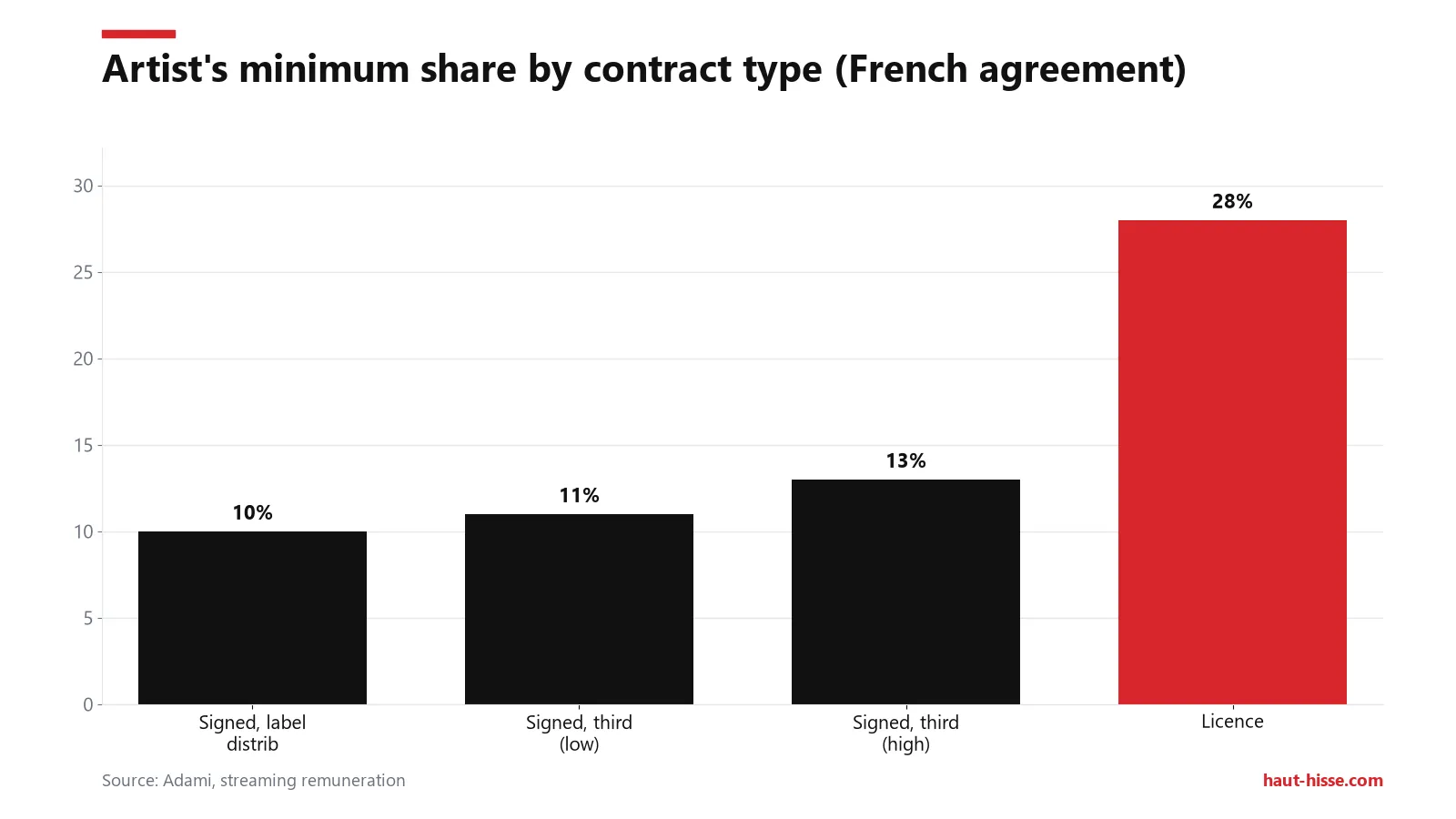
- In France, the Adami cites 28% for licensing contracts (single floor rate). For a signed artist, the agreement cites 10% before deductions (11% during) and 11% to 13% if a third party distributes.
- The $0.003 per stream figure comes from 2018 data shared by Soundcharts: it is an old, rough average.
2018: how much does Spotify pay per stream? A $0.003 average passes for a rate
The figure of a few fractions of a cent per stream is based on 2018 data: it summarizes an old average, not a set rate.
That year, Soundcharts estimated the average value of a stream at $0.00318, or about $3.18 per 1,000 streams for recording rights holders. Scaled up to one million streams, that average yields roughly $3,180 before any artist cut. Many pages repeat this figure without mentioning its date. Soundcharts itself points out that free and regional streams dilute the average. It covers what rights holders receive, not what the artist pockets afterward.
Spotify actually rejects this interpretation. Billboard shared its stance: the rate per stream is a “misconception.”
The shared pool: two-thirds of revenue distributed proportionally
Spotify sets no price per stream: the total payout is a global sum divided among all rights holders—meaning the labels, distributors, publishers, and management companies that own the rights to a track.
Spotify sets aside roughly two-thirds of its music revenue (from Premium subscriptions and advertising) for royalties, and then each rights holder receives a proportional share based on their weight in total streams. According to the Spotify for Artists royalty guide, about four-fifths of this pool goes to sound recordings and one-fifth to publishing.
The mechanism is called streamshare: your share of streams determines your share of the money. Spotify gives this example: a rights holder who accounts for 1% of a country’s streams receives 1% of that country’s recording royalties. No fixed dollar amount is attached to an individual stream.
Therefore, the amount per stream constantly shifts. The pool changes every month, the total number of streams does too, and the ratio between the two moves with them. For another situation where revenue depends on volume and margin, you can read how Costco makes money.
Premium streams vs. free streams
Streams from Premium subscribers contribute more to the pool than those from free users, according to Spotify for Artists.
As a result, the value of a stream varies by country and month. For an artist, the geographic origin of their audience impacts their earnings just as much as their total stream volume.
Recording rights and publishing rights
The pool is split into two categories. Recording rights, also known as masters, compensate the actual sound recording and go to the label or distributor. Publishing rights compensate the composition and lyrics, going to songwriters and composers. Recordings receive the largest share, while publishing gets the smaller share.
This distinction matters for anyone who writes music without performing it, or vice versa. Looking at the work of the songwriters behind major pop hits, it is clear that the person who signs the melody is not always the voice on heavy rotation.
April 1, 2024: the 1,000-streams-per-track threshold takes effect
This threshold removes low-play tracks from the calculation, creating a limited impact on total stream volume but affecting a massive number of individual tracks.
Spotify states that 99.5% of all streams come from tracks above the threshold, according to the announcement shared by Music Business Worldwide. The remainder—meaning a very small share of listening—is spread across a huge number of tracks.
The threshold is accompanied by a minimum unique listener requirement, which Spotify has not disclosed. Simply hitting 1,000 streams by generating them yourself or within a tight circle is therefore not necessarily enough.
The same announcement introduced penalties for labels and distributors in cases of blatant artificial streaming, and a minimum two-minute duration requirement for functional noise tracks (such as white noise).
For an emerging artist, the consequence is clear: a track below the threshold generates zero recording royalties. A debut single that stalls at a few hundred streams over the year earns nothing for its rights holder, regardless of what a single stream is worth that month.
2025: how much does 1 million streams on Spotify pay? The cascade down to the artist
Spotify pays the money to rights holders, who then pay artists and songwriters according to individual contracts. Consequently, the artist does not receive the gross amount, and their cut depends primarily on their contract rather than just their play count.
In 2025, Spotify paid out more than $11 billion to the music industry, bringing its cumulative total to nearly $70 billion since launch, according to its Loud & Clear report. Such a massive envelope cannot be read as a simple per-stream invoice: it gets split up, then filtered through individual agreements.
To isolate the contract’s effect, let us take a fictional artist, Camille Roux, invented for this example, who tallies one million streams. This hypothetical scenario is unsourced, and no current value per stream is established. The table below applies the minimum rates of the French professional agreement, published by the Adami—the society managing performing artists’ rights—starting with €100 received by the producer.
It then applies those percentages, as a rough order of magnitude, to Soundcharts’ 2018 average: roughly $3,180 for one million streams. The calculation is a simple multiplication of that baseline by each rate. The agreement’s rates apply to sums received by the producer, whereas the 2018 average applies to what rights holders get, making this an approximation.
| Artist situation | Adami minimum rate | Artist cut per €100 received by producer | Payout for 1 million streams (2018 baseline, approx.) | Note |
|---|---|---|---|---|
| Signed artist, label self-distributes | 10% before deductions, 11% during | €10 (€11 during deductions) | $318 ($349.80 during deductions) | Lowest case under the agreement |
| Signed artist, third-party distribution | 11% and 13% | €11 and €13 | $349.80 and $413.40 | Two rates per the agreement |
| Licensing contract | 28% (single floor rate) | €28 | $890.40 | Highest minimum share |
These rates are floors: a contract can provide for more. Depending on the agreement, the artist’s cut ranges from a single share to nearly triple. Based on the 2018 baseline, one million streams therefore amounts to a few hundred dollars for the artist, before any distributor commission.
The French agreement also provides, according to the Adami, a guaranteed minimum gross advance of €1,000 per unreleased album, reduced to €500 gross if the producer is a very small enterprise (fewer than 10 employees and under €2 million in turnover). This advance secures a baseline minimum upon signing, prior to any stream-based calculations.
This table has limits. A distributor commission, which may apply when an artist uses a third party, is not included here, nor is the SACEM share, which covers songwriting royalties rather than sound recordings. The net amount actually collected is therefore lower or different from what this grid suggests.
Artist Paul Wizman confronts this pay scale with his own statement in his video “How much Spotify paid me for 1 Million streams?!”:
Independent artist vs. major label: do they earn the same?
No: the money comes from the same pool, but what the artist keeps depends on their contract, label, and distributor.
An independent artist works through a distributor or secures a direct licensing deal with a label. Soundcharts cites distributors like Believe or TuneCore, noting that payouts follow each artist’s individual agreement. When self-produced, the artist generally keeps a larger share of what Spotify sends to the rights holder, but they bear production and promotion costs entirely on their own.
A signed artist has their share fixed by contract. In France, Adami minimums range from 10% for a signed artist to 28% under a licensing deal. In the UK, the Competition and Markets Authority (CMA)—the British competition watchdog—noted in its official release that the average royalty rate in major label artist contracts rose from 19.7% in 2012 to 23.3% in 2021. This is British, dated data, pointing to a general trend rather than a rate directly applicable in France.
Every intermediary takes a commission: label, publisher, distributor. No blanket percentage is established for these deductions, aside from the floors in the French agreement. Before signing, compare the artist’s share against the exact baseline it is calculated from. Independents account for a large share of the total, as 2025 figures show later in this article. For another example of artist earnings tied to rights, see how much Mr Bean earns for Rowan Atkinson.
Label and distributor share
The label or distributor is the primary recipient of the money paid out by Spotify for the recording. They keep a portion and pass the rest on to the artist according to their contract. Under the French framework, the professional agreement only sets the artist’s minimum share; the balance remains with the producer.
Distributors pay themselves through a commission that varies depending on the service tier, which this article does not quantify. An artist using both a label and a distributor faces two successive cuts before their share reaches their bank account.
SACEM and publishing royalties
SACEM (Société des auteurs, compositeurs et éditeurs de musique) handles publishing rights: it compensates those who wrote or composed the track. Adami, on the other hand, deals with performing artists. The same artist can collect from both sides if they write and sing their own material, but the revenue streams are distinct, and each follows its own distribution rules.
What the mechanics show, and their limits
One million streams does not make a career: streaming concentrates revenue among a small elite, and an artist’s cut is determined much more by their contract than by their play count.
The most recent figures come from Spotify’s primary data in its Loud & Clear report, partly summarized by Hypebot.
| 2025 benchmark | Figure | Source |
|---|---|---|
| Artists who generated at least $100,000 in royalties on Spotify alone | Over 13,800 | Spotify, Loud & Clear |
| Artists who generated over $1 million | Over 1,500 | Spotify, Loud & Clear |
| Share of royalties generated by independent artists and labels | Roughly half | Spotify, Loud & Clear |
| Royalties generated by the 100,000th artist in the rankings | Over $7,300 | Hypebot |
| Share of new artists hitting $100,000 living outside the United States | Roughly 85% | Hypebot |
These numbers measure generated royalties, not artists’ net income: the label’s, distributor’s, and collective management societies’ shares have already been deducted or still need to be subtracted.
The UK offers an older point of reference. The CMA noted on November 29, 2022, that over 60% of streams accounted for music recorded by the top 0.4% most popular artists. It also estimated that in 2021, an artist could expect around £12,000 for 12 million streams in the UK, a threshold reached by fewer than 1% of artists.
In France, certifications from SNEP (Syndicat national de l’édition phonographique) provide other benchmarks:
- a gold single requires 15 million equivalent streams;
- since July 2024, 7 freemium streams count as 1 premium stream;
- for albums, since January 2016, track streams are added up, half of the streams from the most-played track are subtracted, and 1,500 streams equal one album sale.
One million streams remains a long way from a gold record, and even further from stable income.
What the mechanics show: money flows from the shared pool to rights holders, then to the artist, and every step (streamshare, the 1,000-stream threshold, contracts) reduces or shapes the total sum. The limitations lie in the data itself. The 2018 average is dated, the CMA benchmarks are British and predate 2025, and Spotify’s figures cover generated royalties rather than net revenue. Aside from Adami’s minimum floors, no universal commission rate is established.
Frequently asked questions
How much does Spotify pay for 1,000 streams?
It depends on the shared pool, the country, and the month. An old 2018 benchmark, detailed above, puts the value for rights holders at a few dollars for 1,000 streams. The artist receives only a portion of this, varying by contract, after label or distributor deductions.
How much does 1 million streams on Spotify pay?
This represents about one thousand times the 1,000-stream benchmark, but the result depends on listeners’ countries, the share of Premium streams, and the month. The artist receives what their distributor or label pays out according to their agreement, after any applicable commissions.
How many streams on Spotify do you need to make $10,000?
That represents roughly ten times the 1,000-streams benchmark, but the exact result depends on listeners’ countries, the share of Premium streams, and the month. An independent artist receives what their distributor or label pays out according to their agreement, after potential commissions.
Who is the highest paid artist on Spotify?
An independent artist publishes tracks via a distributor, such as Believe or TuneCore, or through a licensed label. They then collect their share according to their contract, following any deductions.
How these articles are prepared: our editorial policy

