



Published
Understanding why lottery winners go broke comes down to concrete financial behaviors rather than bad luck or a supposed curse: mental accounting, peer pressure, and illiquid investments. The widely cited claim that 70% go bankrupt within five years is unverified—the National Endowment for Financial Education (NEFE) refuted it in 2018.
A jackpot looks like absolute insurance against financial hardship. Yet economic research tells a more nuanced story: in Florida, a sizable random windfall does not prevent bankruptcy, it merely delays it. In Sweden, however, winners report sustained, higher life satisfaction. The following sections separate urban legend from empirical findings, examine what actually triggers insolvency, and outline what distinguishes those who run out of money from those whose wealth endures.
Key takeaways
- The claim that 70% of lottery winners end up broke within five years stems from an unverified 2001 statement, debunked by the NEFE on January 12, 2018.
- In Florida, substantial random windfalls merely postpone bankruptcy for financially vulnerable recipients rather than preventing it.
- In Norway, the share of the windfall spent peaks in the year of the win (0.35 on average) and depends heavily on windfall size and liquid assets.
- Swedish jackpot winners report higher life satisfaction for over a decade, although the impact on daily happiness is significantly smaller.
Where does the 70% lottery winner bankruptcy myth come from?
The statistic claiming that 70% of winners go bankrupt within five years has no basis in academic research. The NEFE, frequently cited as the source, clarified in 2018 that it never produced such findings.
Origin of the 70% myth
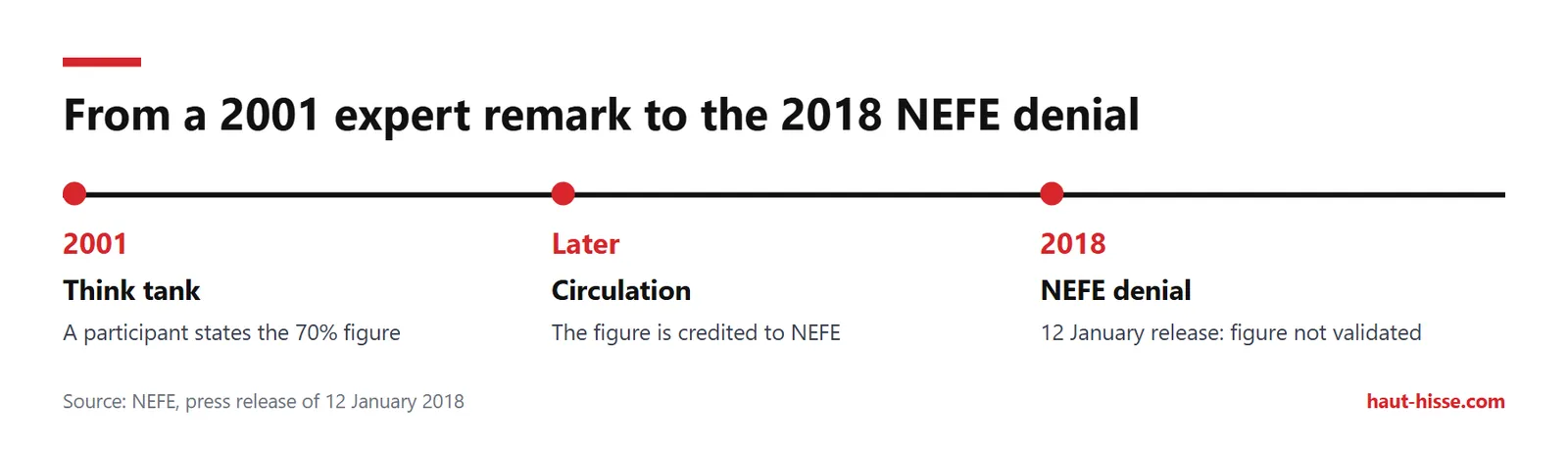
According to the NEFE, the statistic originated with a participant at a 2001 expert think tank who shared it without verification. It subsequently circulated through the media as if it were the result of official research conducted by the organization.
The NEFE’s 2018 refutation
In its statement released on January 12, 2018, the US financial education organization left no room for ambiguity:
“This statistic is not backed by research from NEFE, nor can it be confirmed by the organization.” (NEFE, 2018)
In other words, the claim is unsupported by any NEFE research.
Debunking the fake 70% statistic attributed to the NEFE
The website LotteryUSA also flagged this statistic as unreliable, echoing the NEFE’s clarification.
Yet the myth persists across international media. A promotional Swiss real estate blog still attributes a nearly 70% bankruptcy rate over five years to the NEFE.
Three distinct categories must be separated:
- What is proven: the 70% figure is completely unfounded.
- What is popular: the legend of a “lottery curse.”
- What remains to be examined: actual cases of financial distress, their underlying causes, and their real frequency.
Further data on the long-term outcomes of winners is examined in our investigation on what happens to lottery winners.
How many lottery winners actually go broke? What studies show
Econometric research does not support massive failure rates. Instead, studies suggest that large cash windfalls delay bankruptcy among financially vulnerable winners, and that financial ruin depends primarily on liquidity and spending behavior.
The Florida study
Scott Hankins, Mark Hoekstra, and Paige Marta Skiba published a study in The Review of Economics and Statistics (2011, vol. 93, no. 3, pp. 961–969). They compared Florida lottery winners who randomly won between $50,000 and $150,000 against smaller winners. Their findings center on three points:
- Such cash transfers “only postpone bankruptcy rather than prevent it.”
- Among large winners who eventually filed for bankruptcy, net assets and unsecured debt were similar to those of small winners.
- The authors concluded that skepticism regarding the long-term stabilizing effects of cash transfers may be warranted.
The scope of this research is specific: it examined mid-sized prizes within a single population in Florida. It did not evaluate the trajectory of multi-million-dollar jackpot winners.
Other research and the video that summarizes it
A preregistered Swedish study by Lindqvist, Östling, and Cesarini surveyed winners 5 to 22 years after their windfall. It focused on life satisfaction rather than bankruptcy rates.
In his video “How a Lottery Win Might Change You!”, Patrick Boyle contrasts bankruptcy anecdotes with academic findings, dismantling the notion of widespread ruin.
The table below compiles the popular bankruptcy myth alongside empirical results from Florida, Norway, and Sweden, detailing the scope and limitations of each finding.
| Common claim | What the research shows | Scope and limits |
|---|---|---|
| 70% go bankrupt in 5 years | NEFE (2018): claim is unsupported by research, traced back to an unverified 2001 think-tank remark | Lack of proof does not establish the true failure rate |
| Large windfalls prevent bankruptcy | Florida (Hankins, Hoekstra, Skiba, 2011): bankruptcy is delayed, not prevented; bankrupt big winners match small winners in net wealth and debt | Prizes of $50,000 to $150,000, Florida population only |
| Spending surges in year one | Norway (Fagereng, Holm, Natvik, 2016): average 0.35 spent in the year of the win, followed by a sharp drop | Measures consumption expenditure, not insolvency |
| Life satisfaction increases permanently | Sweden (Lindqvist, Östling, Cesarini, 2020): sustained increase with no erosion over a decade | Far smaller effects on daily happiness and mental health |
Mental accounting and spending: why lottery winners go broke
Mental accounting is the cognitive tendency to assign money to subjective categories. It often leads recipients to treat a windfall as “play money” rather than core capital, making it easier to burn through. Norwegian data indicates a clear consumption peak in the first year after receiving funds.
Mental accounting: how it leads to squandering a jackpot
Earned income is usually treated as “serious” money reserved for rent, mortgages, and bills. A lottery win, by contrast, is categorized as a “bonus” or “lucky money,” subjected to looser discipline. While this behavioral mechanism is plausible, its exact share among bankrupt lottery winners has not been measured directly; none of the empirical studies cited test mental accounting itself. Similar cognitive biases explain why prices end in 99.
What Norwegian economists Fagereng, Holm, and Natvik measured in a Statistics Norway (SSB) working paper dated November 30, 2016 is the marginal propensity to consume (MPC): the fraction of an additional euro received that gets spent. Their findings show:
- The MPC peaks in the year the prize is received, with a mean estimate of 0.35, before dropping sharply in subsequent years.
- The share spent varies only according to the prize size and the recipient’s liquid assets.
- The propensity to consume among the lowest 25% of winners is twice as high as among the top 25% of winners.
As an illustration based on this working paper, an MPC of 0.35 applied to a €100,000 windfall corresponds to an average of €35,000 spent within the first year. The prize figure is hypothetical, but the mathematical calculation is taken directly from the study.
Sudden wealth syndrome: what remains an unproven hypothesis
The phrase “sudden wealth syndrome” appears frequently in the media and everyday conversation. It is not a recognized clinical diagnosis. It describes the concept that an abrupt financial windfall triggers euphoria, an illusion of limitless resources, and a drop in financial vigilance. It remains a descriptive hypothesis rather than a clinically validated condition.
The empirical boundary is clear: Norwegian data examines expenditure within a single country and proves no direct link to bankruptcy. An initial surge in first-year spending can also reflect debt clearance or deferred capital purchases.
Family pressure, lifestyle inflation, and illiquid investments: the other pitfalls
Three factors frequently overlap: financial demands from social circles, lifestyle inflation, and locking up capital in illiquid assets. Only the last factor is substantiated by empirical data here.

Social and family pressure
Gifts, loans, and family expectations represent a plausible mechanism frequently documented in press profiles. However, no rigorous percentage exists to measure how much this pressure contributes to overall bankruptcy rates. It should be treated as a working hypothesis, not a proven primary cause.
Lifestyle spending
Upgrading one’s standard of living creates ongoing, recurring commitments:
- More expensive real estate;
- Luxury vehicles;
- High-end subscriptions;
- Property maintenance and taxes.
These expenses persist long after the year of the win. The mechanics behind these costs are explored in our analysis of the true cost of luxury, though prize-winner-specific figures remain unmeasured.
Illiquid investments
An illiquid asset cannot be quickly converted into cash without delays or substantial loss of value. The Norwegian researchers pointed out that many households are wealthy on paper but hold mostly illiquid assets and display high marginal spending. From their findings, liquidity matters more than balance-sheet net worth.
For instance, capital tied up in a private business or commercial property cannot cover unexpected cash demands without a sale. The owner appears wealthy on paper but faces a cash shortfall when bills come due. The proportion of bankruptcies driven by business ventures or real estate has not been quantified to date.
Lack of financial literacy
The Florida study suggests that prior net wealth and debt levels matter more than the windfall amount itself: large winners who file for bankruptcy look almost identical to small winners in both metrics. This indicates a statistical correlation rather than proven causation. Financial literacy itself was not measured in the study.
What separates winners who collapse from those who last
Available empirical data points to balance-sheet liquidity, the size of the prize relative to pre-existing financial distress, and spending patterns, rather than fate or a curse.

In Norway, prize size and liquid assets alone explain the proportion of money spent. In Florida, winners who ultimately went bankrupt mirrored small winners in terms of baseline debt and net assets. The table below summarizes these dynamics using an empirical framework, without constituting financial advice.
| Circumstance | Risk observed in the data | Empirical limitation |
|---|---|---|
| Capital primarily tied up in illiquid assets | Wealthy but illiquid households exhibit a high propensity to spend (Norway) | Measures consumption levels, not legal bankruptcy |
| Low baseline net worth and high unsecured debt | Bankrupt large winners share financial profiles with small winners (Florida) | Correlation, not direct proof of causation |
| Modest windfall relative to financial needs | Smaller windfalls are spent at twice the rate, proportionally (Norway) | Data from a single country |
When assessing any claim regarding lottery winner bankruptcy, the following approach helps separate fact from fiction:
- Identify the primary source of the claim (study, institution, publication date) and confirm it exists.
- Verify what was actually measured: legal bankruptcy, annual expenditure, life satisfaction, or labor earnings.
- Note the demographic group and the size of the windfalls studied (Florida, Norway, Sweden).
- Distinguish observed statistical correlations from proven causal relationships.
- Disregard commercial or promotional content that repeats statistics without primary references.
None of the academic studies evaluated here measured the impact of professional advisory services on capital retention. The framework above describes observed behaviors, not an investment guide. For personal decisions, certified professionals and legal advisers evaluate individual circumstances, while guidance from market regulators—such as the AMF, France’s Financial Markets Authority—regularly highlights asset risks.
How does France’s FDJ support lottery winners?
According to an unofficial summary published by a real estate blog, Française des Jeux (FDJ, France’s national lottery operator) contacts winners via its Major Winners division starting at €500,000, offering optional, free guidance for amounts over €1 million. These thresholds should be confirmed directly on fdj.fr.
This framework is not confirmed on an official page. According to that same summary, the program consists of:
- Contact threshold: €500,000, initiated by the Major Winners service.
- Support threshold: From €1 million upwards, according to the summary (a figure subject to verification on fdj.fr).
- Content: Estate planning and legal workshops, free and voluntary.
- Structure: Group follow-up over five years, featuring around twenty workshops annually.
No cited academic study has evaluated whether this specific program improves long-term wealth preservation. In jurisdictions such as Belgium or Quebec, tax treatments and payout structures differ and must be verified through local official channels.
Lottery winner well-being: are winners happier after a jackpot?
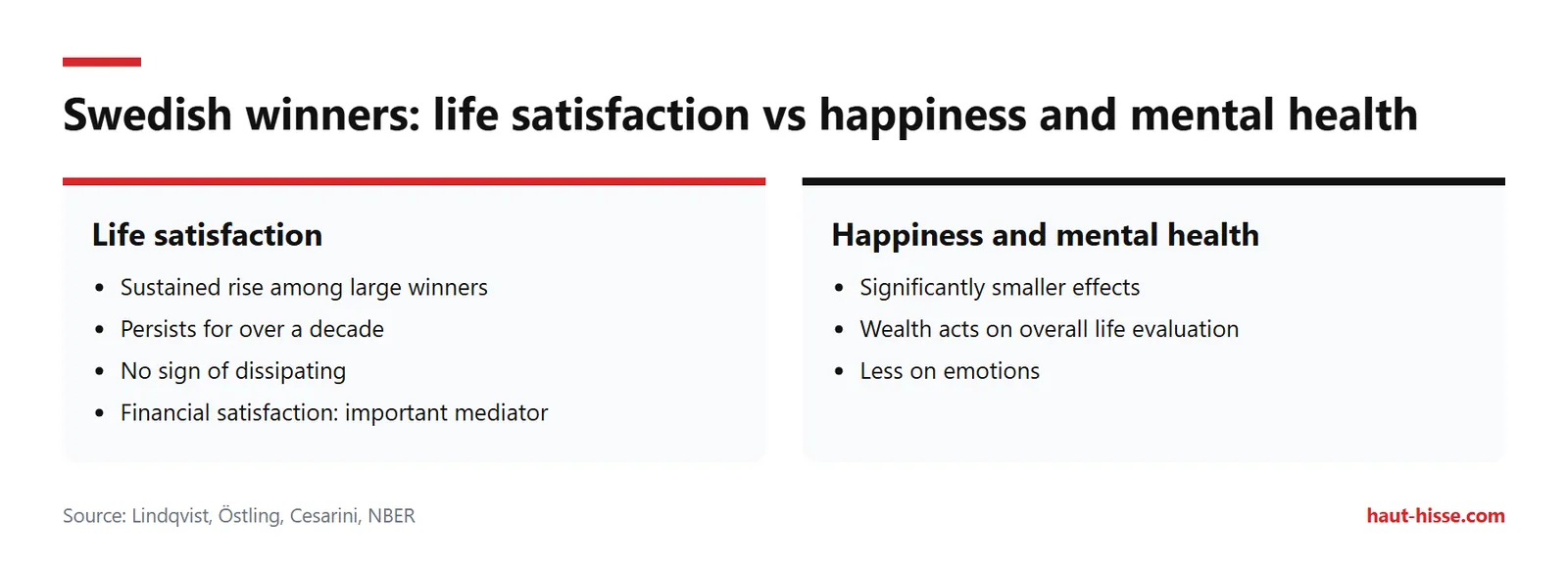
Swedish winners of large jackpots report sustained increases in overall life satisfaction lasting more than ten years, but the measured effect on day-to-day happiness and mental health is substantially smaller.
Lindqvist, Östling, and Cesarini released their findings as a NBER working paper in 2018, later published in The Review of Economic Studies (2020, vol. 87, no. 6, pp. 2703–2726). Their key findings include:
- Large winners experience lasting increases in overall life satisfaction “that persist for over a decade and show no evidence of dissipating with time.”
- Effects on daily happiness and mental health are significantly smaller, suggesting wealth influences cognitive life evaluation much more than daily mood.
- Financial satisfaction acts as a central mediator behind this sustained increase.
Coverage by LotteryUSA reported that over 3,300 winners were surveyed 5 to 22 years after winning. This figure comes from that secondary report rather than the NBER abstract itself.
Employment patterns also change. A Swedish study covering 249,278 lottery players aged 21 to 64 whose labor earnings were tracked from 1991 to 2010, summarized by J-PAL, showed a modest but persistent decrease in labor earnings. Married winners reduced their earnings more than their spouses: 0.981 SEK per 100 SEK won, compared to 0.458 SEK for the spouse.
Higher life satisfaction does not preclude individual winners from facing financial strain. Because these studies track population averages across distinct dimensions of life, heightened subjective well-being and financial vulnerability can exist alongside each other.
Frequently asked questions
What is sudden wealth syndrome?
It is a popular descriptive phrase rather than a recognized medical diagnosis. It refers to the concept that an unexpected financial windfall triggers emotional excitement, an impression of infinite wealth, and reduced financial caution. This explanation remains an unproven hypothesis: academic studies on lottery winners track concrete metrics like consumer spending, bankruptcy filings, and life satisfaction scores rather than this syndrome.
What do lottery winners do with their money?
Spending behaviors vary by country and jackpot size. In Norway, household spending spikes in the year the prize is collected before declining steeply. In Sweden, winners exhibit a modest, long-lasting reduction in labor earnings. These studies measure broad statistical averages across populations rather than detailing how every single individual spends their payout.
Do lottery bankruptcies mostly come from businesses or real estate?
No empirical data exists to prove this claim. The reasoning relies on a plausible behavioral mechanism: capital tied up in illiquid assets cannot cover sudden, short-term liabilities without a forced liquidation. Research from Norway emphasizes that ready cash liquidity influences spending and balance-sheet vulnerability far more than total paper net worth.
How these articles are prepared: our editorial policy

