


Published
SPCX is the ticker for SpaceX stock. It opened at $150 on June 12, 2026, closed that day near $161, and stood at $147.79 before its first quarterly report. On November 20 it closed at $127.79, a market value of about $1.74 trillion, according to Morningstar. That report shows $14,575M of third-quarter revenue, but its largest segment is Super Intelligence. None of its three segments is called Starlink, Launch or xAI.
SpaceX’s $4,404M third-quarter net income came with $1,025M of other income and a $390M income tax benefit. Over nine months the company still shows a net loss of $413M, and its purchases of property and equipment reached $48,069M.
Contents
- How much is SpaceX stock right now, and what is SPCX worth?
- What is inside SpaceX’s $14,575M quarter? Three segments, not Starlink
- Who is buying? One unnamed customer is 34.5% of SpaceX revenue
- Is SpaceX profitable? What the $4,404M net income leaves out
- Where did the IPO money go? $48,069M of capex in nine months
- Who controls SpaceX stock? Ten-vote shares and a Tesla mention
- What happens to SpaceX stock when the lock-up ends?
- Frequently asked questions
How much is SpaceX stock right now, and what is SPCX worth?
SPCX opened at $150 on June 12, 2026 and closed at around $161, up 19%. That valued SpaceX at $2.1 trillion after a $75 billion raise. On November 20, 2026, SPCX closed at $127.79, down 7.7% on the day, for a market value of about $1.74 trillion, according to Morningstar. The price moves daily: check a live quote before relying on these figures.
On June 12, 2026, SpaceX became a listed company. The IPO had been valued at $1.77 trillion, and the day’s close put the market value at $2.1 trillion. An offer price per share is not stated here: the $150 is the opening trade, and the IPO is described by its valuation.
France 24 presented the listing, before it happened, as heading toward the biggest IPO ever carried out.
As a public company, SpaceX wants to fund a heavy AI build-out with IPO money. The quarterly filing shows what stands in the way: capex far above operating cash flow, rising debt, concentrated customers and a lock-up calendar for early shareholders.
The stock did not hold its first-day close. During the decline after the IPO, it traded at about 49 times forward revenue, against about 15 for Tesla, with fewer than 5% of shares tradable. The last dated price is $147.79, the close before the Q3 results published on October 20, 2026, which is below the day-one close of around $161. The results beat expectations: net income of $4.4 billion against $1.87 billion expected by FactSet, and revenue of $14.6 billion against a $12.9 billion consensus. A valuation of 49 times forward revenue depends on what that revenue is made of, and the 10-Q does not use the names the headlines use.
What is inside SpaceX’s $14,575M quarter? Three segments, not Starlink
SpaceX reports three segments: Space, Connectivity and Super Intelligence. Starlink sits inside Connectivity, launches inside Space, and xAI, X and Cursor inside Super Intelligence. At $7,560M, Super Intelligence is larger than Connectivity at $5,248M.
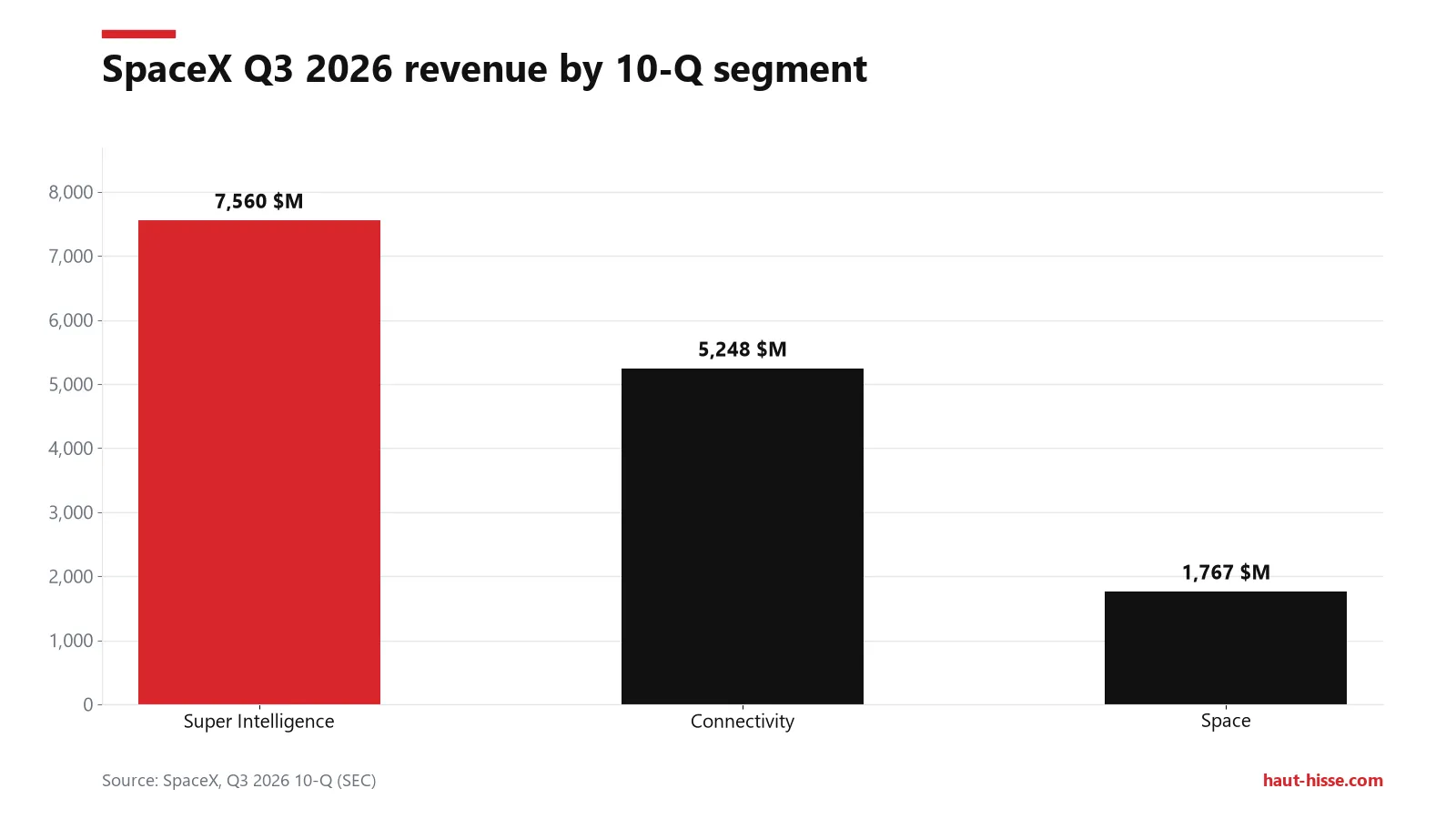
Q3 2026 revenue was $14,575M, against $5,576M a year earlier. Over nine months, revenue was $27,083M against $13,714M. Headlines talk about Starlink and xAI, but the filing breaks the total down differently. The table maps each segment to the brand names the media use, with Q3 2026 revenue.
| Segment in the 10-Q | Q3 2026 revenue | What sits inside |
|---|---|---|
| Space | $1,767M | Launches; Launch Services $1,130M |
| Connectivity | $5,248M | Starlink; consumers $3,121M, enterprise and government $2,127M |
| Super Intelligence | $7,560M | xAI, X, Cursor |
The three lines add up to the $14,575M total. Because the 10-Q does not report Starlink, Launch or xAI as segments, a search for “Starlink revenue” lands on the Connectivity line, which includes more than consumer subscriptions: the enterprise and government line is $2,127M of it. Reading a company by what it reports rather than by its label is the exercise behind what Palantir actually does too.
The operating numbers behind the lines are large. Starlink reached 13.6 million subscribers, up 89%. The AI business earned $7.6 billion, up 830%, by renting out computing capacity after the xAI acquisition in February. That rental revenue is the reason Super Intelligence now outweighs the satellite business in the quarter.
The largest segment is also the one tied to a single unnamed customer.
Who is buying? One unnamed customer is 34.5% of SpaceX revenue
In Q3 2026, a “Customer B” linked to Super Intelligence accounted for 34.5% of revenue, and a “Customer A” present in all three segments for 16.6%. The 10-Q names neither. One customer also accounts for 27.7% of receivables, the money customers owe the company at the end of the period.
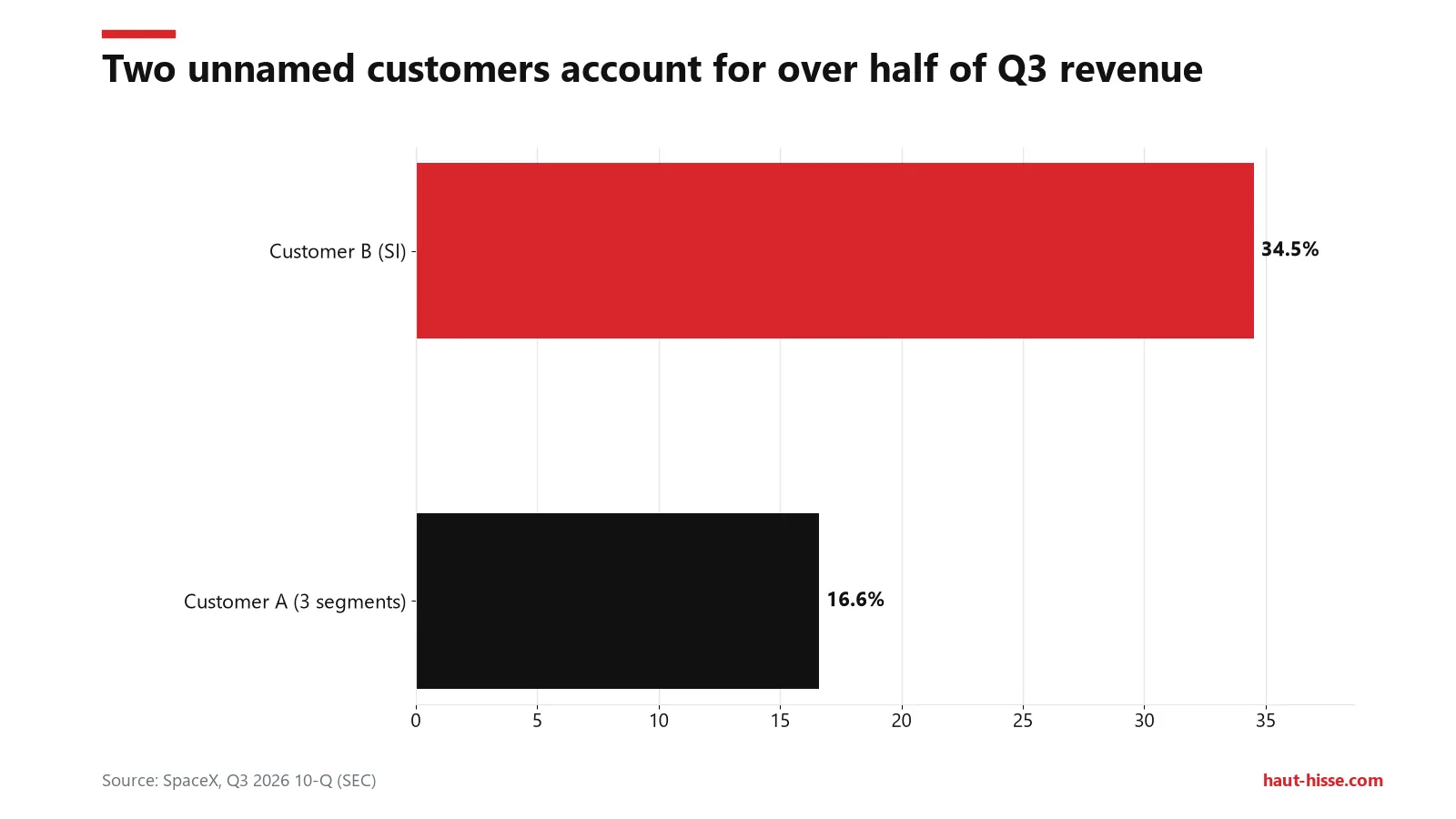
The filing does not identify the customers or give the U.S. government’s share of revenue, so any name attached to Customer A or B is a guess. What the filing does show is how much weight two buyers carry: together, 51.1% of the quarter’s revenue.
Backlog, the value of contracted work not yet delivered, was $62,959M at September 30, 2026, with about 67% expected to be recognized within a year. A backlog that large is a point in SpaceX’s favor on visibility. It does not say who holds the contracts.
The Super Intelligence revenue of $7,560M comes from capacity rental, which fits a concentrated customer base, but the filing does not say whether that revenue comes from Customer B. That link stays an open point.
Revenue that depends this much on a few buyers still has to turn into profit, and the headline profit figure needs a closer look.
Is SpaceX profitable? What the $4,404M net income leaves out
SpaceX had Q3 2026 operating income of $2,791M and net income of $4,404M. Over nine months, operating income is $705M but net income is -$413M. Q3 2025 operating income was -$273M, so the quarter is a reversal.
Net income of $4,404M is larger than operating income of $2,791M, and two items explain part of that gap: $1,025M of other income and a $390M income tax benefit. The nine-month figures also carry a $1,545M loss on debt extinguishment, the cost of retiring debt early. The 10-Q does not say how long the other income will recur, so one strong quarter is not a trend.
The longer record is of losses. The IPO prospectus showed a 2025 net loss of $4,937M, a Q1 2026 net loss of $4,276M and an accumulated deficit of $41,311M at March 31, 2026. In 2025 the company reported $18.7 billion of revenue and a $2.6 billion operating loss. Its adjusted EBITDA, a profit measure before interest, taxes, depreciation and amortization, was $6.6 billion, against that net loss.
The profit in 2025 came from one segment. Connectivity posted $11,387M of revenue, $4,423M of operating income and $7,168M of segment adjusted EBITDA.
The operating profit exists, but the cash flow statement tells a different story: spending is running far ahead of it.
Where did the IPO money go? $48,069M of capex in nine months
Purchases of property and equipment reached $48,069M over nine months of 2026, against $13,097M of operating cash flow. The IPO’s net proceeds were recorded at $85,675M. Capex in the same period of 2025 was $13,846M, so spending is up more than threefold.
On the balance sheet at September 30, 2026, SpaceX held $51,294M of cash and $38,561M of marketable securities. Debt and finance leases stood at $38,844M, against $22,896M at December 31, 2025. The company raised equity and still added debt while spending.
The prospectus split 2025 capex by segment: Space $3,832M, Connectivity $4,178M and AI $12,727M. In Q1 2026 alone, AI capex was $7,723M. The filings give the split by segment and no further detail on what the money was spent on.
That split reverses the earlier picture. The segment that posted $4,423M of operating income in 2025, Connectivity, is not the one absorbing most of the capital. AI is, and AI is also the segment tied to the largest unnamed customer.
BFM Business put the listing to its viewers as a question: a bet of the century or stock-market folly.
Whoever decides how that capital is allocated also holds the votes, and the 10-Q hints at a possible Tesla combination.
Who controls SpaceX stock? Ten-vote shares and a Tesla mention
Elon Musk holds 849 million Class A shares and 5.6 billion Class B shares, and each Class B share carries 10 votes. His 2025 salary was $54,000, a figure that sits next to a holding worth far more than any pay package. His 5.6 billion Class B shares count for ten times as many votes as the same number of ordinary shares.
The 10-Q lists a possible tie-up with Tesla among its forward-looking statements, the section where a company flags plans and risks that have not happened yet:
“the evaluation of a potential combination with Tesla, Inc.” — SpaceX 10-Q (2026)
That is the whole mention. No terms, timing or decision are given, so it describes an evaluation and nothing more.
Capex of $48,069M, a backlog tied to a few buyers and a possible combination with another public company all sit under the same governance structure. A shareholder with ten-vote shares is the person those decisions run through.
Musk’s shares are in the group still locked up, which brings the calendar of who can sell and when.
What happens to SpaceX stock when the lock-up ends?
A first release covers 911.5 million shares, about $123 billion at the time of the report, and a second covers 455.8 million shares if the price stays above $175.50 (source: Boursorama). The float, the share of stock that can trade freely, could reach about 40% by December 8.

After the IPO, fewer than 5% of shares were tradable. The remaining 60%, including Musk’s shares, stay locked until mid-2027, according to the Reuters report carried by Boursorama. Reuters framed the selling wave as a worry ahead of the expiry, and that is how it should be read: as a reported concern, not a forecast.
The second release depends on a price condition. It applies only if the stock holds above $175.50, and the $147.79 close before the Q3 report was below that level. Whether the condition is met depends on where the stock trades afterward.
The mechanism is simple. When more shares can be sold, the supply available to the market changes. That says nothing about the direction of the price, which also depends on demand and on what the company reports.
For a shareholder, December 8 takes the float from under 5% to about 40%: the supply that can reach the market grows at least eightfold (our calculation), and nobody knows yet who will sell.
That leaves the question the next 10-Q will settle: once 40% of the shares can trade, will Customer B still account for more than a third of SpaceX’s revenue? If it does, the stock will depend as much on an unnamed buyer as on rockets. The way to read it is the same as for any heavily covered company: segments and customers, not brand names.
Frequently asked questions
What is SpaceX’s stock ticker?
SpaceX trades as SPCX. The stock opened at $150 on June 12, 2026, its first day of trading, and closed at around $161. It closed at $147.79 before the Q3 report published October 20, 2026, and at $127.79 on November 20, 2026, according to Morningstar.
Is Starlink a separate segment in SpaceX’s financial reports?
No. The 10-Q reports three segments: Space, Connectivity and Super Intelligence. Starlink sits inside Connectivity, which had $5,248M of revenue in Q3 2026. Launches sit inside Space, and xAI, X and Cursor inside Super Intelligence.
Who is SpaceX’s biggest customer?
The 10-Q does not say. It reports a “Customer B,” linked to Super Intelligence, at 34.5% of Q3 2026 revenue, and a “Customer A,” present in all three segments, at 16.6%. Neither is named, and the filing does not give the U.S. government’s share.
Does SpaceX make a profit?
In Q3 2026 it reported net income of $4,404M, helped by $1,025M of other income and a $390M tax benefit. Over nine months, net income is -$413M. Operating income is $2,791M for the quarter and $705M for the nine months.
Read next
How these articles are prepared: our editorial policy

