


Published
So how does IKEA make money? Through a franchise model that splits revenue between two entities. Inter IKEA, which owns the concept, collects a 3% royalty on franchisees’ net sales and sells them products wholesale. Ingka Group, its main franchisee, runs the stores and shopping centers.
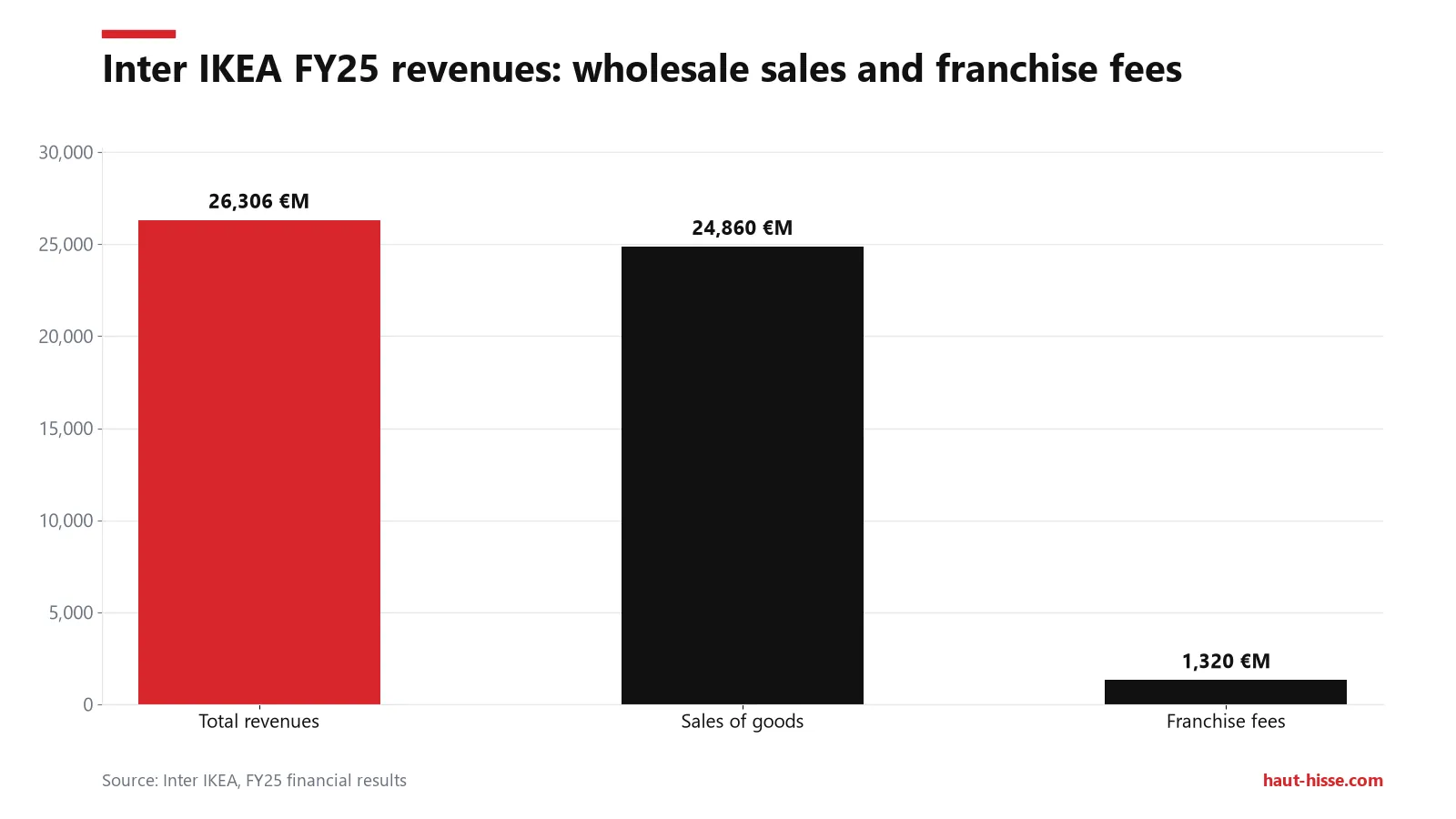
The royalty is a real income stream, but it is a minority of the total. According to Inter IKEA’s FY25 results page, it came to €1,320 million out of €26,306 million in revenue (year ended August 31, 2025), of which €24,860 million was merchandise sales. Ingka Centers’ profitability is not published. This guide follows the money between entities: the royalty, wholesale sales, shopping centers, foundations, and then a European tax investigation.
Key takeaways
- Franchisees pay Inter IKEA Systems B.V. a royalty based on their net sales, but wholesale sales weigh far more in its revenue.
- Ingka Group is only one of IKEA’s 12 franchisees. It runs IKEA Retail, Ingka Centres and Ingka Investments.
- Ingka Centres mainly supports IKEA store locations and drives traffic to them. Its own profitability is not published.
- Two foundations, one in the Netherlands and one based in Liechtenstein, sit at the top of the ownership of Ingka and the IKEA concept.
- In FY25, Inter IKEA’s net profit fell by about a third, while Ingka’s rose significantly.
How does IKEA make money? Two companies, not one
IKEA is not a single company but a franchise system. Inter IKEA owns the concept and the brand, while franchisees such as Ingka Group run the stores.
Inter IKEA Systems B.V., based in the Netherlands, owns the IKEA concept and the brand’s intellectual property. A brand can be worth far more than its products. Our article on how Liquid Death sells water is another example. According to Inter IKEA’s country-by-country report, the range is managed from Sweden by IKEA of Sweden AB, and sourcing is handled from Switzerland by IKEA Supply AG.
Ingka Group brings together in-store sales (IKEA Retail), shopping centers (Ingka Centres) and the investment arm (Ingka Investments).
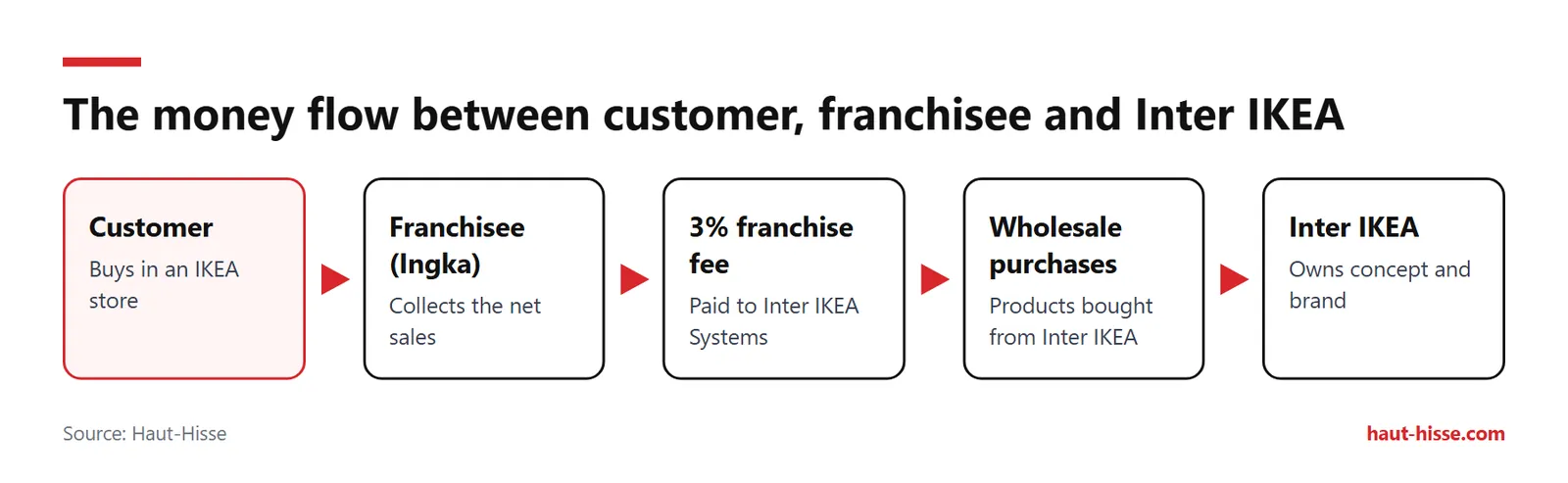
The public sees one group selling Billy bookcases. In reality, money flows between separate entities. The franchisee collects from the customer, pays the royalty to Inter IKEA, and buys its products from Inter IKEA.
Across the network, retail sales reached €44.6 billion in FY25, down 1%. Our article on how Costco makes money covers another large retailer.
The official figures don’t always match, so read these as rough orders of magnitude:
| Data point | First value | Second value |
|---|---|---|
| Franchisees | 12 franchisees (IKEA) | 13 company groups holding a franchise agreement (Inter IKEA, press release of November 7, 2025) |
| Markets and stores | 63 markets for the franchise system | 525 stores in 64 markets (same IKEA page) |
| IKEA Retail visits, FY25 | 736 million in the text | 739 million in a list on the same page |
| Ingka Centers sites | 37 in the key figures box | 35 in the page text |
Inter IKEA vs. Ingka Group: who does what?
Inter IKEA is the franchisor and wholesaler. Ingka Group is the main franchisee and retailer. The two share a founder, but they have different leaders and owners.
The table below summarizes the division of roles, based on the Inter IKEA Foundation and the Stichting INGKA Foundation page on Wikipedia.
| Criterion | Inter IKEA | Ingka Group |
|---|---|---|
| Role | Franchisor: concept, brand, wholesale | Franchisee: stores and shopping centers |
| Key entity | Inter IKEA Systems B.V. (Netherlands) | INGKA Holding (Leiden) |
| Owner | Inter IKEA Foundation (Liechtenstein) | Stichting INGKA Foundation (Netherlands) |
| Direct customers | The franchisees | The general public |
On the end-customer side, Ingka’s IKEA Retail has 620 touchpoints and 736 million visits in FY25, according to Ingka.
The difference between Ingka and Inter IKEA comes down to what they do: one owns and licenses the concept, the other sells. As for who owns IKEA, there is not one owner but two foundations, described further below.
How much does the 3% franchise royalty bring in?
Franchisees pay 3% of their net revenue to Inter IKEA Systems B.V. in exchange for access to the IKEA concept. Inter IKEA describes this mechanism in its country-by-country report: elements of the concept are made available, including to franchisees, for a royalty of 3% of net sales.
Here is a simple example based on the 3% rate published by Ingka: for €100 of net sales in a franchised store, €3 goes to Inter IKEA Systems. That is not profit for the franchisee, which also pays for, among other things, the products it buys wholesale.
The following figures come from Inter IKEA’s FY25 results page.
| Item (FY25 results page) | FY25 | FY24 |
|---|---|---|
| Total revenue | €26,306 million | not specified |
| Merchandise sales | €24,860 million | not specified |
| Franchise royalties | €1,320 million | €1,348 million |
According to the same results page, the royalty accounts for about 5% of Inter IKEA’s revenue, and merchandise sales for more than 94%. Applying 3% to the €44.6 billion in network sales reported by Retail Dive gives about €1.34 billion. That is close to, but not the same as, the €1,320 million reported. Don’t draw a rule from this. One possible explanation is that net sales subject to the royalty don’t exactly match total network sales.
According to the FY25 results page, the royalty fell about 2% in one year, from €1,348 million to €1,320 million. Over the same period, Inter IKEA’s net profit dropped by nearly a third, according to Retail Dive. The royalty is stable in value, but it is not the main source of revenue.
Who pays the royalty? A calculation from store to visit
The system’s 12 franchisees, spread across 63 markets according to IKEA, do not contribute equally. Ingka alone sells €39 billion through IKEA Retail, nearly nine-tenths of the network’s €44.6 billion. Let’s apply the 3% rate to Ingka’s sales, then divide the result by the 736 million visits in FY25. Ingka’s sales figures come from Furniture News.
| Step | Calculation | Estimated result |
|---|---|---|
| Ingka IKEA Retail sales, FY25 | Published figure | €39 billion |
| Theoretical royalty from Ingka | €39 billion × 3% | about €1.17 billion |
| Share of Inter IKEA’s €1,320 million in royalties | €1,170 million / €1,320 million | about 89% |
| Remainder for other franchisees | €1,320 million − €1,170 million | about €150 million |
| Sales per visit at Ingka | €39 billion / 736 million | about €53 |
| Royalty per visit | 3% of €53 | about €1.59 |
These are our own estimates, not published data. IKEA Retail sales are not necessarily the same as the net sales subject to the royalty. A visit is also not a purchase: the €53 figure measures average revenue per visit, not average basket size. The result is still a useful order of magnitude: Inter IKEA’s royalty depends very heavily on one franchisee, Ingka. This concentration is not new. According to Wikipedia, INGKA Holding already controlled 372 of IKEA’s 432 stores in 2006. That figure is old, so treat it as a historical benchmark.
The two entities side by side
The table compares the two entities in FY25 (FY24 in parentheses), based on Retail Dive for Inter IKEA and Furniture News for Ingka.
| Metric | Inter IKEA, FY25 (FY24) | Ingka Group, FY25 (FY24) |
|---|---|---|
| Revenue | €26.3 billion (€26.5 billion) | €41.5 billion (-0.9%) |
| Operating profit | €1.7 billion (€2.3 billion) | €1.5 billion (€1.3 billion) |
| Net profit | €1.5 billion (€2.2 billion) | €1.4 billion (€0.8 billion) |
| Franchise royalties | €1,320 million (€1,348 million) | Pays the royalty |
| Product sales | €24,860 million in merchandise sales | €39 billion in IKEA Retail sales (-1.6%) |
Inter IKEA’s revenue is nearly €15 billion lower than Ingka’s, but it has a higher operating profit. Using the rounded figures from Retail Dive and Furniture News (€1.7 billion on €26.3 billion, and €1.5 billion on €41.5 billion), the franchisor’s operating margin is about 6.5%, versus about 3.6% for the retailer. The franchisor keeps more profit per euro of revenue.
Wholesale sales, flat-pack furniture and product margins
Inter IKEA sells products wholesale to retailers. Flat packaging moves final transport and assembly to the customer, which reduces logistics costs. Wholesale volumes rose about 6% in FY25, according to Inter IKEA’s press release of November 7, 2025, which also reports an effective tax rate of 21.3%.
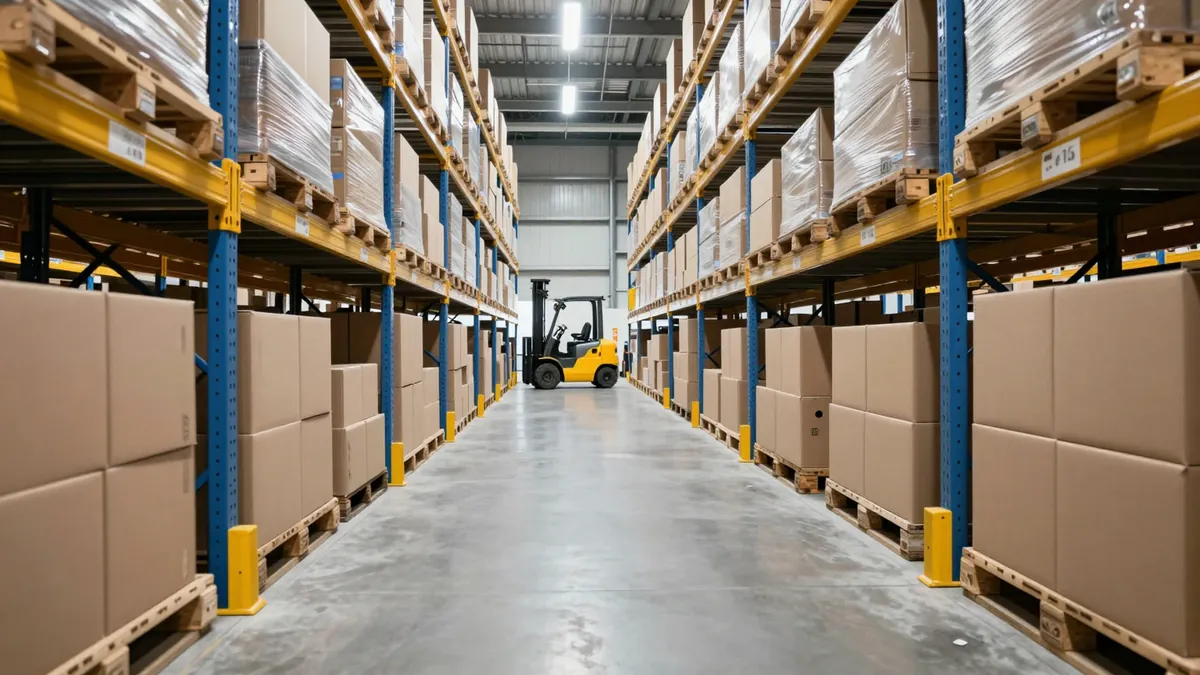
The flat-pack model is well known. The customer takes home a flat box and assembles the furniture. That transport and assembly work no longer weighs on the seller’s operating costs. The supply chain runs through IKEA Supply AG, which holds most of the inventory.
IKEA does not publish margins product by product, whether for Billy or any other item. Any per-unit margin cited online is an estimate. Only overall margins by entity can be calculated, as in the table above.
The FY25 results also show that this model is not immune to shocks. Inter IKEA’s operating profit and net profit fell sharply, even as volumes sold to franchisees grew. A well-oiled model can still weaken, as our article on the bankruptcy of Kodak explains.
What is Ingka Centres’ role, and what do we know about its profitability?
Ingka Centres’ main purpose is to support IKEA store locations and attract traffic to them, in addition to its role as a commercial property owner. Ingka puts it this way: supporting store openings and generating visits. A shopping center that draws people mainly benefits the IKEA store next door.
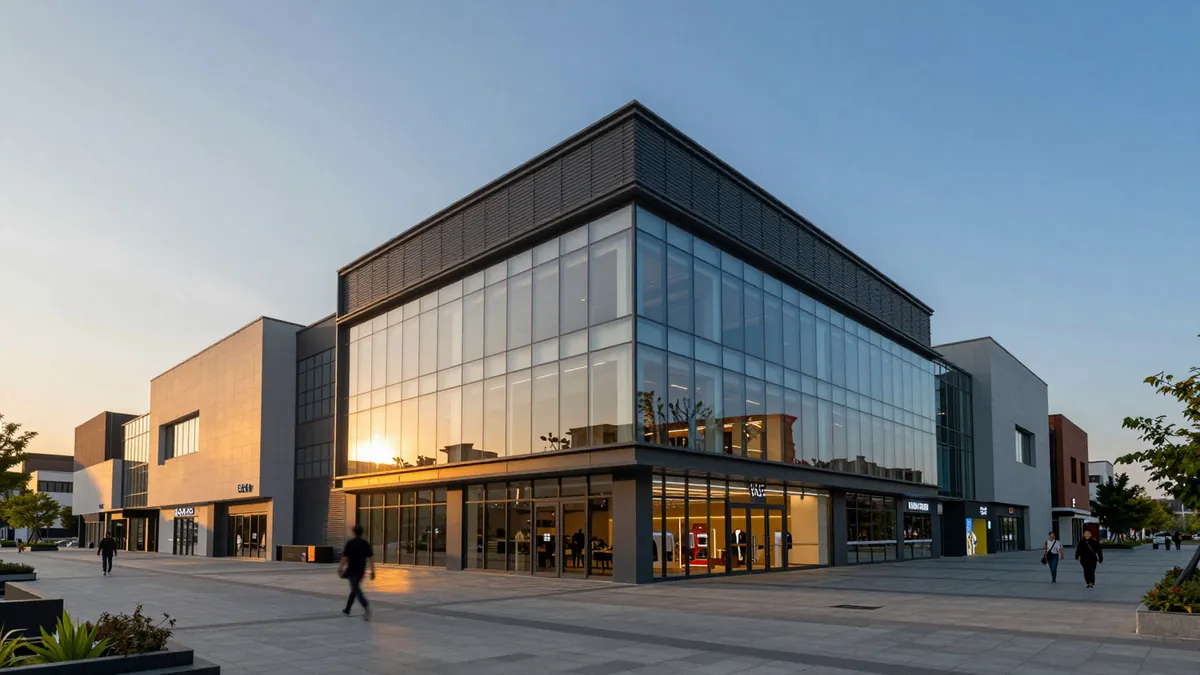
History supports this logic. The first mall opened in 1973 in Sundsvall, Sweden, next to an IKEA store. Today, according to the Ingka Centres page, Ingka Centres operates centers in 14 countries, with 320 million visits a year. In China, the centers use the LIVAT brand.
Here is how the two visitor flows compare:
- IKEA Retail, FY25: 736 million visits to stores, according to Ingka.
- Ingka Centres: 320 million visits a year, according to Ingka.
The centers therefore receive a little less than half as many visits as the stores. Their stated mission is to feed that traffic, not primarily to generate their own profit.
Ingka Centres’ profitability is not published separately. As a result, its contribution to Ingka’s profit cannot be quantified, and nothing shows that the shopping center business alone explains the group’s profitability. Ingka Investments is the group’s third business. Its weight in the results is not publicly broken down either.
Low prices and foot traffic: a business hypothesis
Intotheminds reads IKEA’s strategy as a bet on smaller stores of 2,000 to 4,000 m² and on price cuts: less margin per item in exchange for more traffic. The role of restaurants in that traffic remains a business hypothesis, with no public figures.
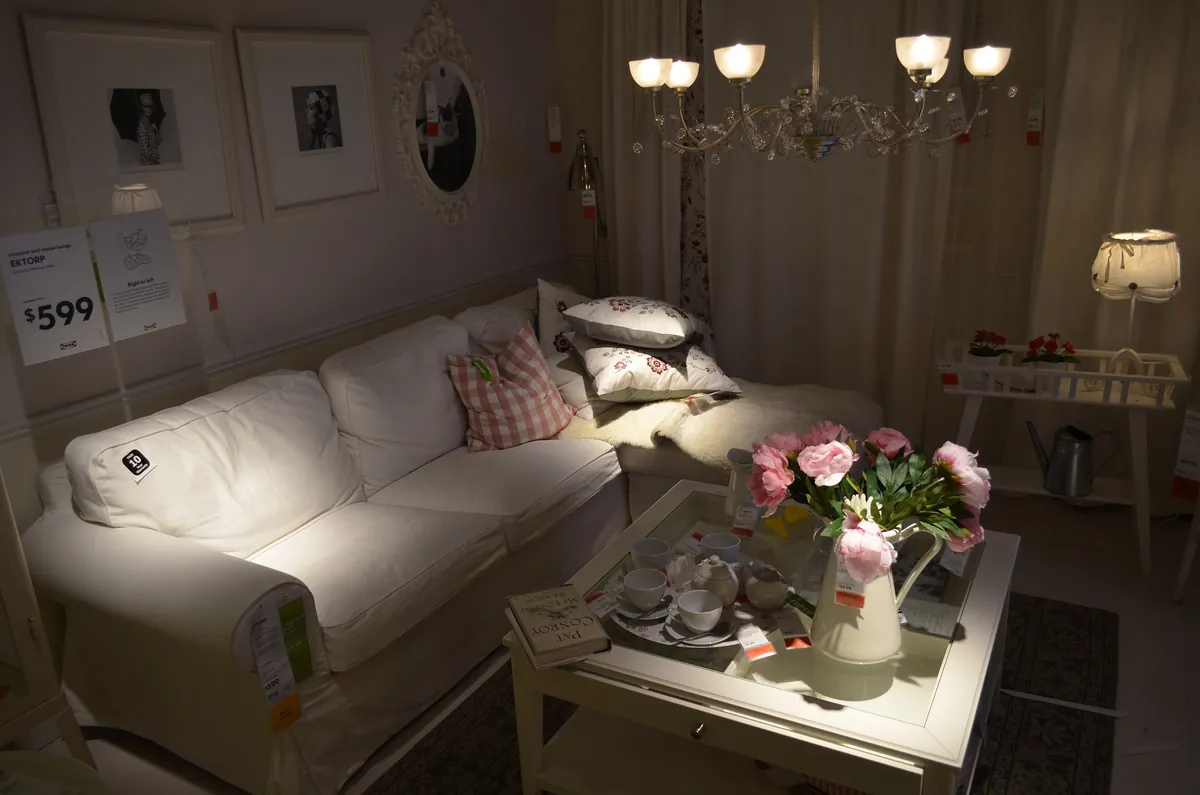
Ingka’s results fit a pattern of falling revenue per unit. IKEA Retail sales fell 1.6% in FY25 while volumes rose 1.6%, according to Furniture News. If those volumes refer to items sold, which the source does not specify, the average price per item would have fallen. Displayed prices also shape buyer behavior. Our article on why so many prices end in 99 explains this.
No public figure gives the margin on restaurants or loss-leader products. Their role as traffic drivers is a commercial logic, not a proven profit line.
The French case shows the limits of this reading. According to Intotheminds, IKEA operates 37 stores there and generated €3.5 billion in revenue in 2024-2025, down 4.4%.
Why is IKEA owned by foundations in the Netherlands and Liechtenstein?
Ingka depends on a Dutch foundation, and the IKEA concept belongs to a foundation based in Liechtenstein, whose stated purpose is to secure IKEA’s independence and long-term continuity.
The Dutch side: Ingka
The Stichting INGKA Foundation, created in 1982 by Ingvar Kamprad, holds INGKA Holding, based in Leiden. That company controls the large majority of IKEA stores. The foundation has no owner or beneficiary and pays no dividends to private shareholders. Its endowment was estimated at $36 billion in 2006 by The Economist, according to Wikipedia. That figure is old, so treat it as a dated benchmark.
In FY25, Ingka reinvested 85% of its net profit and paid 15% as a dividend to the foundation, with €3.4 billion in investment, according to Furniture News.
The Liechtenstein side: the concept
The Interogo Foundation was founded on March 29, 1989 in Vaduz. On September 1, 2023, the Inter IKEA Foundation was split off from it. It is now the ultimate owner of Inter IKEA Holding B.V. Its mission is stated as follows:
“to secure the independence and the longevity of the IKEA Concept and the financial reserves needed to ensure this.” Inter IKEA Foundation, 2023
This mission appears in the foundation’s own presentation.
The money trail, from customer to foundations
- The customer pays at the checkout of a store run by a franchisee, such as Ingka Group.
- The franchisee pays the franchise royalty to Inter IKEA Systems B.V.
- It also buys its products wholesale from Inter IKEA.
- Ingka reinvests most of its profit and passes the rest to the Stichting INGKA Foundation.
- Inter IKEA belongs to Inter IKEA Holding B.V., whose ultimate owner is the Inter IKEA Foundation.
So who owns IKEA? Ingka has no private shareholders: it belongs to the Stichting INGKA Foundation. Inter IKEA Holding B.V.’s ultimate owner is the Inter IKEA Foundation.
This Uptin video presents Ikea’s structure as a highly effective tax shelter, which sheds light on why the foundation setup matters.
The European tax investigation into Inter IKEA Systems
On December 19, 2017, the European Commission opened an in-depth investigation into two Dutch tax rulings granted to Inter IKEA Systems. A tax ruling is an advance decision by the tax authority on how a transaction will be treated. Pinsent Masons outlines the issues: the annual licence fee paid before 2011 to a Luxembourg company (Holding), and the buyback of the intellectual property in 2011.
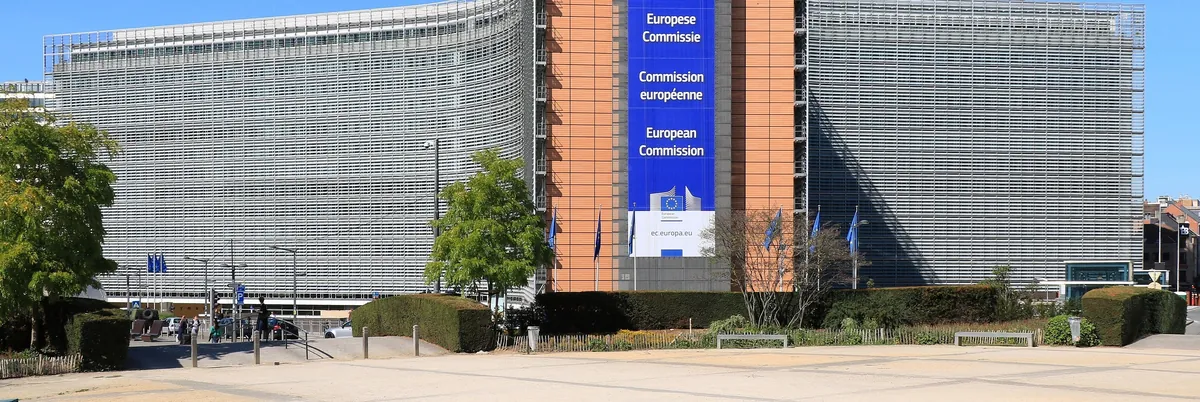
In 2011, Systems bought back that intellectual property using an intragroup loan from its parent company in Liechtenstein. The Commission examined whether the deductible interest shifted a significant share of franchise profits to Liechtenstein, and whether the price and interest matched the economic reality of the transaction. These franchise profits are the income generated by the royalty franchisees pay, at the rate published by Ingka.
European Commissioner Margrethe Vestager summed up the stakes:
“Member states cannot let selected companies pay less tax” Margrethe Vestager, 2017
The quote is repeated in the same Pinsent Masons article. An in-depth investigation examines concerns; it is not a conviction. This royalty flow explains why the group’s tax structure is sensitive: the more stable the income, the more it matters where it is booked.
Frequently asked questions
What is IKEA’s financial performance?
FY25 results are mixed. Inter IKEA’s net profit fell by about a third, Ingka’s rose, and network sales dipped slightly. The royalty section above details both entities’ figures.
What net margin does IKEA make on flat-pack furniture?
IKEA does not publish a net margin per piece of furniture. Only overall margins can be calculated from the financial statements. The retailer, Ingka, has a lower overall operating margin than the franchisor, Inter IKEA. Any per-unit margin cited for a specific model is an estimate.
Why do IKEA’s revenue figures differ from one source to another?
These totals measure different scopes: retail sales across the whole network, Inter IKEA’s wholesale and royalty revenue, and Ingka’s revenue alone. Adding them up or comparing them without care leads to misreading.
How these articles are prepared: our editorial policy

